The Structure of Government (HSC SSCE Economics): Revision Notes
📚Revision Notes
The Structure of Government
Introduction
Understanding how government operates in Australia is essential for analyzing its economic role. Governments intervene in the economy to improve market outcomes and address market failures. To fully grasp the government's role in Australia's market economy, we must first examine the structure and operation of Australian governments at different levels.
Note
The government's role in Australia's economy operates through a carefully designed multi-level structure. Each level has specific responsibilities and powers that shape how economic policy is developed and implemented across the nation.
Australia's three-tiered government structure
Australia operates under a three-tiered system of government, with distinct responsibilities allocated across three levels:
Commonwealth (Federal) Government
The Commonwealth Government sits at the top of the hierarchy. It holds primary responsibility for managing the national economy and exercises the greatest influence over Australia's economic performance. Key areas under Commonwealth control include:
- National economic management
- Monetary policy and currency
- Foreign affairs
- Defence
- Welfare systems
State and territory governments
Australia has six state governments plus two self-governing mainland territories (the Australian Capital Territory and the Northern Territory). States play crucial roles in:
- Infrastructure development
- Delivering essential government services (particularly health and education)
- Fostering regional economic development
- Understanding and responding to specific regional needs
Local governments
At the base of the structure sit 537 local governments (councils). Their responsibilities are more localized and include:
- Local planning and development approvals
- Community facilities (parks, libraries)
- Local roads and maintenance
- Waste collection services
The federal system and the Australian Constitution
What is the Australian Constitution?
The Australian Constitution is the fundamental legal document that establishes the framework for Australia's democratic system of government. It defines the relationship between the Commonwealth and state governments and sets out the absolute limits on governmental powers.
Australia has operated as a federal system since becoming a nation in 1901. Under this system, the Commonwealth and state governments function independently of each other while often collaborating on policy matters. State governments further delegate certain powers to local governments, though local government is not explicitly mentioned in the Constitution.
Important
The Australian Constitution is the supreme legal document that establishes the boundaries of governmental power. No government—Commonwealth, state, or local—can act beyond the powers granted to it by this foundational document.
Division of powers
The Constitution establishes what the Commonwealth Government can and cannot do. The Commonwealth can only act under specific constitutional "heads of power" - defined areas where it has legal authority to make laws. These include:
- Foreign affairs
- Defence
- Currency and banking
- International trade
State governments retain all powers not explicitly assigned to the Commonwealth in the Constitution. For most economic matters—such as business regulation, taxation, health, and education—the Commonwealth shares responsibility with the states.
Note
The "heads of power" are like a list of specific permissions granted to the Commonwealth Government. If a power isn't listed in the Constitution, it automatically remains with the state governments. This division creates a system of checks and balances that prevents excessive concentration of power at any single level.
Evolution of Commonwealth power
Since Federation in 1901, Commonwealth power has gradually expanded across most policy areas. Several factors explain this shift:
National economic integration: As Australia evolved into a single national economy, a unified approach to economic issues became more practical.
High Court interpretations: Over the past century, the High Court has adopted increasingly broad interpretations of the Commonwealth's constitutional powers, allowing it to extend its reach.
Voluntary power transfers: States have progressively handed additional powers to the Commonwealth, recognizing the benefits of national coordination in certain areas.
Constitutional constraints in practice
Constitutional limitations mean the Commonwealth must negotiate with state and territory governments when implementing major economic reforms. This requirement can create challenges, as securing agreement from six state governments is often difficult.
Recent years have seen extensive Commonwealth-State negotiations over key policy areas including:
- Energy policy
- Indigenous affairs
- School funding
- Health service delivery
Note
While these constraints can slow policy implementation, they ensure that states—who often understand their regions' specific needs best—have meaningful input into national policy decisions. This collaborative approach helps prevent one-size-fits-all solutions that may not work effectively across Australia's diverse regions.
State government: responsibilities and expenditure
Service delivery responsibilities
Although states have a more limited role in national economic management compared to the Commonwealth, they carry extensive responsibilities for delivering essential government services.
Health system: States operate the public hospital system and manage health infrastructure. However, the Commonwealth plays a major role in funding healthcare through the Medicare system.
Education: States run the public school education system and manage education policy at the primary and secondary levels.
Infrastructure: State governments are responsible for critical infrastructure including:
- Road networks
- Public transport systems
- Electricity generation and distribution
- Water utilities
- Regional planning and development
This service delivery role means state governments are often best positioned to understand the specific needs of their cities and regional communities.
State expenditure patterns
The following breakdown shows how the NSW Government allocated its $83.3 billion budget in 2019-20:
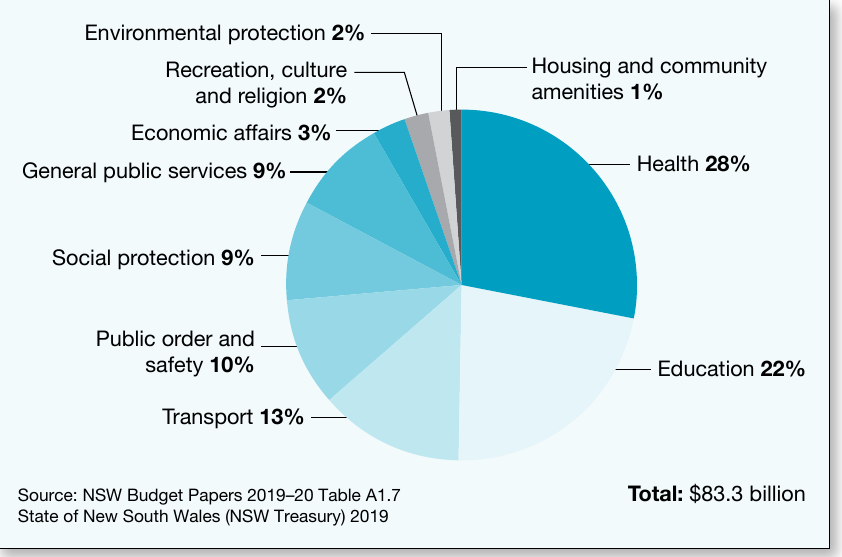
The two largest expenditure categories are:
- Health (28%): The single biggest spending area, reflecting the high cost of operating hospitals and health services
- Education (22%): The second-largest area, covering public schools and educational infrastructure
Other significant expenditure areas include:
- Transport (13%): Investment in roads, railways, and public transport
- Public order and safety (10%): Police, courts, and emergency services
- Social protection (9%): Support services for vulnerable populations
These spending patterns demonstrate that state governments focus primarily on service delivery rather than broader economic management.
Note
Notice how health and education together account for 50% of state expenditure. This concentration reflects the labor-intensive nature of these services and their fundamental importance to community wellbeing and economic development.
Vertical fiscal imbalance
The revenue challenge for states
A key feature of Australian federalism is what economists call vertical fiscal imbalance. This occurs when the Commonwealth controls most taxation powers while states retain significant expenditure responsibilities. This imbalance creates a structural mismatch between revenue-raising capacity and spending obligations.
Important
Vertical fiscal imbalance is one of the most significant structural challenges in Australian federalism. States are responsible for delivering expensive services like health and education, but they don't control sufficient taxation powers to fund these services independently. This creates ongoing dependency on Commonwealth funding and complicates policy coordination.
Historical origins
The vertical fiscal imbalance has its roots in the Second World War. During this period, the Commonwealth took over all income taxation powers from the states. While this centralization was initially justified as a wartime measure, the Commonwealth retained these powers permanently. States were left to fund their extensive service delivery obligations through alternative means.
State revenue sources
Given limited taxation powers, state governments rely on several revenue sources:
Goods and Services Tax (GST): This is the single largest revenue source for states. The Commonwealth collects the GST and distributes it to states through a complex formula. The distribution arrangements are frequently contested, as states debate what constitutes a fair allocation.
Commonwealth grants: States receive direct grants from the Commonwealth for specific programs, particularly in health. These grants often come with conditions that allow the Commonwealth to influence how states deliver services.
State taxes: To supplement GST and grants, states impose various taxes including:
- Payroll tax (on wages paid by larger employers)
- Stamp duty (on property transactions and certain documents)
- Licenses and registration fees
- Gambling taxes
- Land taxes
Asset recycling: In recent years, some state governments (notably NSW) have adopted "asset recycling" programs. This involves selling or leasing government-owned assets (such as ports, electricity networks, or land) to fund large infrastructure investments. This approach allows states to transform one-off asset sales into long-term infrastructure that generates ongoing economic benefits.
Note
Asset recycling is a controversial strategy. Supporters argue it converts underutilized assets into productive infrastructure that generates long-term economic benefits. Critics worry that selling revenue-generating assets may reduce future government income and force states to rely more heavily on debt financing.
Commonwealth involvement in state services
Council of Australian Governments (COAG)
The Commonwealth has become increasingly involved in funding services traditionally considered state responsibilities. This involvement often occurs through the Council of Australian Governments (COAG), which brings together Commonwealth, state, and territory governments to coordinate policy.
Recent areas of increased Commonwealth engagement include:
- Early childhood education
- School infrastructure
- Specific health services
- Major road construction projects
Funding as leverage
By providing additional funding for state services, the Commonwealth can exercise greater control over how states implement policies. This creates a dynamic where states benefit from additional resources but must accept Commonwealth conditions or priorities.
Example
Example: WestConnex Infrastructure Project
The WestConnex road project in Sydney, estimated to cost $16.8 billion and scheduled for completion in 2023, received $1.5 billion in direct funding from the Commonwealth Government, plus an additional $2 billion in concessional loans.
This substantial federal contribution gave the Commonwealth significant influence over the project's design and implementation, even though road infrastructure is constitutionally a state responsibility.
This funding arrangement illustrates how Commonwealth financial support enables it to shape state infrastructure priorities, even in areas constitutionally under state control.
Local government
Responsibilities and functions
Local governments (councils) focus on community-level services and planning. Their core responsibilities include:
Planning and development: Councils make decisions about local development applications, zoning, and land use. This gives them significant influence over how communities evolve and grow.
Local services: Essential community services such as:
- Waste collection and disposal
- Road construction and maintenance
- Parks and recreational facilities
- Libraries and community centers
Regulatory functions: Councils enforce local regulations through fees, licenses, and fines (for example, building approval fees, pet registration, and parking fines).
Revenue sources
Local governments have a more limited revenue base than state or Commonwealth governments:
Rates (approximately 75% of revenue): Levied on local property owners based on property values. This is the primary source of council funding.
Government grants (approximately 25% of revenue): Funding from Commonwealth and state governments for specific purposes.
Fees and charges: Additional revenue from building fees, dog licenses, parking fines, and facility hire.
Council amalgamations
The number of local governments has declined over time as state governments have pursued council amalgamations. The stated goal of these mergers is to create larger, more efficient councils that can deliver better services at lower cost.
Note
The NSW Government recently undertook a major amalgamation program, arguing it would generate efficiency benefits for ratepayers. However, the program proved controversial, with many communities and councils opposing the mergers—some even mounting legal challenges.
Ultimately, just over half of the proposed amalgamations proceeded. The remaining proposals were abandoned, particularly those affecting regional areas where community opposition was strongest. This outcome highlights the tensions between efficiency objectives and community preferences for local representation.
Remember!
Summary
Key Points to Remember:
-
Australia has three levels of government: Commonwealth (Federal), State/Territory (8), and Local (537 councils), each with distinct responsibilities and powers.
-
The Constitution defines the federal system: It sets out what powers the Commonwealth has (heads of power) and leaves remaining powers to the states. Commonwealth power has gradually expanded through High Court interpretation and voluntary state transfers.
-
Vertical fiscal imbalance is a key feature: The Commonwealth controls most taxation powers, while states have major expenditure responsibilities. States rely heavily on GST distribution and Commonwealth grants, supplemented by their own limited taxes.
-
States deliver most government services: Health (28% of NSW budget) and education (22%) are the largest state expenditure areas. States also manage infrastructure like roads, transport, and utilities.
-
Intergovernmental cooperation is essential: Major economic reforms require Commonwealth-State negotiation through bodies like COAG. The Commonwealth increasingly funds state services, giving it influence over state policy implementation.