Order of Transformations (HSC SSCE Mathematics Advanced): Revision Notes
📚Revision Notes
Order of Transformations
Introduction
When working with functions, we often need to apply multiple transformations to create new graphs. The order of transformations refers to the sequence in which these changes are applied to a parent function. Understanding this order is crucial because applying transformations in different sequences can produce different final equations and graphs.
A transformation is an operation that changes a function's graph by affecting its position, orientation, or scale. The three main types of transformations are:
- Dilations: stretch or compress the graph
- Reflections: flip the graph over an axis
- Translations: shift the graph horizontally or vertically
Note
The order in which you apply these transformations matters because each one modifies the equation, and subsequent transformations work on the already-modified equation. Each transformation builds upon the previous one's result.
Types of transformations
Dilations
A dilation changes the size of a graph by stretching or compressing it.
Horizontal dilation by :
This gives:
Vertical dilation by :
This gives:
Reflections
A reflection flips a graph across an axis.
Reflection in the -axis:
This gives:
Reflection in the -axis:
This gives:
Translations
A translation shifts a graph without changing its shape or orientation.
Horizontal translation by :
This gives:
Important
Watch out! Subtracting moves the graph right by units. This is opposite to what you might expect - subtraction moves right, addition moves left for horizontal translations.
Vertical translation by :
This gives:
The standard convention
When combining transformations, there is a standard order determined by how they appear in the equation. For an equation of the form:
The transformations are applied in this order:
- Horizontal dilation (factor ) - affects the inside the function
- Horizontal translation (by ) - the subtraction inside the brackets
- Vertical dilation (factor ) - the coefficient outside the function
- Vertical translation (by ) - the constant added at the end
Important
Key principle: Transformations inside the function brackets affect and happen first; transformations outside the brackets affect and happen last.
Unless explicitly told otherwise, you should follow this standard order.
Worked example 1: Transforming a quadratic function
Let's explore what happens when we transform by dilating vertically and horizontally by and translating right by unit. We'll see how different orders produce different results.
Example
Vertical dilation then translation
Task: Apply vertical dilation by , then translate right by unit.
Working:
Start with the parent function:
Apply vertical dilation by :
Translate right by :
Result: The transformed function is g(x) = 2(x - 1)²
Vertex: From the equation , we can identify the vertex at (1, 0).
Example
Translation then vertical dilation
Task: Apply translation right by unit first, then vertical dilation by .
Working:
Start with the parent function:
Translate right by :
Apply vertical dilation by :
Result: The transformed function is g(x) = 2(x - 1)²
Vertex: The vertex is at (1, 0).
Note
Key insight: For vertical transformations, the order doesn't matter! Both sequences produce the same equation and the same vertex. This is because vertical dilation and vertical translation work on different aspects of the function (the coefficient and the constant term).
Example
Horizontal dilation then translation
Task: Apply horizontal dilation by , then translate right by unit.
Working:
Start with the parent function:
Apply horizontal dilation by :
Translate right by :
Simplify:
Result: The transformed function is g(x) = (x-1)²/4
Vertex: From the equation , the vertex is at (1, 0).
Example
Translation then horizontal dilation
Task: Apply translation right by unit first, then horizontal dilation by .
Working:
Start with the parent function:
Translate right by :
Apply horizontal dilation by :
Result: The transformed function is g(x) = (x/2 - 1)²
To find the vertex, rewrite with a common denominator:
Vertex: Setting the expression inside the brackets to zero:
The vertex is at (2, 0).
Important
Key insight: For horizontal transformations, order matters! When we dilate first then translate, the vertex is at . When we translate first then dilate, the vertex moves to . This happens because horizontal transformations both affect the values inside the function, and they don't commute.
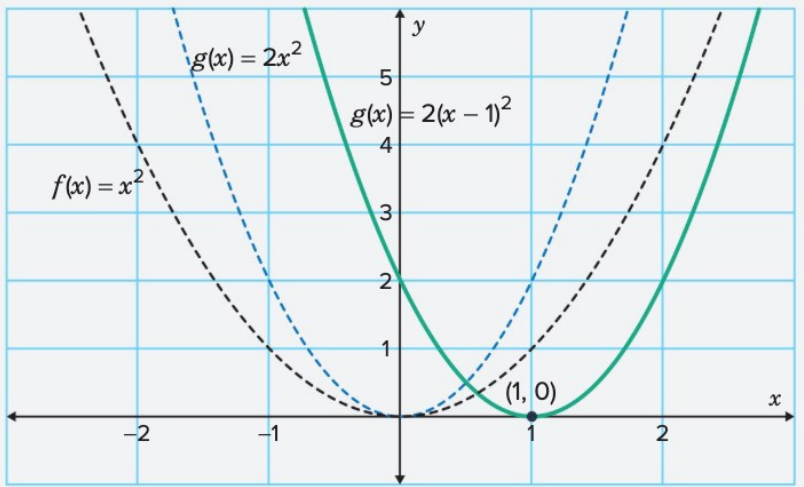
The graph above shows the different results from applying vertical dilation and horizontal translation in different orders for a quadratic function.
Graphical comparison
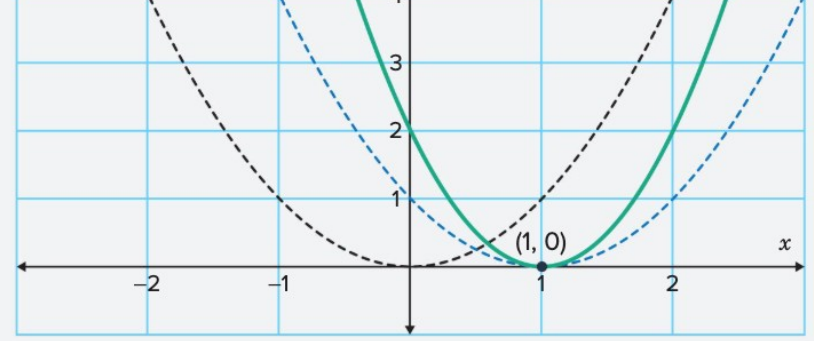
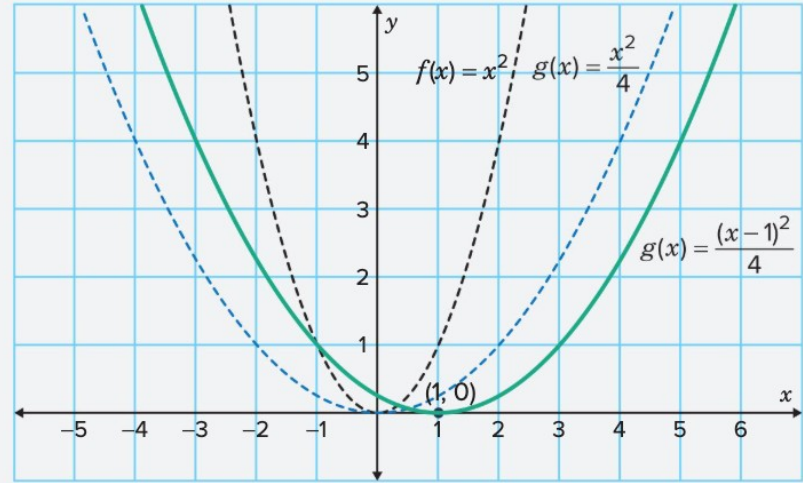
When we sketch both cases:
Vertical transformations:
- Vertical dilation then translation produces with vertex at
- Translation then vertical dilation produces with vertex at
- These are identical
Horizontal transformations:
- Horizontal dilation then translation produces with vertex at
- Translation then horizontal dilation produces with vertex at
- These are different graphs
Note
Important observation: Vertical dilation and horizontal translation yield the same equation regardless of order because they affect different axes. Horizontal dilation and translation produce different graphs with vertices at for dilation-first and for translation-first, because both transformations affect the -axis.
Worked example 2: Transforming a reciprocal function
Now let's examine what happens when we transform by reflecting over the -axis and translating up by units. We'll see how the order affects the asymptotes.
Example
Reflection then translation
Task: Reflect over the -axis, then translate up by units.
Working:
Start with the parent function:
Reflect over the -axis (multiply by ):
Translate up by units:
Result: The transformed function is g(x) = -1/x + 2
Asymptotes:
- Vertical asymptote: x = 0 (unchanged from parent function because we didn't shift horizontally)
- Horizontal asymptote: y = 2 (shifted up units from )
Example
Translation then reflection
Task: Translate up by units first, then reflect over the -axis.
Working:
Start with the parent function:
Translate up by :
Reflect over the -axis:
Apply the distributive property:
Result: The transformed function is g(x) = -1/x - 2
Asymptotes:
- Vertical asymptote: x = 0 (unchanged)
- Horizontal asymptote: y = -2 (the reflection changed the sign of the translation)
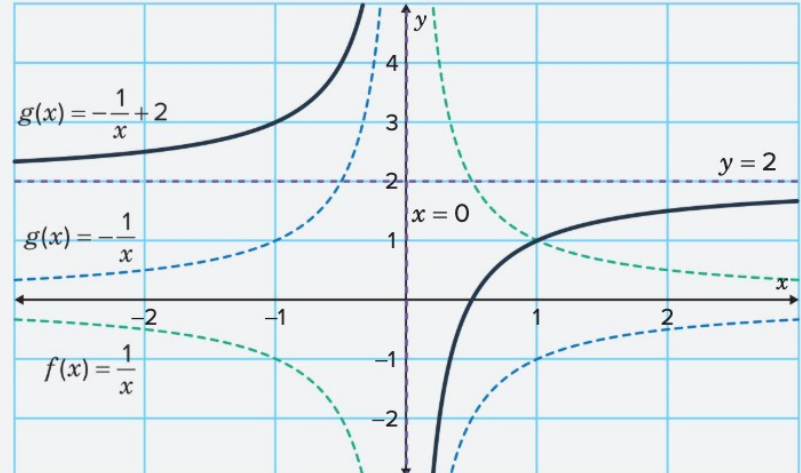
Graphical comparison
When we sketch both cases and label the asymptotes:
- Reflection then translation produces with asymptotes at and y = 2
- Translation then reflection produces with asymptotes at and y = -2
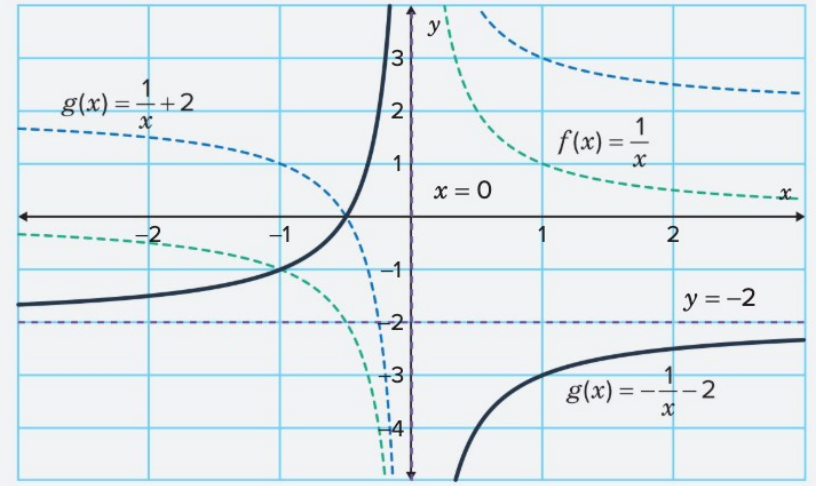
Important
Important observation: The order changes the horizontal asymptote significantly. When we reflect after translating, the vertical shift's position is affected by the reflection, moving the horizontal asymptote from to . This demonstrates how later transformations act on the results of earlier ones.
Key insights about transformation order
Understanding when order matters is essential:
Note
When order matters and when it doesn't:
-
Vertical transformations commute: Vertical dilation and vertical translation can be applied in either order and produce the same final equation. This is because they affect different parts of the equation (the coefficient and the added constant).
-
Horizontal transformations don't commute: Horizontal dilation and horizontal translation produce different results depending on the order. Both affect the variable inside the function, so they interact with each other.
-
Reflections interact with translations: When you reflect after translating, the reflection affects the position of the translated graph. This is particularly important for asymptotes and other key features.
Important
Best practices:
-
Follow the equation structure: The safest approach is to apply transformations in the order suggested by the equation structure: horizontal transformations (inside the function) before vertical transformations (outside the function), with dilations before translations.
-
Key features change with order: Vertices, asymptotes, and other important graph features can end up in different positions depending on transformation order.
Exam tips
Note
Strategies for success:
- Always write down the parent function first
- Work through transformations step by step, writing out each intermediate equation
- When comparing different orders, sketch graphs to visualize the differences
- Pay special attention to how the vertex or asymptotes change position
- Remember: "inside the brackets" means horizontal (affects ), "outside the brackets" means vertical (affects )
- Unless told otherwise, follow the standard convention: dilations and reflections before translations
Remember!
Summary
Key Points to Remember:
- The order of transformations matters - different sequences can produce different final graphs and equations
- Three main transformation types: dilations (stretch/compress), reflections (flip), and translations (shift)
- Standard order: Apply transformations as they appear in the equation - horizontal (inside brackets) before vertical (outside brackets)
- Vertical transformations commute - vertical dilation and translation can be done in either order with the same result
- Horizontal transformations don't commute - the order of horizontal dilation and translation affects the final vertex position and graph shape