Reciprocal and Absolute Value Functions (HSC SSCE Mathematics Advanced): Revision Notes
📚Revision Notes
Reciprocal and Absolute Value Functions
Introduction
In this note, you will learn how to transform reciprocal and absolute value functions using translations, reflections, and dilations. These transformations change the position, shape, and orientation of the graphs. You will learn to find equations of transformed functions, determine key features like asymptotes and vertices, identify domain and range, and sketch graphs of transformed functions.
Transformations of reciprocal functions
The general form
The reciprocal function can be transformed using translations, reflections, and dilations. When transformations are applied, the general form becomes:
This equation contains three important parameters that control the transformation:
Note
Understanding each parameter is crucial for predicting how the graph will change. The parameter affects the shape and orientation, while and control the position of the graph.
Parameter (dilation factor):
- When , the graph stretches vertically (becomes steeper)
- When , the graph compresses vertically (becomes flatter)
- When , the graph reflects over the x-axis
Parameter (horizontal translation):
- When , the graph shifts right by units
- When , the graph shifts left by units
Parameter (vertical translation):
- When , the graph shifts up by units
- When , the graph shifts down by units
Domain, range and asymptotes
When a reciprocal function is transformed, its domain and range change according to the translation parameters. The function also has two asymptotes that shift with the transformations.
Domain: The domain excludes the value where the denominator equals zero. This occurs at . The domain is written as , or using interval notation: .
Range: The range excludes the value of the horizontal asymptote. This is , or using interval notation: .
Vertical asymptote: This is a vertical line that the graph approaches but never touches. It occurs at x = a.
Horizontal asymptote: This is a horizontal line that the graph approaches but never touches. It occurs at y = b.
Important
Remember the pattern: For reciprocal functions, both the domain and range are restricted. The vertical asymptote is at (affecting domain), and the horizontal asymptote is at (affecting range). The graph has two separate curved sections that never cross these asymptotes.
Worked example: reciprocal function transformation
Example
Worked Example: Transforming a Reciprocal Function
Question: Transform by translating right by 2 units and up by 3 units, then reflecting over the -axis.
Part a) Determine the equation of the transformed function
To find the transformed function, we apply the transformations step by step using the general form with , , and (negative because of reflection).
Start with the original function:
Translate right by 2 and up by 3:
Reflect over the -axis (multiply by ):
Distribute the negative sign:
The transformed function is g(x) = -1/(x - 2) - 3.
Part b) Determine the asymptotes
The asymptotes are found using the parameters and from the equation.
The vertical asymptote is at :
The horizontal asymptote is at :
Part c) Determine the domain and range
The domain excludes the vertical asymptote where :
Domain: x ≠ 2, or
The range excludes the horizontal asymptote where :
Range: y ≠ -3, or
Part d) Sketch the graph, labelling the asymptotes, a key point and the y-intercept
To sketch the graph, we need to find a key point and the -intercept.
Find a key point by substituting :
The point at is .
Find the -intercept by substituting :
The -intercept is at .
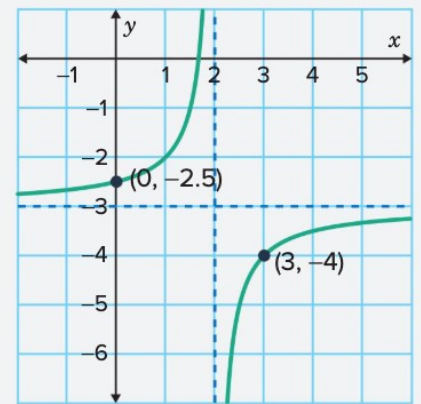
The graph shows the transformed function with:
- Vertical asymptote at (shown as a vertical dashed line)
- Horizontal asymptote at (shown as a horizontal dashed line)
- Key points at and
Notice how the asymptotes have shifted from their original positions at and to the new positions at and . This confirms that the transformations were applied correctly.
Transformations of absolute value functions
The general form
The absolute value function creates a V-shaped graph. When transformations are applied, the general form becomes:
This equation uses the same three parameters as the reciprocal function, but they affect the graph differently:
Parameter (dilation factor):
- When , the V-shape becomes narrower (steeper)
- When , the V-shape becomes wider (less steep)
- When , the V-shape flips upside down (reflects over the -axis)
Parameter (horizontal translation):
- When , the graph shifts right by units
- When , the graph shifts left by units
Parameter (vertical translation):
- When , the graph shifts up by units
- When , the graph shifts down by units
Vertex, domain and range
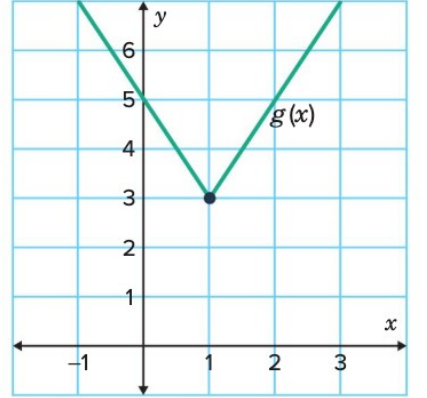
Unlike reciprocal functions, absolute value functions do not have asymptotes. Instead, they have a vertex where the V-shape meets.
Vertex: The vertex is the turning point of the V-shape. It is located at (a, b). This is the lowest point when , or the highest point when .
Important
Be careful with the vertex location! In the equation , the vertex is at , NOT at . This is a common mistake to avoid.
Domain: The domain of an absolute value function is all real numbers: .
Range: The range depends on the sign of :
- If , the V-shape opens upward and the range is
- If , the V-shape opens downward and the range is
Note
The key difference between reciprocal and absolute value functions is that absolute value functions have no restrictions on their domain, while reciprocal functions exclude one value. Additionally, absolute value functions have a clear vertex, while reciprocal functions have asymptotes instead.
Worked example: absolute value function transformation
Example
Worked Example: Transforming an Absolute Value Function
Question: Transform by dilating vertically by a factor of 2, translating left by 1 unit, and down by 2 units.
Part a) Determine the equation of the transformed function
To find the transformed function, we use the general form with , , and .
Start with the original function:
Apply dilation with :
Apply translations with and :
The transformed function is g(x) = 2|x + 1| - 2.
Part b) Determine the vertex
The vertex is located at from the equation .
For , we have and .
The vertex is at (-1, -2).
Part c) Determine the range
The range depends on the value of and .
Since , the V-shape opens upward, and the range starts at the vertex and extends to infinity:
Range: [[-2, ∞)]
Part d) Determine the x-intercepts and sketch the graph
To find the -intercepts, set and solve for .
Start with the transformed function:
Set equal to zero:
Add 2 to both sides:
Divide both sides by 2:
Solve the absolute value equation. This gives two cases:
Case 1:
Case 2:
The -intercepts are at (0, 0) and (-2, 0).
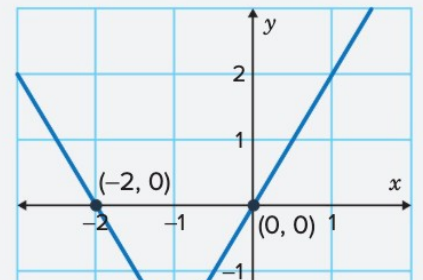
The graph shows the transformed function with:
- Vertex at
- -intercepts at and
- A steeper V-shape due to the dilation factor of 2
The vertex has moved from the origin to , and the graph is narrower than the parent function because it has been stretched vertically by a factor of 2.
Exam tips
When working with transformed functions, follow these helpful strategies:
Note
For reciprocal functions:
- Always identify the asymptotes first using and
- Remember that the domain and range both have restrictions
- Plot at least two points on each branch of the hyperbola
- The graph has two separate curved sections that never touch the asymptotes
For absolute value functions:
- Find the vertex first using
- The -intercepts require solving an absolute value equation (two cases)
- The graph forms a V-shape with the vertex at the tip
- Check whether is positive (opens up) or negative (opens down)
General transformation tips:
- Work step by step through each transformation
- Write down the parameter values , , and before starting
- Sketch a rough graph to visualize the transformation
- Double-check your asymptotes, vertex, domain and range
Remember!
Summary
Key Points to Remember:
-
Reciprocal functions have the form , with vertical asymptote at and horizontal asymptote at . The domain is and range is .
-
Absolute value functions have the form , with vertex at . The domain is all real numbers and the range is if , or if .
-
The parameter controls dilation and reflection. When , the graph stretches; when , it compresses; when , it reflects over the -axis.
-
The parameters and control translations. The value shifts the graph horizontally (right if positive, left if negative), and shifts it vertically (up if positive, down if negative).
-
To sketch transformed graphs, identify key features first (asymptotes for reciprocal functions, vertex for absolute value functions), then find intercepts and additional points to complete the sketch.