Euler’s Number and Derivatives (HSC SSCE Mathematics Advanced): Revision Notes
📚Revision Notes
Euler's Number and Derivatives
What is Euler's number?
Euler's number is a special mathematical constant denoted by the letter . It is an irrational number, which means it cannot be expressed as a simple fraction and its decimal representation goes on forever without repeating.
The approximate value of Euler's number is:
What makes Euler's number truly remarkable is its unique relationship with differentiation. It is the only base for an exponential function where the derivative of the function equals the function itself.
Note
Euler's number is named after the Swiss mathematician Leonhard Euler. While other exponential functions like or change their behavior when differentiated, only e^x remains unchanged through the differentiation process.
The derivative of
The exponential function has an extraordinary property:
This means that when we differentiate , we simply get back. The function is its own derivative.
Important
What does this mean? The rate of change of the function at any point equals the value of the function at that point. If you're standing on the curve at some point, the slope of the tangent line at that point equals the -coordinate where you're standing.
This property distinguishes from all other exponential functions. For example, if we consider where is any positive number other than , then only when .
Example
Worked Example: Finding the derivative at
Let's find the value of the derivative of at .
Strategy: Use the property and evaluate at .
Solution:
Substituting :
The gradient at x = 0 is 1, confirming that .
Note: This result tells us that at the point on the curve , the tangent line has a slope of .
Tangent to exponential functions
Because we know that the derivative of is , we can find the equation of the tangent line at any point on the curve. The derivative gives us the gradient at any point , which is simply .
To find the equation of a tangent line, we use the point-slope form:
where is the gradient and is the point of tangency.
Note
At any point on , the gradient of the tangent equals the -coordinate. For example, at the point , the gradient is .
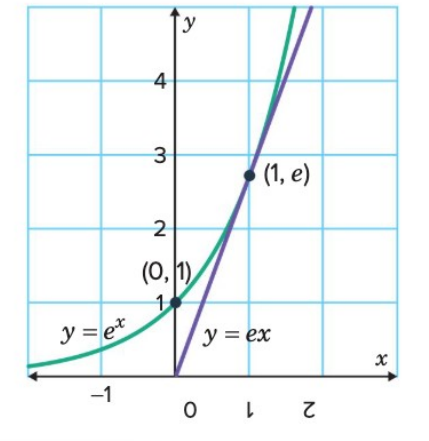
The graph shows the curve passing through the points and . The tangent line at the point has gradient .
Example
Worked Example: Finding the tangent equation at
Let's determine the equation of the tangent to at .
Strategy: Find the point and gradient at using , then use point-slope form.
Solution:
First, find the point: At , , so the point is .
The gradient at x = 1 is e.
Now use the point-slope form:
The equation of the tangent is y = ex.
Reflect and check: We can verify this by substituting into : , which matches the point .
Important terminology
Note
Derivative: The result obtained after differentiation. For a function , the derivative is the gradient function of and is denoted .
For the exponential function , the derivative is at any point.
Remember!
Summary
Key Points to Remember:
- Euler's number is a special irrational constant
- The exponential function has the unique property that - it equals itself when differentiated
- This means the slope at any point on the curve equals the -coordinate at that point
- To find the equation of a tangent to at point , use point-slope form with gradient
- At , the derivative is (since ), and at , the derivative is (since )