Circles and Semicircles (HSC SSCE Mathematics Advanced): Revision Notes
📚Revision Notes
Circles and Semicircles
A circle is a set of points that are all the same distance from a fixed centre point. In mathematics, we can describe circles using equations, and understanding these equations helps us graph circles and work with their properties.
Deriving the circle equation
The equation of a circle is found by applying Pythagoras' theorem to describe all points at equal distance from a centre point.
Consider any point on a circle with its centre at the origin . This point is at a specific distance (the radius) from the centre.
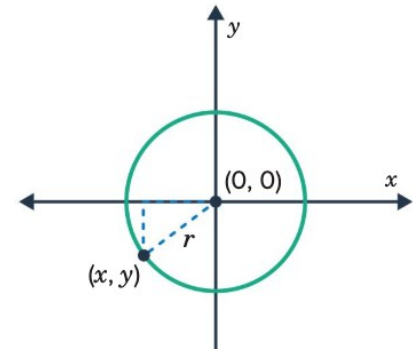
A right-angled triangle is formed with:
- Vertices at , , and
- The hypotenuse is the radius
- The horizontal leg has length
- The vertical leg has length
Using Pythagoras' theorem, we can write:
Where:
- is the x-coordinate of a point on the circle
- is the y-coordinate of a point on the circle
- is the radius (distance from the origin to any point on the circumference)
Important
This equation ensures that every point satisfying it is exactly distance from the origin. The value of determines the circle's size - a larger radius produces a larger circle.
Example
Worked Example: Deriving a circle equation
Question: Derive the equation of a circle with a distance of 7 from its fixed point at the origin.
Solution:
Start with the circle equation:
Substitute :
Evaluate:
The equation is x² + y² = 49.
Example
Worked Example: Verifying a point on a circle
Question: Verify that the point lies on a circle with a distance of 5 from its fixed point at the origin.
Solution:
Write the equation:
Substitute , , and :
Evaluate each term:
Evaluate:
Since both sides are equal, the point satisfies , confirming it lies on the circle.
Graphing circles
To graph a circle with equation , we plot the centre at the origin and mark points at distance along the axes.
Note
The key features of a circle centred at the origin are:
- Centre at
- Radius
- x-intercepts at
- y-intercepts at
Example
Worked Example: Graphing a circle
Question: Graph the circle .
Solution:
First, identify the radius. The equation has the form , so:
The circle has:
- Centre at
- Radius
- Key points at , , , and
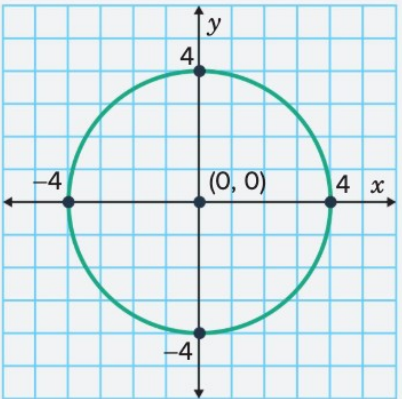
Check: We can verify the intercepts by substituting. When : , so . When : , so . This confirms our intercepts.
Finding the equation from a graph
When we have a graph of a circle, we can determine its equation by finding the radius. The circle is centred at the origin , and we find by measuring the distance from the origin to any point on the circumference.
Note
The intercepts are often the easiest points to use since they lie on the axes, making calculations simpler.
Example
Worked Example: Finding equation from a point
Question: A circle has its fixed point at and passes through . Find its equation.
Solution:
We need to find the radius . Substitute the point into :
(taking the positive square root)
The equation is x² + y² = 36.
Check: The point should also satisfy this equation: , which is true.
Semicircles
A semicircle is half of a circle. When we solve the circle equation for one variable, we create equations for semicircles.
Upper and lower semicircles
Solving the circle equation for gives:
This produces two functions:
- Upper semicircle: (positive square root, above the x-axis)
- Lower semicircle: (negative square root, below the x-axis)
For these semicircles:
- is the y-coordinate of a point on the semicircle
- is the x-coordinate of a point on the semicircle
- is the radius
- Domain: or
Right and left semicircles
Solving the circle equation for gives:
This produces two functions:
- Right semicircle: (positive square root, right of the y-axis)
- Left semicircle: (negative square root, left of the y-axis)
For these semicircles:
- is the x-coordinate of a point on the semicircle
- is the y-coordinate of a point on the semicircle
- is the radius
- Range: or
Important
Key pattern to remember:
- Positive square root = Upper or Right semicircle
- Negative square root = Lower or Left semicircle
The sign of the square root determines which half of the circle you get!
Note
Understanding Domain and Range:
For upper/lower semicircles (solved for ), the domain tells you how far left and right the semicircle extends along the x-axis.
For right/left semicircles (solved for ), the range tells you how far up and down the semicircle extends along the y-axis.
Example: The equation with radius has domain and forms the upper semicircle, while with has range and forms the left semicircle.
Example
Worked Example: Graphing an upper semicircle
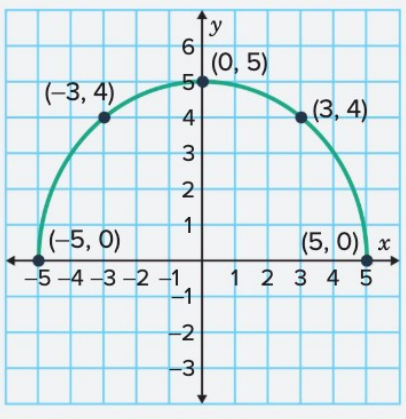
Question: Graph the semicircle .
Solution:
First, identify the form and radius. The equation comes from , so:
The positive square root indicates this is the upper semicircle.
Find the domain. For the square root to be defined:
Domain:
Key points to plot:
- - the highest point
- - right endpoint
- - left endpoint
- and - additional points for accuracy
Example
Worked Example: Graphing a left semicircle
Question: Graph the semicircle .
Solution:
Identify the form and radius. The equation comes from , so .
The negative square root indicates this is the left semicircle.
Find the range. For the square root to be defined:
Range:
Key points to plot:
- - the leftmost point
- - top endpoint
- - bottom endpoint
- and - additional points
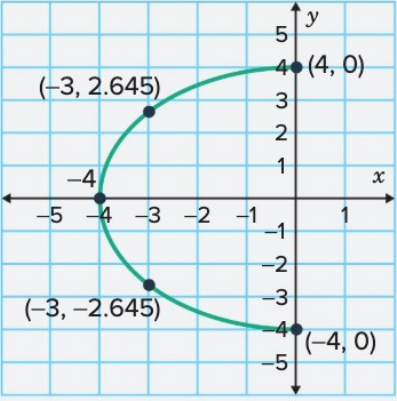
Check: The point approximately satisfies the original circle equation: , confirming it lies on the semicircle.
Summary
Key Points to Remember:
- The equation of a circle centred at the origin is x² + y² = r², derived from Pythagoras' theorem
- To graph a circle, plot the centre at and mark points at distance along the x- and y-axes
- To find a circle's equation from its graph, identify the radius from a point on the circumference
- Semicircles are created by solving for one variable: gives upper/lower semicircles; gives right/left semicircles
- The positive square root gives the upper or right semicircle, while the negative square root gives the lower or left semicircle