Characteristics of Functions (HSC SSCE Mathematics Advanced): Revision Notes
📚Revision Notes
Characteristics of Functions
Introduction
Understanding the characteristics of functions is essential for analysing mathematical relationships. In this note, you will learn how to identify the domain and range of a function, find where functions cross the axes, and determine the values that make a function equal to zero.
Domain and range
What is domain?
The domain of a function represents all the allowable input values (the -values) for which the function is defined. Think of it as the set of values you can safely substitute into the function without causing mathematical problems.
Note
In mathematical terms, the domain is the set of real numbers on which the function or relation is defined. A helpful way to remember this: Domain = "Door" - what values can enter the function.
What is range?
The range of a function represents all the possible output values (the -values) that the function can produce. These are the values of the dependent variable that result from substituting domain values into the function.
Note
If you think of a function as a machine, the domain is what you can put in, and the range is what you can get out. Remember: Range = "Results" - what values can exit the function.
Finding the domain
When determining the domain of a function, you need to identify any restrictions that would make the function undefined. Here are the key rules to check:
Important
Division restrictions:
- Denominators cannot equal zero
- For example, in , we have , so the domain is all real numbers except
Square root restrictions:
- Even roots require a non-negative radicand (the expression under the root)
- For example, in , we need , so the domain is
If there are no such restrictions, the domain is all real numbers.
Finding the range
The range is determined by evaluating the function over its entire domain to identify all possible output values. This often requires:
- Analysing the behaviour of the function
- Considering limits as approaches certain values
- Examining the function's graph
Note
Finding the range can be more challenging than finding the domain. You may need to consider the function's behaviour at extreme values, turning points, and any asymptotic behaviour.
Worked example: Domain and range from a table
Example
Worked Example 1: Determining Domain and Range from a Table
Let's determine the domain and range for a function represented by the following table:
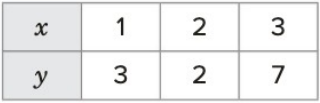
Solution:
To find the domain and range, we list the unique -values and -values from the table.
Step 1: Identify all -values (inputs)
- Domain:
Step 2: Identify all -values (outputs)
- Range:
The domain consists of all the input values shown in the table, and the range consists of all the output values.
Worked example: Domain and range of a reciprocal function
Example
Worked Example 2: Domain and Range of a Reciprocal Function
Determine the domain and range of the function .
Strategy:
For the domain, identify values of where the function is defined by checking the denominator. For the range, evaluate the function over its domain to find all possible outputs.
Finding the domain:
Write the function
The denominator must not be zero
The domain is all real numbers where .
Finding the range:
Consider the behaviour of the function as approaches positive and negative values
The function can take any real value except zero as approaches zero from either side. Thus, the range is all real numbers except zero.
Reflection:
The function is undefined at due to division by zero. The range includes all real numbers except zero because as approaches zero, the function approaches positive or negative infinity, never actually reaching zero.
Zeroes and intercepts
What is a zero?
A zero of a function is a point in the domain where the function equals zero. In other words, it's a solution to the equation . Geometrically, zeroes correspond to the x-intercepts of the function's graph.
What is an intercept?
An intercept is the point where a curve crosses an axis in the coordinate plane.
Types of intercepts:
- -intercept: The point where the curve crosses the -axis (where ). This is the same as a zero of the function.
- -intercept: The point where the curve crosses the -axis (where ). This is found by evaluating .
Note
Memory Aid for Intercepts:
- -intercept: Set and solve for
- -intercept: Set (or ) and solve for
Sometimes intercepts refer to the signed distance from the origin to where the curve crosses the axis. For example, for the line , the -intercept is .
Worked example: Finding zeroes and the y-intercept
Example
Worked Example 3: Finding Zeroes and the y-intercept
For the function , identify:
Part a) The zeroes
Strategy:
To find the zeroes, solve the equation .
Solution:
Set the function equal to zero
Add to both sides
Take the square root of both sides
The zeroes are x = -2 and x = 2.
Part b) The y-intercept
Strategy:
Evaluate to find where the function crosses the -axis.
Solution:
Write the function
Substitute
Evaluate
The -intercept is -4.
This means the function crosses the -axis at the point .
Summary
Key Points to Remember:
-
The domain is the set of allowable input values (-values) for a function. Check for restrictions from denominators (cannot be zero) and even roots (radicand must be non-negative).
-
The range is the set of all possible output values (-values) that a function can produce.
-
A zero of a function is where . These correspond to the x-intercepts on the graph.
-
The -intercept is found by evaluating , which tells you where the function crosses the -axis.
-
Always check your domain carefully—missing a restriction can lead to undefined values in your function!