Functions and Relations (HSC SSCE Mathematics Advanced): Revision Notes
📚Revision Notes
Functions and Relations
What is a relation?
A relation describes a connection between two sets of values. In mathematics, we typically work with relations between -values (inputs) and -values (outputs).
Note
Think of a relation as a rule that links elements from one set to elements in another set. For example, if we have a set of people and a set of ages, the relation "is the age of" connects each person to their age.
Key terminology
Before we explore relations further, let's clarify some important terms:
Set: A collection of distinct objects or elements. Sets can be described in several ways:
- By listing elements:
- Using words: "the set of prime numbers"
- Using a rule:
Element: A member of a set. For example, is an element of the set of natural numbers, written as .
Ordered pairs: Relations can be expressed as sets of ordered pairs , where is from the first set and is from the second set, with related to .
Representing relations
Relations can be shown in multiple ways. Let's look at the relation defined by for :
This same relation can be expressed as:
- Algebraic formula:
- Table of values: as shown above
- Ordered pairs:
- Graph: plotted points on a coordinate plane
What is a function?
A function is a special type of relation. While all functions are relations, not all relations are functions.
Important
A function is a relation where each input (-value) is linked to exactly one output (-value). This means that for every value you put in, you get precisely one value out.
Real-world example
Consider a vending machine selling juice bottles at $3 each. Let represent the number of bottles and represent the cost in dollars:
The rule for this function is . Each -value (number of bottles) corresponds to exactly one -value (cost), making this a one-to-one function.
Types of relations
Relations are classified based on how inputs map to outputs. There are four main types:
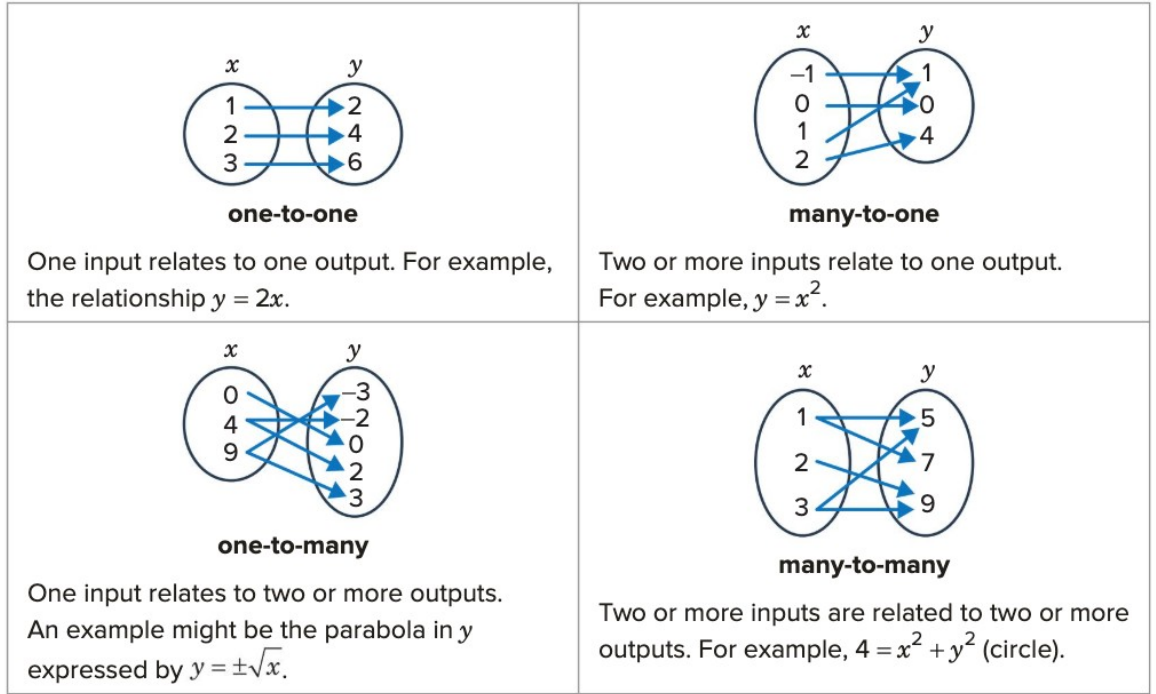
One-to-one
Each input relates to exactly one output, and each output comes from exactly one input.
Example: The relationship
In this type:
- Input maps to output
- Input maps to output
- Input maps to output
Note
Each input has one output, and no outputs are repeated. This is a function.
Many-to-one
Two or more inputs relate to the same single output.
Example: The relationship
In this type:
- Inputs and both map to output
- Input maps to output
- Inputs and both map to output
Note
Even though multiple inputs share outputs, each input still has only one output. This is a function.
One-to-many
One input relates to two or more outputs.
Example: The relationship (a sideways parabola)
In this type:
- Input maps to outputs and
- Input maps to outputs and
- Input maps to outputs and
Important
Because a single input produces multiple outputs, this is NOT a function.
Many-to-many
Two or more inputs relate to two or more outputs.
Example: The relationship (a circle)
In this type:
- Inputs and both map to outputs and
- Input maps to output
Important
Multiple inputs produce multiple outputs. This is NOT a function.
Which relations are functions?
Only one-to-one and many-to-one relations are functions. The key requirement is that each input must have exactly one output.
The vertical line test
The vertical line test is a quick visual method to determine whether a graph represents a function.
Important
The rule: If you can draw a vertical line that intersects or touches a graph at more than one point, then the graph does NOT represent a function.
Why does this work? A vertical line represents a single -value. If the line touches the graph at multiple points, that means the single -value corresponds to multiple -values, violating the definition of a function.
Graph that passes the test
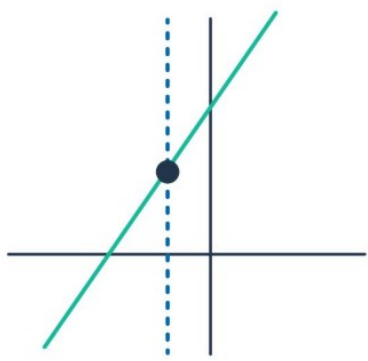
Note
This graph passes the vertical line test because any vertical line drawn will intersect the graph at most once. Each -value produces only one -value, so this represents both a relation and a function.
Graph that fails the test
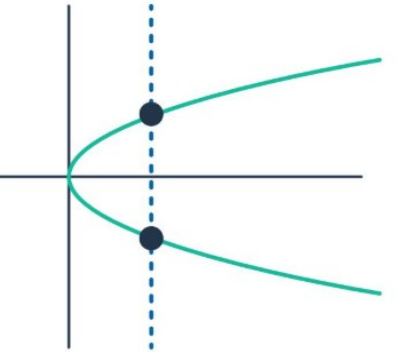
Note
This graph fails the vertical line test. A vertical line intersects the graph at two points, showing that one -value corresponds to two different -values. This represents a relation but NOT a function.
Worked example 1: Testing a table
Example
Worked Example: Determining if a Table Represents a Function
Question: This table represents a relation between and . Determine if it represents a function.
Strategy:
A function requires each -value to have exactly one -value. We need to check the table for any repeated -values with different -values.
Solution:
Looking at the table, we can see that appears twice:
- When , we have
- When , we also have
Since the -value of corresponds to two different -values ( and ), this is a one-to-many relationship.
Conclusion: This relation is NOT a function.
Worked example 2a: Testing a graph (reciprocal function)
Example
Worked Example: Testing a Reciprocal Function
Question: Determine whether this graph represents a function.
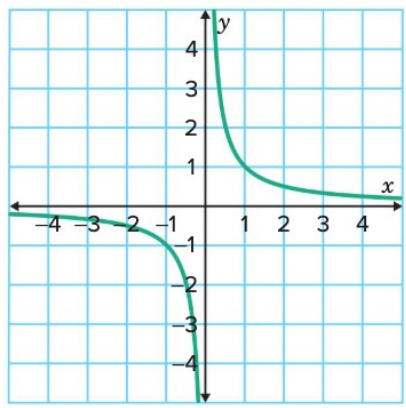
Strategy:
Apply the vertical line test. If no vertical line intersects the graph more than once, it's a function.
Solution:
The graph shows (a reciprocal function or hyperbola). When we imagine drawing vertical lines across the graph:
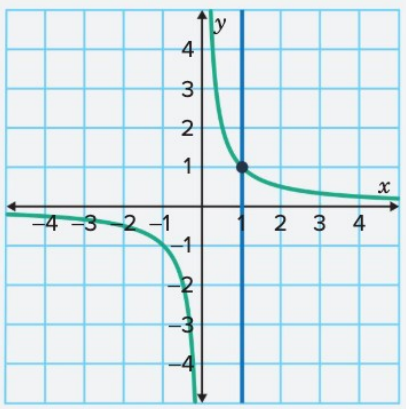
Each vertical line at any -value intersects the curve at most once. For all -values, each input produces exactly one -value.
Conclusion: This graph represents both a relation and a function.
Note: All functions are relations, but not all relations are functions. Since each input has exactly one output, this is indeed a function.
Worked example 2b: Testing a graph (sideways parabola)
Example
Worked Example: Testing a Sideways Parabola
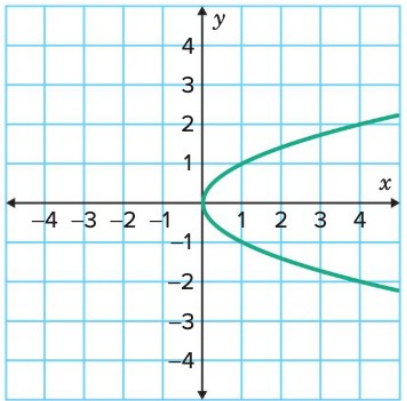
Question: Determine whether this graph represents a function.
Strategy:
Apply the vertical line test to check for multiple intersections.
Solution:
This graph appears to show a sideways parabola (like or ). When we draw a vertical line at :
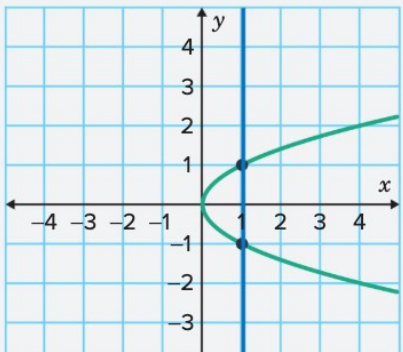
The vertical line at intersects the graph at two points: and . This means the single -value of corresponds to multiple -values.
Conclusion: This graph represents a relation but NOT a function.
Reflection: If we restricted the graph to only (the upper branch), it would then be a function, as each -value would have only one corresponding -value.
Worked example 3a: Testing an equation (linear)
Example
Worked Example: Testing a Linear Equation
Question: Determine whether the equation describes a relation and/or a function.
Strategy:
Graph the equation and apply the vertical line test.
Solution:
The equation is a linear equation that passes through the origin with a steep positive slope.
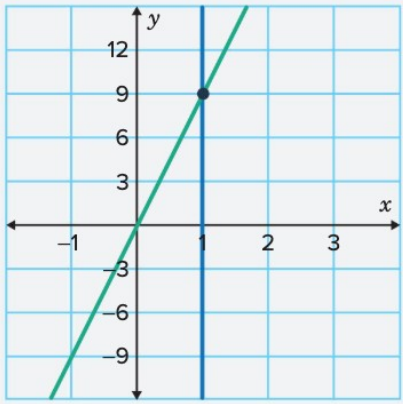
When we apply the vertical line test, every vertical line intersects the graph at exactly one point. This means each -value produces precisely one -value.
Conclusion: The equation describes both a relation and a function. Specifically, it's a one-to-one function since each input has a unique output.
Worked example 3b: Testing an equation (quadratic)
Example
Worked Example: Testing a Quadratic Equation
Question: Determine whether the equation describes a relation and/or a function.
Strategy:
Graph the equation and apply the vertical line test.
Solution:
The equation is a quadratic equation that forms a parabola opening upward with vertex at .
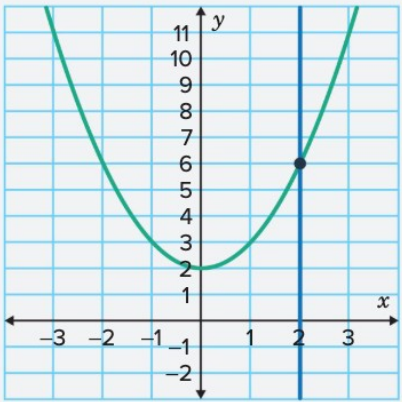
When we apply the vertical line test, every vertical line intersects the graph at exactly one point. Each -value produces only one -value.
Conclusion: The equation describes both a relation and a function. This is a many-to-one function because multiple inputs (like and ) can produce the same output (), but each individual input still produces only one output.
Reflection: While different -values may produce the same -value (many-to-one), this is still a function because the critical requirement is that each -value has exactly one corresponding -value.
Remember!
Summary
Key Points to Remember:
-
A relation is any connection between two sets of values, represented by formulas, tables, ordered pairs, or graphs.
-
A function is a special relation where each input has exactly one output. Think: "one input, one output."
-
Only one-to-one and many-to-one relations qualify as functions. One-to-many and many-to-many relations are not functions.
-
The vertical line test is your quick check: if any vertical line touches a graph more than once, it's not a function.
-
All functions are relations, but not all relations are functions.This is because functions have the extra requirement that each input maps to exactly one output.