Average Rate of Change (HSC SSCE Mathematics Advanced): Revision Notes
📚Revision Notes
Average Rate of Change
What is average rate of change?
The average rate of change is a fundamental concept in calculus that helps us understand how a function behaves over a specific interval. It tells us how quickly the output of a function changes as the input values change between two points.
Note
Think of it as measuring the overall rate at which something is changing. For example, if you're tracking the distance a car travels over time, the average rate of change would tell you the average speed over that time period.
Key definitions
Important
Average rate of change: The change in one quantity divided by the corresponding change in another quantity.
Secant line: A straight line that passes through two points on the graph of a function.
The formula
For a function over the interval , the average rate of change is calculated using:
Where:
- represents the change in the function's output:
- represents the change in the input:
- is the starting point of the interval
- is the ending point of the interval
Note
This formula essentially calculates "rise over run" between two points on the function. The Greek letter delta (Δ) is used to represent "change in" a quantity.
Geometric interpretation
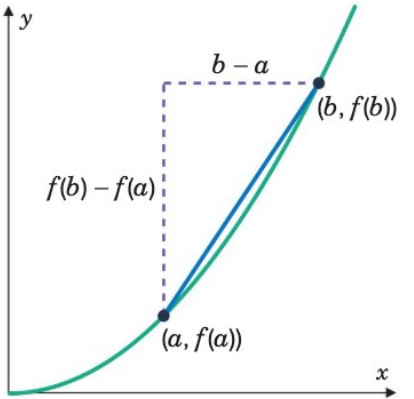
On a graph, the average rate of change corresponds to the gradient (slope) of the secant line connecting two points on the curve. The secant line joins the points and .
Note
In the diagram above, you can see:
- The curve of the function
- Two points: and
- The secant line connecting these points
- The horizontal change:
- The vertical change:
The gradient of this secant line equals the average rate of change over the interval.
Worked examples
Example
Worked Example 1: Quadratic Function
Question: For the function , find the average rate of change over the interval .
Solution:
Step 1: Identify the values
- and
Step 2: Evaluate at
Step 3: Evaluate at
Step 4: Apply the formula
Answer: The average rate of change is 4.
Note
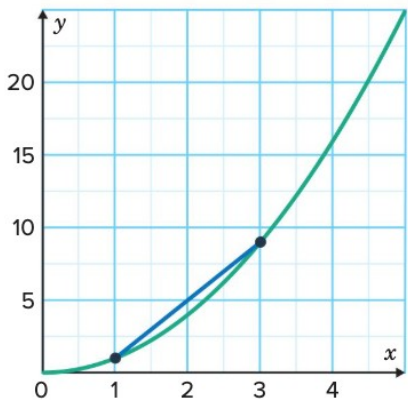
This result represents the gradient of the secant line between the points and on the graph of , as shown in the diagram above.
Example
Worked Example 2: Real-World Application
Question: A water tank's volume is modelled by , where is in litres and is in hours. Find the average rate of change of volume from to .
Solution:
Step 1: Identify the values
- and
Step 2: Evaluate at
Step 3: Evaluate at
Step 4: Apply the formula
Answer: The average rate of change is 50 litres per hour.
Interpretation: This result tells us that the volume increases at an average rate of 50 litres per hour over the interval . This also represents the gradient of the secant line on the graph of .
Summary
Key Points to Remember:
- The average rate of change measures how much a function's output changes per unit change in input over a given interval.
- The formula is:
- Geometrically, the average rate of change equals the gradient of the secant line connecting two points on the function's graph.
- To calculate it: evaluate the function at both endpoints, find the difference in outputs, divide by the difference in inputs.
- The average rate of change has practical applications in many real-world contexts, such as calculating average speed, rate of volume change, or rate of population growth.