Quadratic and Cubic Functions (HSC SSCE Mathematics Advanced): Revision Notes
📚Revision Notes
Cubic Functions
Introduction to cubic functions
A cubic function is a polynomial function of degree 3. This means it has the general form:
where , , , and are constants, and (otherwise the function wouldn't be cubic). The highest power of is , which gives cubic functions their distinctive curved shape.
Note
The condition is crucial - if , the term disappears and the function becomes quadratic (degree 2) or lower, not cubic.
Cubic functions are important in mathematics and have many real-world applications, including modelling volume relationships, describing the bending of beams in engineering, creating smooth curves in computer graphics, and representing certain economic relationships.
Simple cubic functions
The simplest form of a cubic function is:
where is a non-zero constant called the coefficient or leading coefficient.
Properties of simple cubic functions
Simple cubic functions have several important characteristics:
Origin crossing: Every simple cubic of the form crosses through the origin at the point . You can verify this by substituting into the function: .
Effect of the coefficient k: The value and sign of control two key features of the graph:
- The direction the graph travels
- The steepness of the curve
Important
Understanding the Leading Coefficient:
If (positive), the graph increases as you move from bottom-left to top-right. The larger the value of , the steeper the curve becomes.
If (negative), the graph decreases as you move from top-left to bottom-right. Again, larger values of create steeper curves.
Domain and range: For simple cubic functions, both the domain and range include all real numbers (denoted ). This means the function accepts any real number as input and can produce any real number as output.
Note
The domain represents all possible input values (-values), while the range represents all possible output values (-values). For simple cubic functions, there are no restrictions on either.
Example
Worked Example 1: Graphing
Let's graph by finding key points and understanding the function's behavior.
Strategy:
We'll substitute several -values into the function to find corresponding -values, then plot these points. Since , we know the graph will increase from bottom-left to top-right through these points.
Solution:
Choose -values of , , and to find key points:
When :
This gives us the point .
When :
This gives us the point .
When :
This gives us the point .
Since , the graph increases from bottom-left to top-right, passing through these points.
The domain is and the range is , as the function is continuous and unbounded.
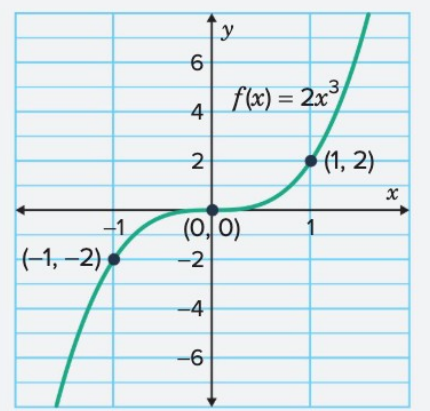
The graph shows the characteristic S-shaped curve of a cubic function, increasing through the key points , , and .
Factored cubic functions
A cubic function can also be written in factored form:
where is the leading coefficient, and , , and are constants.
Properties of factored cubic functions
Finding x-intercepts: The factored form makes it very easy to identify the x-intercepts (also called zeros or roots). These are the points where the graph crosses the x-axis. The function equals zero when any of the factors equals zero, so the x-intercepts occur at , , and .
Note
Why Factored Form is Useful:
To find where the graph crosses the x-axis, set the function equal to zero: . In factored form, this becomes . Using the null factor law, each factor can equal zero independently, giving you the x-intercepts directly without having to solve a complicated cubic equation!
Direction of the graph: Just like simple cubics, the sign of determines the overall direction:
- If , the graph increases overall (rises to the right)
- If , the graph decreases overall (falls to the right)
Domain and range: Unless restricted by the context of a problem, the domain is and the range is .
Example
Worked Example 2: Analyzing
Let's work through finding the intercepts, domain, range, and graph for this factored cubic function.
Part a: Find the x- and y-intercepts
Strategy for x-intercepts:
Set and solve for using the factored form.
Solution for x-intercepts:
Using the null factor law, set each factor equal to zero:
, or , or
, or , or
The x-intercepts are at , , and .
Strategy for y-intercept:
Substitute into the function to find where the graph crosses the y-axis.
Solution for y-intercept:
The y-intercept is at .
Part b: Determine the domain and range
Since the function is not restricted by any practical context, the domain is and the range is .
Part c: Graph the function
Strategy:
Plot the intercepts found in part (a), and use the domain and range from part (b) to understand the graph's extent.
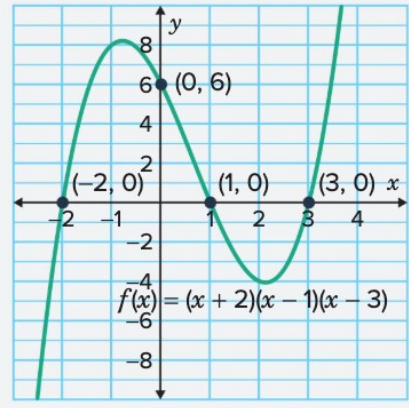
The graph shows a cubic curve with x-intercepts at , , and , and y-intercept at . The function increases overall since the implied coefficient is positive.
Applications of cubic functions
Cubic functions are used to model many real-world situations. Some common applications include:
- Engineering: Describing the bending or deflection of beams under load
- Computer graphics: Creating smooth Bézier curves for design and animation
- Economics: Modelling certain cost, profit, or production functions
- Population dynamics: Representing growth patterns in some biological models
- Volume relationships: Connecting the dimensions of three-dimensional objects to their volumes
When working with real-world applications, it's crucial to consider the practical domain - the set of input values that make sense in the context of the problem. The practical domain may be more restricted than the mathematical domain of .
Important
Mathematical Domain vs. Practical Domain:
While the mathematical domain of a cubic function is typically all real numbers (), the practical domain considers real-world constraints. For example:
- Lengths and dimensions must be positive
- Time typically starts at zero
- Quantities may have physical upper limits
Always analyze the problem context to determine which values make sense practically, even if they're valid mathematically.
Example
Worked Example 3: Volume of a Box
A box is made from a cm by cm piece of cardboard by cutting squares of side cm from each corner. The volume is given by:
Part a: Determine the practical domain for which the volume is positive
Strategy:
Find where by solving for the roots. Divide the number line into intervals using these roots. Test a point in each interval to determine where . Finally, apply the physical constraints of the problem to find the practical domain.
Solution:
First, find the roots by setting :
Using the null factor law:
, or , or
These roots divide the number line into intervals: , , , and .
Now test a point in each interval to determine where :
| Interval | Test point | Calculation | ? |
|---|---|---|---|
| No | |||
| Yes | |||
| No | |||
| Yes |
The volume is positive over the intervals and .
However, we must consider the physical constraints. The shorter side of the cardboard is cm. If we cut squares of side cm from each corner, we remove cm from this dimension (one square from each end). For the box to have positive width:
Therefore, must be less than cm. Additionally, must be positive. Combining these constraints with our mathematical analysis, the practical domain is .
Part b: Find the x- and y-intercepts
Strategy:
For x-intercepts, set and check which roots fall within the practical domain. For the y-intercept, evaluate .
Solution for x-intercepts:
From part (a), we know the mathematical x-intercepts are at , , and .
Within the practical domain , there are no x-intercepts because the interval is open (doesn't include the endpoints). The values and are boundary points where , but they're not included in the practical domain.
Solution for y-intercept:
The y-intercept is at , which is an endpoint of the practical domain.
Part c: Graph the function
Strategy:
Calculate additional points within the practical domain , then plot these along with the boundary behavior.
Solution:
Calculate :
This gives the point .
Calculate :
This gives the point .
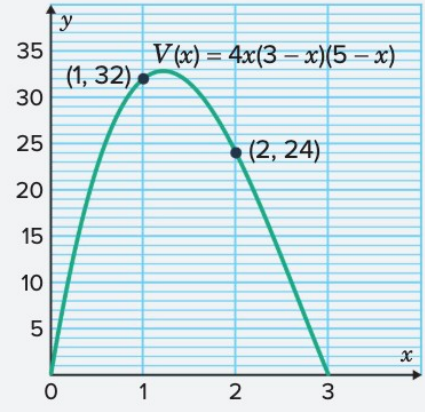
The graph shows the volume function for , with points at and . The volume approaches zero at the boundaries and . Based on these points, the range is estimated as , indicating the maximum volume occurs somewhere between and .
Summary
Key Points to Remember:
-
A cubic function is a polynomial of degree with the general form , where .
-
For simple cubics : the graph always passes through the origin ; if the graph increases from bottom-left to top-right; if the graph decreases from top-left to bottom-right; the magnitude of controls steepness.
-
For factored cubics : the x-intercepts are at , , and ; the sign of determines the overall direction of the graph.
-
Unless restricted, both the domain and range of cubic functions are (all real numbers).
-
In real-world applications, always consider the practical domain - the subset of mathematically valid inputs that make sense in context. Physical constraints often restrict the domain more than pure mathematics would suggest.