Equations of Parabolas (HSC SSCE Mathematics Advanced): Revision Notes
📚Revision Notes
Equations of Parabolas
A quadratic function describes a parabola and can be written in three different forms. Each form is useful depending on what information you have about the parabola.
Forms of quadratic equations
There are three main forms for expressing quadratic functions:
Standard form:
This form shows the coefficients of each term directly. The constant represents the y-intercept.
Vertex form:
This form clearly shows the vertex at . The value of determines how wide or narrow the parabola is and whether it opens upward or downward.
Factorised form:
This form reveals the x-intercepts (also called roots or zeros) at and . These are the points where the parabola crosses the x-axis.
Note
In all three forms, the coefficient is called the leading coefficient. This value determines the parabola's concavity:
- If , the parabola is concave up (opens upward, like a smile)
- If , the parabola is concave down (opens downward, like a frown)
Choosing the right form
The form you choose depends on what information you're given:
Important
Selecting the Appropriate Form:
Use vertex form when: You know the vertex and one other point on the parabola. Substitute the point's coordinates to find .
Use factorised form when: You know the x-intercepts and and one other point. Substitute the point to find .
Use standard form when: You have three general points on the parabola. Create a system of equations to solve for , , and .
Finding equations using vertex form
When you know the vertex and another point, vertex form is the most efficient approach.
Example
Worked Example 1a: Finding the equation
A parabola has vertex and passes through . Find the equation in vertex form.
Solution:
Start with the vertex form and identify the known values.
The vertex tells us that and .
Substitute the point into the equation. This means when , .
Add 1 to both sides:
Divide both sides by 4:
Now substitute all values back into vertex form:
Example
Worked Example 1b: Domain and range
Determine the domain and range of the parabola.
Solution:
The domain of any parabola is all real numbers, written as or . This means the parabola extends infinitely in both horizontal directions.
For the range, examine the vertex and concavity:
Since , the parabola is concave up (opens upward). This means the vertex is a minimum point.
The vertex is at , so the minimum y-value is . The parabola extends upward infinitely from this point.
Therefore, the range is [].
Example
Worked Example 1c: Finding x-intercepts
Find the x-intercepts of the parabola.
Solution:
The x-intercepts occur where . Set the equation equal to zero and solve for .
Add 1 to both sides:
Take the square root of both sides:
This gives two solutions:
First solution:
Second solution:
The x-intercepts are at and .
Example
Worked Example 1d: Sketching the graph
Sketch the graph showing key features.
Solution:
To sketch the parabola, plot these key features:
- Vertex:
- y-intercept: (the given point)
- x-intercepts: and
- Axis of symmetry: (vertical line through the vertex)
- Concavity: Opens upward since
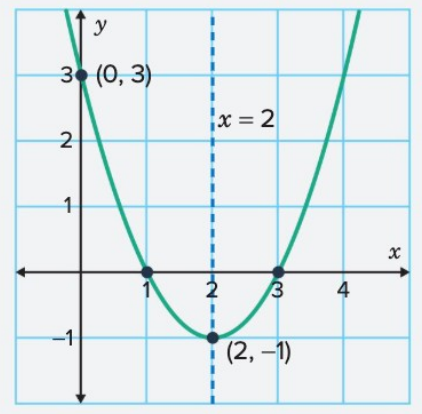
The axis of symmetry is the vertical line . Notice the parabola is symmetric about this line. The x-intercepts are equidistant from the axis of symmetry.
Equating quadratic coefficients
When two quadratic functions are equal for all values of , their corresponding coefficients must match.
Important
Method of Equating Coefficients
For two expressions in standard form:
We can equate the coefficients:
- Coefficients of :
- Coefficients of :
- Constant terms:
This method is particularly useful when:
- Converting between different forms of the same parabola
- Finding unknown parameters in a quadratic expression
- Verifying that two expressions represent the same function
Finding equations using factorised form
When you know the x-intercepts, factorised form provides an efficient starting point.
Example
Worked Example 2a: Converting to standard form
A parabola has x-intercepts and , and vertex . Find the equation in standard form.
Solution:
The x-intercepts tell us that and .
Start with the factorised form:
Since the vertex is at , we know that when , .
Substitute to find :
Divide both sides by :
Now expand the factorised form to standard form:
Expand the brackets:
Combine like terms:
This is the equation in standard form.
Example
Worked Example 2b: Domain and range
Determine the domain and range.
Solution:
Domain: The domain of any parabola is (all real numbers).
Range: Since , the parabola is concave up with a minimum point at the vertex.
The vertex is at , so the minimum y-value is .
Therefore, the range is [].
Example
Worked Example 2c: Finding coefficients by equating
Find the values of , , and such that is equivalent to the parabola.
Solution:
From part (a), we know the standard form is .
First, expand the given expression:
This must equal for all values of .
Equate the coefficients:
- Coefficient of :
- Coefficient of :
- Constant term:
Substitute into the second equation:
This can be rearranged to:
Substitute this into the third equation:
Rearrange to standard form:
Factorise:
This gives or .
Find the corresponding values of :
If :
If :
Therefore, there are two possible solution sets:
- , ,
- , ,
Both sets of values produce equivalent expressions for the same parabola.
Summary
Key Points to Remember:
-
A parabola can be expressed in three forms: standard form (), vertex form (), and factorised form ().
-
Choose vertex form when you know the vertex and another point, factorised form when you know the x-intercepts and another point, and standard form when you have three general points.
-
The domain of any parabola is always , while the range depends on the vertex and whether the parabola opens upward () or downward ().
-
Two quadratic expressions are equal for all if and only if their corresponding coefficients are equal. Use this to convert between forms or solve for unknown parameters.
-
The coefficient determines concavity: positive means concave up (minimum at vertex), negative means concave down (maximum at vertex).