Solve Quadratic Systems (HSC SSCE Mathematics Advanced): Revision Notes
📚Revision Notes
Solve Quadratic Systems
Introduction
A quadratic system involves finding where two functions intersect. This could be where a quadratic function meets a linear function, or where two quadratic functions meet. Understanding how to solve these systems is essential for analysing the relationship between different mathematical functions.
In this topic, you will learn to:
- Find intersection points of a quadratic and a linear function using both algebraic and graphical methods
- Find intersection points of two quadratic functions
- Use the discriminant to determine how many intersection points exist
- Interpret solutions as coordinates where graphs meet
Intersections of quadratics and linear graphs
When we want to find where a quadratic function and a linear function meet, we are looking for their intersection points. These are the points where the two graphs cross each other.
Finding intersection points
The intersection points occur where f(x) = g(x). We can find these points using two different approaches:
Note
Algebraic method:
To solve algebraically, follow these steps:
- Set the two functions equal:
- Rearrange to form a standard quadratic equation:
- Solve the quadratic equation to find the -values of the intersection points
- Substitute each -value back into either original function to find the corresponding -coordinates
Using the linear equation to find the -values is usually quicker than using the quadratic equation.
Note
Graphical method:
To solve graphically:
- Plot both functions on the same coordinate plane
- Identify where the graphs intersect
- Read the coordinates of the intersection points from the graph
This method works well when the intersection points have integer or simple decimal coordinates. However, it may be less accurate for complex values.
Using the discriminant
The discriminant () provides a quick way to determine how many intersection points exist without solving the entire equation. After rearranging the system into the form , the discriminant is:
Important
The value of the discriminant tells us:
- : Two intersection points (the line cuts through the parabola at two places)
- : One intersection point (the line is tangent to the parabola, touching it at exactly one point)
- : No intersection points (the line and parabola don't meet)
Exam tip: Always check the discriminant first if you're asked about the number of intersections. It's much faster than solving the full equation!
Worked example: Quadratic and linear intersection
Let's find the intersection points of and .
Example
Worked Example: Finding Intersection Points Algebraically
Step 1: Set the functions equal to each other.
Step 2: Rearrange to form a quadratic equation.
Step 3: Factorise the quadratic.
Step 4: Solve for .
Step 5: Find the corresponding -coordinates by substituting into .
When :
When :
Solution: The intersection points are (5, 9) and (1, 1).
Graphical solution
To solve graphically, we plot both functions on a coordinate plane and identify where they meet.
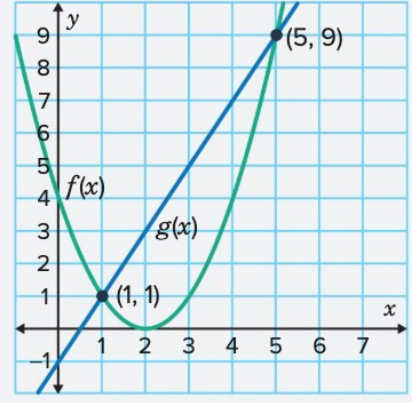
The parabola and the line intersect at (5, 9) and (1, 1), confirming our algebraic solution.
Intersections of two quadratics
Finding where two quadratic functions intersect follows a similar process to quadratic-linear systems. If we have and , their intersection points occur where f(x) = g(x).
Finding intersection points for two quadratics
Note
Algebraic method:
- Set
- Rearrange to form:
- Solve using factorisation, completing the square, or the quadratic formula
- Substitute the -values into either original function to find corresponding -coordinates
Note
Graphical method:
- Plot both parabolas on the same coordinate plane
- Identify where the curves intersect
- Read the coordinates of intersection points
Note that reading exact values from a graph can be challenging when the intersection points involve surds or complex decimals.
Using the discriminant for two quadratics
After rearranging into standard form, the discriminant still tells us about the number of intersections:
Important
- : Two intersection points (the parabolas cross at two places)
- : One intersection point (the parabolas are tangent, touching at exactly one point)
- : No intersection points (the parabolas don't meet)
Exam tip: When solving systems of two quadratics, the quadratic formula is often the most reliable method, especially when the equation doesn't factorise easily.
Worked example: Two quadratics intersection
Find the intersection points of and both graphically and algebraically.
Example
Worked Example: Finding Where Two Parabolas Meet
Step 1: Set the functions equal.
Step 2: Rearrange to standard form.
Step 3: Use the quadratic formula since this doesn't factorise easily.
Substitute , , and :
Step 4: Find the corresponding -coordinates by substituting into .
For :
For :
Solution: The intersection points are approximately and .
In decimal form, these are approximately (3.1, 0.6) and (-0.6, -1.3).
Graphical solution
We can verify our solution by plotting both parabolas.
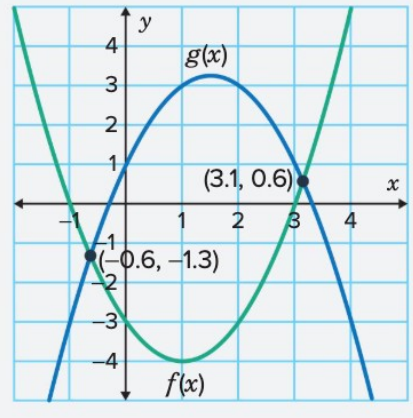
The parabolas and intersect at approximately (3.1, 0.6) and (-0.6, -1.3), which matches our algebraic solution.
Summary
Key Points to Remember:
- Intersection points occur where two functions are equal: solve by setting f(x) = g(x)
- For algebraic solutions, rearrange into a quadratic equation, solve for -values, then substitute back to find -coordinates
- For graphical solutions, plot both functions and identify where they cross
- The discriminant () quickly determines the number of intersections:
- : two intersections
- : one intersection (tangent)
- : no intersections
- When working with two quadratics, the quadratic formula is often the most reliable solving method
- Always verify your solutions by checking that the coordinates satisfy both original equations