First Principles for Derivatives (HSC SSCE Mathematics Advanced): Revision Notes
📚Revision Notes
First Principles for Derivatives
What is a derivative?
A derivative tells us how quickly a function is changing at any specific point. It represents the instantaneous rate of change of the function with respect to its variable.
Geometrically, the derivative gives us the gradient of the tangent line to the curve at a particular point. The derivative of with respect to is written as or .
Key terminology
Derivative
The derivative of a function measures the instantaneous rate of change. It shows us the gradient of the tangent line to the function's graph at any given point.
Note
Think of a derivative as a "speedometer" for your function - it tells you exactly how fast the function is changing at any particular moment.
First principles
First principles is a method for finding the derivative using the limit definition. This fundamental approach forms the basis for all differentiation rules and can be applied to various functions, including linear and quadratic functions.
The first principles formula is:
Limit
A limit is the value that a function or sequence approaches as the input approaches some value. In differentiation, the limit describes the value that the gradient of the secant line approaches as the interval between two points approaches zero.
Important
Understanding limits is crucial: when we write , we mean "as gets infinitely close to zero" - not that equals zero, but that it approaches zero.
Understanding the geometric interpretation
To understand first principles, we need to think about how a tangent line relates to a secant line.
The derivative of a function at a point gives the gradient of the tangent to the curve at that point. We can find this by considering the gradient of a secant line through two points on the curve: and .
The gradient of the secant line is:
Where:
- is the gradient of the secant line
- is the change in the -value (rise)
- is the change in the -value (run), representing a small increment from
As point moves closer to , the value of h approaches zero and the secant line PQ approaches the position of the tangent line at . The gradient of this tangent line is the limiting value of the gradient of the secant line as .
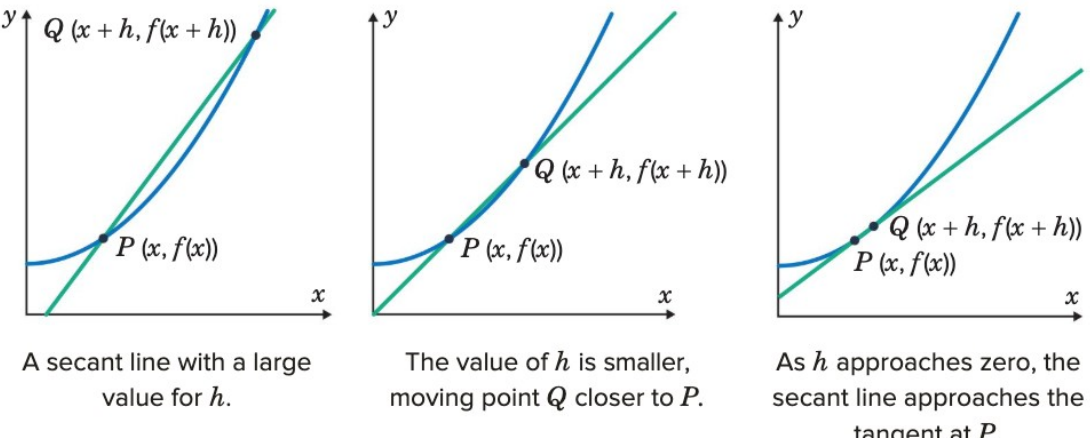
This limiting value is defined as the derivative of f(x) with respect to x, denoted by . The process of finding the derivative using this definition is called differentiation from first principles.
The first principles formula
Important
The First Principles Formula
The derivative from first principles is defined as:
This is the foundation of all calculus differentiation!
Let's understand each component:
- is the derivative of the function
- denotes the limit as h approaches zero
- is the value of the function at
- is the value of the function at
- is a small change in x
This definition is valid provided the limit exists and the tangent is not vertical.
Step-by-step process
To find the derivative of a function using first principles:
- Find : Substitute into the function in place of
- Expand and simplify: Expand any brackets and simplify the expression
- Write the first principles formula: Set up
- Substitute: Replace and with their expressions
- Simplify the numerator: Expand brackets and collect like terms
- Factorise: Factor out h from the numerator
- Cancel the common factor: Cancel from numerator and denominator
- Evaluate the limit: Substitute into the simplified expression
Note
Memory Aid: The "FTF" Process
- First find
- Then take away
- Finally divide by , factorise, and find the limit!
Remember: " means secant → tangent"
Worked examples
Example
Worked Example 1: Differentiating a Linear Function
Let's use first principles to find the derivative of .
Step 1: Find
Step 2: Apply the first principles formula
Step 3: Simplify the numerator
Step 4: Simplify the fraction
Step 5: Evaluate the limit
Therefore, the derivative of f(x) = 3x + 2 is f'(x) = 3.
Example
Worked Example 2: Differentiating a Quadratic Function
Let's use first principles to differentiate .
Step 1: Find
Step 2: Apply the first principles formula
Step 3: Simplify the numerator
Step 4: Factorise from the numerator
Step 5: Cancel the common factor
Step 6: Evaluate the limit
Therefore, the derivative of f(x) = x² + 5x is f'(x) = 2x + 5.
Example
Worked Example 3: Finding the Derivative and Evaluating at a Point
For the function :
Part a: Determine the derivative using first principles
Step 1: Find
Step 2: Apply the first principles formula
Step 3: Simplify the numerator
Step 4: Factorise from the numerator
Step 5: Cancel the common factor
Step 6: Evaluate the limit
Therefore, the derivative is f'(x) = 4x - 3.
Part b: Calculate the gradient of the tangent at
Now we substitute into the derivative we found:
Therefore, the gradient of the tangent to f(x) = 2x² - 3x + 1 at x = 3 is 9.
Exam tips
Note
Essential Exam Tips
- Always show all steps clearly when using first principles
- Don't forget to factorise h from the numerator before cancelling
- Remember that h → 0 means substitute h = 0 after cancelling
- Check your expansion of carefully: it equals
- The derivative gives you a formula; to find the gradient at a specific point, substitute the -value into the derivative
Important
Common Mistakes to Avoid
- Never cancel before factorising it out of the numerator
- Don't substitute too early - only do this after cancelling
- Watch out for sign errors when subtracting from
- Remember to expand correctly - it's NOT
Summary
Summary
Key Points to Remember:
-
The derivative measures the instantaneous rate of change of a function and represents the gradient of the tangent line to the curve at any point.
-
The first principles formula is:
-
Geometrically, as the interval approaches zero, the secant line between two points approaches the tangent line at a single point.
-
The process involves: finding , substituting into the formula, simplifying, factorising , cancelling, and evaluating the limit as .
-
Once you have the derivative , you can find the gradient at any specific point by substituting the -value into .
-
Remember the "FTF" process: First find , Then take away , Finally divide by !