Gradient of a Curve (HSC SSCE Mathematics Advanced): Revision Notes
📚Revision Notes
Gradient of a Curve
Introduction
Note
In this topic, you will learn to:
- Describe the gradient of a curve at a point using its tangent line
- Estimate the gradient of a curve graphically by finding the gradient of its tangent
- Use the gradient of a secant line to approximate the gradient of a curve at a point
- Recognise the derivative, , as the gradient function of a curve
- Define differentiation as the process of finding the derivative of a function
The gradient of a curve at a point
Understanding gradient
The gradient measures how steep a line is. For any straight line containing two distinct points and , we can calculate the gradient using the formula:
This formula gives us the gradient of the line (or line segment ).
The challenge with curves
A straight line has a constant gradient throughout its entire length. However, a curve is different. The steepness of a curve changes as you move from one point to another along the curve. This means we cannot use a single gradient value to describe the entire curve.
To understand the gradient of a curve at a specific point, we need to introduce the concept of a tangent line.
What is a tangent?
Important
A tangent is a straight line that intersects a curve at exactly one point. The tangent touches the curve at that point of contact but does not pass through the curve.
The tangent line has a special property: it has the same direction as the curve at the point where they meet. This makes the tangent line an ideal tool for measuring the gradient of a curve at a specific point.
Defining the gradient of a curve
The gradient of a curve at a particular point is defined as the gradient of the tangent line to the curve at that point.
This means:
- If the tangent is horizontal at a point, the gradient of the curve at that point is zero
- If the tangent slopes upwards from left to right, the gradient is positive
- If the tangent slopes downwards from left to right, the gradient is negative
- If the tangent is vertical, the gradient is undefined
Note
Graphing applications are helpful tools for visualising how the gradient changes along a curve. By drawing tangent lines at various points on a curve, you can examine how the steepness varies and understand the behaviour of the curve more clearly.
Worked example: Estimating gradient using a tangent
Example
Worked Example: Estimating Gradient Using a Tangent
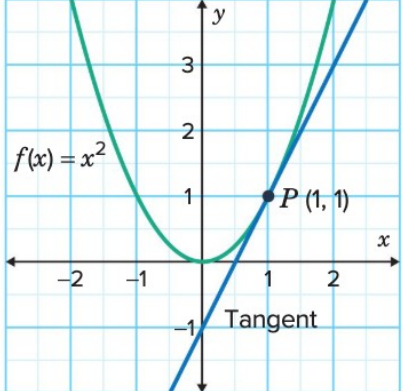
Problem: The graph shows the function and the tangent line to the curve at point . Estimate the gradient of the curve at this point.
Solution:
The gradient of the curve at point equals the gradient of the tangent line at .
To find this gradient, we need to identify two points on the tangent line. From the graph, the tangent at also passes through the point , where the grid lines meet.
Let and .
Using the gradient formula:
The gradient of the tangent line at is 2.
Therefore, the gradient of the curve at is 2.
Approximation of the gradient by a secant
What is a secant?
A secant is a straight line that passes through two distinct points on the graph of a function.
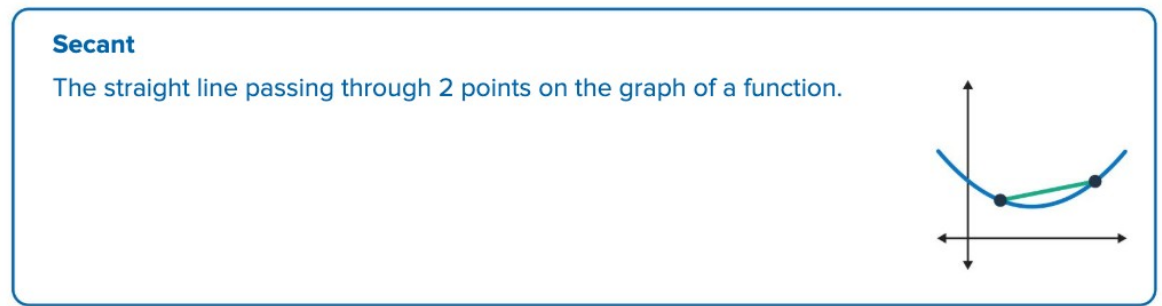
While a tangent touches a curve at one point, a secant intersects the curve at two different points. This difference is important because we can use the gradient of a secant to approximate the gradient of a tangent.
The secant gradient formula
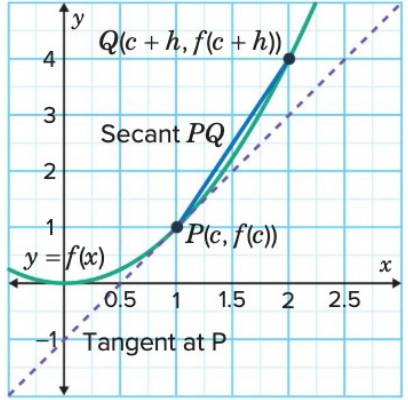
Consider two points on a curve : point and a nearby point , where is a small change in .
The gradient of the secant line is calculated using the standard gradient formula:
Simplifying the denominator:
Important
Where:
- is the gradient of the secant line passing through points and
- is the -coordinate of point
- is the -coordinate of point
- is the horizontal distance (change in ) between and , where
How the secant approximates the tangent
As the value of approaches zero, something important happens. Point moves closer and closer to point along the curve. As this happens, the secant line becomes a better and better approximation of the tangent line at .
The gradient of the secant line approaches the gradient of the tangent line at as . This concept is fundamental to understanding how the gradient of a curve at a point is formally defined in calculus.
Note
Think of it this way: the smaller the value of , the closer point gets to point . When two points are very close together on a curve, the straight line connecting them (the secant) looks almost identical to the tangent line at either point.
Worked example: Calculating secant gradients
Example
Worked Example: Calculating Secant Gradients
This example demonstrates how the secant gradient approaches the tangent gradient as gets smaller.
Problem: For the function at , calculate the gradient of the secant line between and for:
a)
b)
c)
d) What value does the gradient of the secant appear to be approaching as approaches zero?
Solution:
First, we need to find . Since :
We'll use the secant gradient formula:
Part a) When :
Calculate :
Since :
Calculate the gradient:
Part b) When :
Calculate :
Calculate the gradient:
Part c) When :
Calculate :
Calculate the gradient:
Part d) Finding the limiting value:
Looking at our results:
- When , the gradient is
- When , the gradient is
- When , the gradient is
As gets smaller, the gradient of the secant changes from to to . These values appear to approach 2.
This suggests that the gradient of the tangent at is likely to be 2.
Note
Key insight: The gradient of a secant line passing through two points and on a curve is given by . As approaches zero, point approaches point , and the gradient of the secant line provides an increasingly accurate approximation of the gradient of the tangent line at .
The derivative and differentiation
What is the derivative?
The derivative is the result obtained after differentiation. For a function , the derivative is the gradient function of .
The gradient of the tangent to a curve at a point is a fundamental concept in calculus. This gradient is formally defined as the derivative of the function at that point.
Notation for derivatives
Important
The derivative of a function is denoted in several ways:
- (read as "f-dash of x" or "f-prime of x")
- (read as "dee-y by dee-x")
All of these notations represent the same thing: the gradient function of .
The function gives the gradient of the tangent to the curve at any point for which the derivative exists.
Understanding
The derivative is also called the gradient function or the derived function of .
The value of the derivative at a particular point, say , is written as . This value gives the gradient of the tangent to the curve at .
What is differentiation?
Differentiation is the process used to find the derivative of a function.
Through differentiation, we determine the gradient function from the original function .
Condition for the derivative to exist
Note
For the derivative to exist at a point, the tangent line at that point must exist and must not be vertical.
If a curve has a vertical tangent at a point, or if no tangent can be drawn at that point, then the derivative does not exist there.
Worked example: Using derivative notation
Example
Worked Example: Using Derivative Notation
This example shows how to use the derivative notation to find the gradient of a tangent.
Problem: If the gradient of the tangent to the curve at the point where is , what is the value of ?
Solution:
Recall that represents the gradient of the tangent to the curve at .
The gradient of the tangent to at is given as .
By definition, is the gradient of the tangent to at .
Therefore, .
Worked example: Using the derivative formula
Example
Worked Example: Using the Derivative Formula
This example demonstrates how to use a derivative formula to find the gradient of a tangent at a specific point.
Problem: The derivative of a function is . Determine the gradient of the tangent to the curve at the point where .
Solution:
We need to substitute the given -value into the expression for the derivative to find the gradient at that point.
The derivative is:
To find the gradient of the tangent at , calculate :
The gradient of the tangent to the curve at is 9.
Note
Key insight: The derivative of a function , denoted or , gives the gradient of the tangent to the curve at any point . The value is the specific gradient at . Differentiation is the process used to find this derivative function.
Remember!
Summary
Key Points to Remember:
-
The gradient of a curve at a point equals the gradient of the tangent line to the curve at that point. The tangent touches the curve at exactly one point and has the same direction as the curve there.
-
A secant line passes through two points on a curve. Its gradient is given by , where is the horizontal distance between the two points.
-
As approaches zero, the secant line provides an increasingly accurate approximation of the tangent line, and the gradient of the secant approaches the gradient of the tangent.
-
The derivative (also written as ) is the gradient function that gives the gradient of the tangent to at any point . The value gives the specific gradient at .
-
Differentiation is the process of finding the derivative of a function. The derivative exists at a point only if the tangent line exists there and is not vertical.