Tangents and Normals (HSC SSCE Mathematics Advanced): Revision Notes
📚Revision Notes
Tangents and Normals
Learning objectives
By the end of this note, you will be able to:
- Find the equation of a tangent line to a curve at a specific point
- Find the equation of a normal line to a curve at a specific point
- Locate points on a curve where the tangent or normal has a particular gradient
- Connect the gradient of a tangent to its angle of inclination
- Solve problems involving tangents, normals, and angles of inclination
Equations of tangents
What is a tangent line?
A tangent line at the point is a straight line that touches the curve at that specific point and has the same instantaneous gradient as the curve at that point.
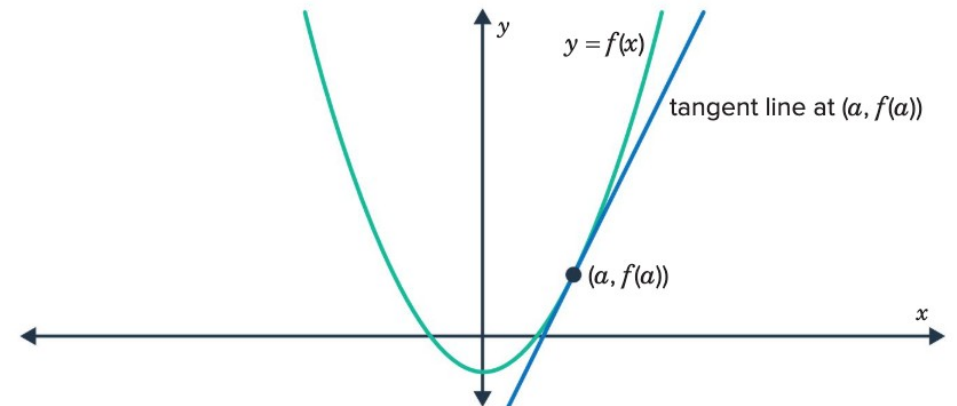
The gradient of the tangent at is found using the derivative, .
Finding the equation of a tangent
To find the equation of the tangent line to the curve at the point , we use the point-gradient formula:
This gives us the tangent equation:
Note
The point-gradient formula is the foundation for finding tangent equations. Make sure you identify the correct point of tangency and calculate the gradient using the derivative at that specific point.
Where:
- are the coordinates of any point on the tangent line
- are the coordinates of the point of tangency (where the tangent touches the curve)
- is the gradient of the tangent at
Example
Worked Example: Finding a tangent equation
Question: Determine the equation of the tangent to the curve at the point .
Solution:
First, find the derivative of :
Next, calculate the gradient of the tangent at :
Now use the point-gradient formula with point and gradient :
The equation of the tangent at the point is .
Example
Worked Example: Finding points with horizontal tangents
Question: Determine the coordinates of the point(s) on the curve where the tangent is horizontal.
Solution:
A horizontal line has a gradient of 0. Therefore, we need to find where the derivative equals .
Find the derivative:
Set the derivative equal to :
Therefore: or
Now substitute these -values back into the original equation to find the corresponding -coordinates.
For :
For :
The points on the curve where the tangent is horizontal are and .
Equations of normals
What is a normal line?
A normal line to a curve at a given point is the straight line that is perpendicular to the tangent at that point . The normal passes through the same point as the tangent but forms a right angle with it.
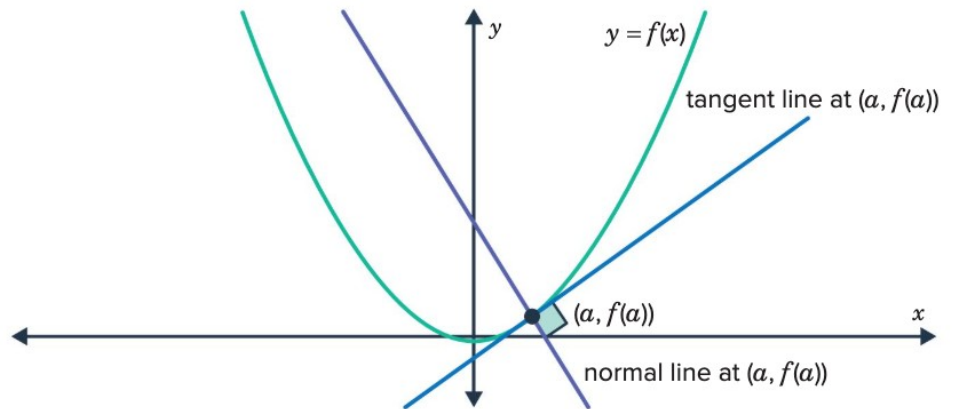
Relationship between tangent and normal gradients
If the tangent line at has a gradient of , then the normal line has a gradient that is the negative reciprocal of the tangent's gradient.
Important
For perpendicular lines, the product of their gradients equals (for non-vertical and non-horizontal lines):
This is a fundamental relationship that connects the gradients of tangent and normal lines. Understanding this property is essential for solving normal line problems.
Therefore, the gradient of the normal is:
Where:
- is the gradient of the normal line
- is the gradient of the tangent line, equal to , where
Finding the equation of a normal
The equation of the normal to the curve at the point is given by:
Where:
- are the coordinates of any point on the normal line
- are the coordinates of the point on the curve
- is the gradient of the tangent at (must be non-zero)
Example
Worked Example: Finding a normal equation
Question: Determine the equation of the normal to the curve at the point .
Solution:
First, find the derivative of :
Calculate the gradient of the tangent line at :
Calculate the gradient of the normal line:
Use the point-gradient formula with point and gradient :
The equation of the normal line is .
Example
Worked Example: Finding points with a specific normal gradient
Question: Determine the coordinates of the point on the curve where the normal has a gradient of .
Solution:
Since we know the gradient of the normal is , we can find the gradient of the tangent using:
Find the derivative of the function:
Equate the derivative to the tangent gradient to solve for :
Substitute into the function to find the -coordinate:
The coordinates of the point are .
Angle of inclination
What is the angle of inclination?
The angle of inclination is the angle a straight line makes with the positive -axis, measured anticlockwise. The angle is always in the range .
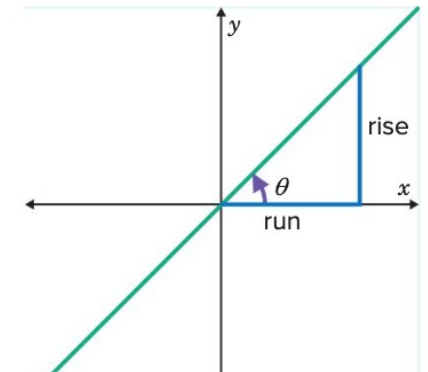
Note
The angle of inclination is always measured anticlockwise from the positive -axis, which means it can never be negative. If you get a negative angle from a calculator, you'll need to add to convert it to the correct obtuse angle.
Relationship between gradient and angle of inclination
Using trigonometry, the gradient (rise over run) of a line is equal to the tangent of its angle of inclination, :
Where:
- is the gradient of the line
- is the angle measured anticlockwise from the positive -axis
Since the derivative gives the gradient of the tangent to the curve at , this relationship connects the derivative to the angle of the tangent line:
Note
Key points about angles and gradients:
- If the gradient is positive, the angle is acute ()
- If the gradient is negative, the angle is obtuse ()
Example
Worked Example: Finding x-coordinate from angle
Question: Consider the function . Determine the -coordinate of the point on the curve where the tangent makes an angle of with the positive -axis.
Solution:
Find the derivative of the function:
Determine the gradient of the tangent using the given angle:
Equate the derivative to the tangent gradient to solve for :
The tangent on the curve has a gradient of at the point where .
Example
Worked Example: Finding angle from a point
Question: Determine the angle of inclination, rounded to the nearest degree, of the tangent to the curve at the point where .
Solution:
Find the derivative of :
Determine the gradient of the tangent at :
Since , we need to find the angle. A negative gradient means the angle of inclination is obtuse. A calculator may return a negative angle, so we add to find the correct obtuse angle:
The angle of inclination is approximately .
Summary
Key Points to Remember:
-
Tangent line: The tangent at point touches the curve with the same gradient as the derivative at that point. Its equation is .
-
Normal line: The normal is perpendicular to the tangent at the same point. Its gradient is the negative reciprocal of the tangent's gradient: . Its equation is .
-
Finding specific gradients: To find points where a tangent or normal has a specific gradient, set the derivative (or its negative reciprocal) equal to that gradient and solve for , then substitute back to find .
-
Angle of inclination: The gradient of a line relates to its angle with the positive -axis by the formula . Positive gradients give acute angles, negative gradients give obtuse angles.
-
Problem-solving strategy: Always start by finding the derivative, then use it to calculate the gradient at the required point or solve for points with specific gradients.