Secant, Cosecant, and Cotangent (HSC SSCE Mathematics Advanced): Revision Notes
📚Revision Notes
Secant, Cosecant, and Cotangent
Introduction to reciprocal trigonometric ratios
In addition to the three basic trigonometric ratios (sine, cosine, and tangent), there are three reciprocal trigonometric ratios that extend our toolkit for working with right-angled triangles. These are secant (sec), cosecant (cosec), and cotangent (cot).
Each reciprocal ratio is defined as the multiplicative inverse of one of the basic ratios. Understanding these ratios allows you to work more efficiently with certain trigonometric problems and prepares you for more advanced mathematical concepts.
Note
These three ratios form a complementary set to the basic trigonometric functions, creating a complete family of six trigonometric ratios. Each reciprocal ratio has a specific relationship with its corresponding basic ratio: sec-cos, cosec-sin, and cot-tan.
The three reciprocal ratios
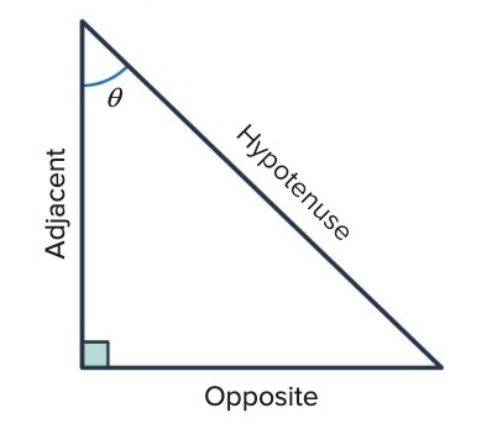
To understand these ratios, we first need to recall the sides of a right-angled triangle relative to an angle .
Secant (sec θ)
The secant of an angle is the reciprocal of its cosine.
In terms of the sides of a right-angled triangle, secant is the ratio of the hypotenuse to the adjacent side.
where .
This ratio tells us how many times longer the hypotenuse is compared to the adjacent side.
Cosecant (cosec θ)
The cosecant of an angle is the reciprocal of its sine.
In terms of the sides of a right-angled triangle, cosecant is the ratio of the hypotenuse to the opposite side.
where .
This ratio tells us how many times longer the hypotenuse is compared to the opposite side.
Cotangent (cot θ)
The cotangent of an angle is the reciprocal of its tangent.
In terms of the sides of a right-angled triangle, cotangent is the ratio of the adjacent side to the opposite side.
where .
This ratio compares the adjacent side to the opposite side, which is the reverse of the tangent ratio.
When are these ratios undefined?
An important consideration is that these ratios become undefined when their denominators equal zero. Since division by zero is not possible in mathematics, we must identify when this occurs.
Important
Watch out for undefined values!
Division by zero makes these ratios undefined at specific angles:
- becomes undefined at θ = 90° (because )
- Both and become undefined at θ = 0° (because and )
For acute angles between 0° and 90°, and are always defined.
We'll explore these boundary cases in more detail later in these notes.
Exact values from special triangles
Just as we can find exact values for sine, cosine, and tangent at special angles, we can also determine exact values for secant, cosecant, and cotangent at the angles 30°, 45°, and 60°. These values come from two special right-angled triangles.
The 45-45-90 triangle
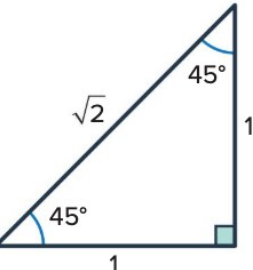
Consider an isosceles right-angled triangle where the two legs each have length 1 unit. This triangle has two 45° angles and one 90° angle.
Using Pythagoras' theorem to find the hypotenuse:
Note
The 45-45-90 triangle pattern
This special triangle has sides in the ratio 1:1:√2. The two equal legs each measure 1 unit, and the hypotenuse measures √2 units. This pattern remains consistent regardless of the triangle's size.
From this triangle, we can calculate the exact values:
The 30-60-90 triangle
To find exact values for 30° and 60° angles, we start with an equilateral triangle where all sides measure 2 units and all angles are 60°.
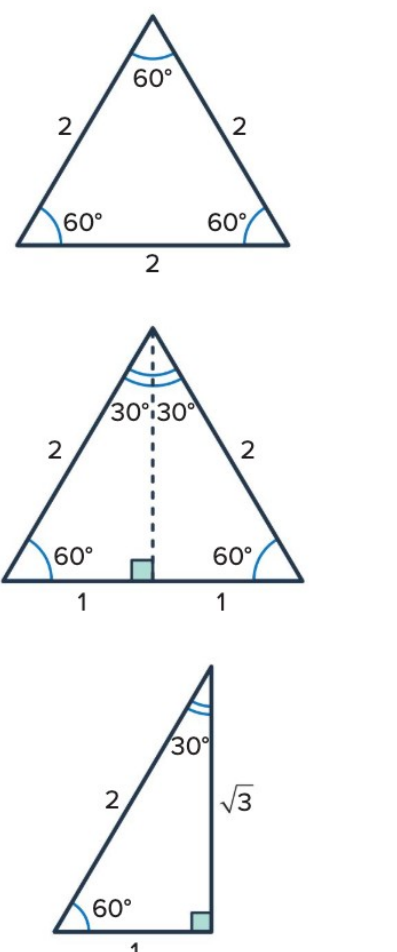
When we draw an altitude from one vertex to the opposite side, it bisects both the angle and the base. This creates two congruent right-angled triangles, each with angles of 30°, 60°, and 90°.
The altitude divides the base into two segments of 1 unit each. Using Pythagoras' theorem, we can find that the altitude has length units.
Note
The 30-60-90 triangle pattern
This special triangle has sides in the ratio 1:√3:2. When you divide an equilateral triangle in half, you always create this characteristic pattern:
- Shortest side (opposite 30°) = 1 unit
- Medium side (opposite 60°) = √3 units
- Hypotenuse = 2 units
Focusing on one of these right-angled triangles, we have a 30°-60°-90° triangle with:
- Hypotenuse = 2
- Opposite side to 30° angle = 1
- Adjacent side to 30° angle (opposite to 60°) =
From this triangle, we can calculate:
For 30°:
For 60°:
Summary table of exact values
Here are all the exact values organised in a table for easy reference:
| Angle | sec | cosec | cot |
|---|---|---|---|
Note
Similar triangles have identical ratios
Not every isosceles right-angled triangle has sides measuring 1, 1, and √2, but no matter how large or small the triangle is, the two base angles will always be 45° angles. Therefore, the ratios of the sides will always be the same. This principle also applies to triangles with 60° and 30° angles. Any pair of similar triangles have the same side ratios, and therefore the same exact value trigonometric ratios.
Boundary values
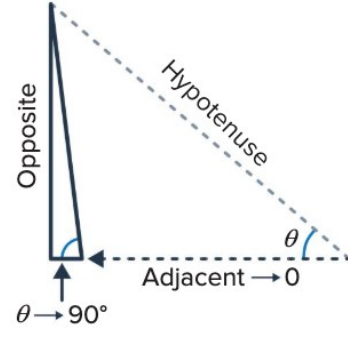
The boundary values of , , and at and are found by examining what happens to the side ratios in a right-angled triangle as approaches these angles.
As θ → 0°
As the angle approaches 0°, the opposite side approaches 0 and the hypotenuse approaches the length of the adjacent side.
Let's examine each ratio:
Secant:
Cosecant:
This is undefined because we cannot divide by zero.
Cotangent:
This is also undefined.
As θ → 90°
As the angle approaches 90°, the adjacent side approaches 0 and the opposite side approaches the length of the hypotenuse.
Let's examine each ratio:
Secant:
This is undefined because we cannot divide by zero.
Cosecant:
Cotangent:
Important
Understanding boundary values geometrically
At the boundary angles (0° and 90°), the triangle becomes "collapsed" in one direction:
- At θ = 0°, the triangle flattens horizontally - the opposite side vanishes
- At θ = 90°, the triangle becomes vertical - the adjacent side vanishes
Whenever a side length becomes zero in the denominator, the ratio is undefined. When both numerator and denominator approach the same value, the ratio approaches 1.
Summary table of boundary values
These boundary values, which don't describe physical triangles, are important for understanding the complete behaviour of these functions:
| Angle | sec | cosec | cot |
|---|---|---|---|
| Undefined | Undefined | ||
| Undefined |
Worked examples
Example
Worked Example 1: Finding values in a specific triangle
Question: In a right-angled triangle, the hypotenuse is 5 cm, the side adjacent to angle is 4 cm, and the side opposite is 3 cm. Find the exact values of:
a)
b)
c)
Solution:
Part a:
We use the formula .
Part b:
We use the formula .
Part c:
We use the formula .
Example
Worked Example 2: Using exact value triangles
Question: Use the exact value triangles to find:
a)
b)
c)
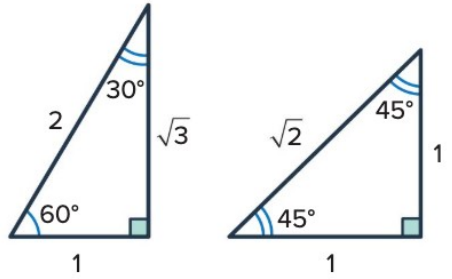
Solution:
Part a:
We refer to the triangle with the 60° angle and use the secant ratio.
Part b:
We refer to the triangle with the 45° angle and use the cosecant ratio.
Part c:
We refer to the triangle with the 30° angle and use the cotangent ratio.
Example
Worked Example 3: Justifying boundary values
Question: Justify that and using the side ratios in a right-angled triangle.
Solution:
Part a:
We use the side ratio for secant as .
As , the adjacent side approaches the hypotenuse in length.
Part b:
We use the side ratio for cotangent as .
As , the adjacent side approaches 0.
Remember!
Summary
Key Points to Remember:
-
Reciprocal relationships: Secant, cosecant, and cotangent are the reciprocals of cosine, sine, and tangent respectively. This means , , and .
-
Triangle ratios: In a right-angled triangle, , , and .
-
Exact values: Memorise the exact values for 30°, 45°, and 60° using the special triangles. The 45°-45°-90° triangle has sides 1:1:√2, and the 30°-60°-90° triangle has sides 1:√3:2.
-
Undefined values: These ratios become undefined when you would need to divide by zero. At 0°, both and are undefined. At 90°, is undefined.
-
Boundary values: At the boundary angles, sec 0° = 1, cosec 90° = 1, and cot 90° = 0.