Trigonometric Equations (HSC SSCE Mathematics Advanced): Revision Notes
📚Revision Notes
Trigonometric Equations
What is a trigonometric equation?
A trigonometric equation is an equation that includes trigonometric functions such as sine, cosine, or tangent. When you solve a trigonometric equation, you are finding the angles that make the equation true. These solutions are usually found within a specific restricted domain, such as or .
Note
The restricted domain is typically chosen to capture one complete cycle of the trigonometric function. This ensures we find all unique solutions within a standard interval before considering periodicity for extended domains.
Solving basic trigonometric equations
Finding the principal angle
To solve equations like , you use the inverse function to find the principal angle. The principal angle is the angle measured anticlockwise from the positive -axis, with a value in the interval .
The general form is:
where:
- is a constant where
- is the angle that satisfies the equation
Using the CAST rule to find all solutions
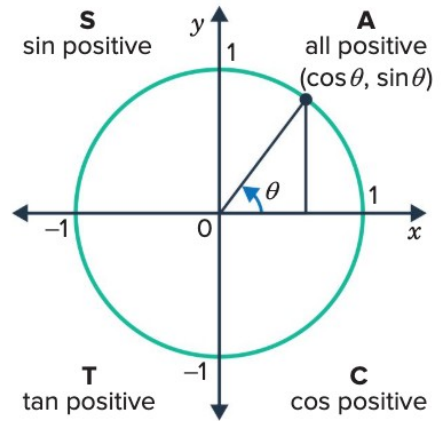
The CAST rule (also called ASTC) helps you identify which trigonometric functions are positive in each quadrant of the unit circle. This is essential for finding all solutions to a trigonometric equation within the restricted domain.
Important
The CAST Rule:
- Quadrant 1 (A): All trigonometric ratios are positive (cos , sin , tan all positive)
- Quadrant 2 (S): Only sin is positive
- Quadrant 3 (T): Only tan is positive
- Quadrant 4 (C): Only cos is positive
Note
How to use the CAST rule:
When solving :
- If is positive, solutions are in Quadrants 1 and 2
- If is negative, solutions are in Quadrants 3 and 4
Similar rules apply for and .
Example
Worked Example: Solving a basic equation
Problem: Solve for on .
Solution:
Write the equation:
Take the inverse cosine of both sides:
Evaluate:
Since is positive, is positive in Quadrants 1 and 4 (ASTC: A and C).
The reference angle is (Quadrant 1).
In Quadrant 4, the angle is:
Therefore, the solutions are .
Extended domain equations
Understanding periodicity
Trigonometric functions are periodic, meaning they repeat their values at regular intervals:
- and repeat every (or radians)
- repeats every (or radians)
Note
The periodic nature of trigonometric functions means that if is a solution, then (or ) is also a solution for sine and cosine. For tangent, (or ) is also a solution.
Solving equations in extended domains
To solve equations in domains beyond , such as or :
- First find all solutions in
- Then add or subtract multiples of (or ) to cover the extended domain
This process uses the periodic nature of trigonometric functions to identify all possible angles that satisfy the equation.
Example
Worked Example: Extended domain
Problem: Solve for on .
Solution:
Write the equation:
Take the inverse tangent of both sides:
Evaluate:
Since is positive, is positive in Quadrants 1 and 3 (ASTC: A and T).
In , solutions are (Quadrant 1) and (Quadrant 3).
Now add to each solution to cover :
The solutions are .
Quadratic trigonometric equations
What are quadratic trigonometric equations?
Some trigonometric equations can be rearranged into quadratic form in terms of a trigonometric function. For example, an equation like is quadratic in .
Note
Method for solving quadratic trigonometric equations:
- Substitute a variable (e.g., ) to convert to a standard quadratic equation
- Solve the quadratic using factorisation or the quadratic formula
- Find angles for each value of the variable using inverse functions and the ASTC mnemonic
- Ensure all angles are within the restricted domain
Example
Worked Example: Quadratic equation
Problem: Solve for on .
Solution:
Write the equation:
Substitute :
Using the quadratic formula to solve for :
Since , solve for where .
For :
For :
Since is negative, we take the angles in Quadrants 3 and 4 (where sine is negative).
The solutions are .
Checking your solutions
Important
Always verify your answers by substituting each value of back into the original equation. This helps catch any errors and confirms that all solutions satisfy the equation.
For example, checking in :
The solution is correct.
Summary
Key Points to Remember:
- Inverse functions help you find the principal angle, which is your starting point for finding all solutions
- The CAST rule tells you which trigonometric functions are positive in each quadrant, helping you identify where all solutions lie
- Periodicity allows you to extend solutions beyond by adding or subtracting multiples of the period ( or for sine and cosine, or for tangent)
- Quadratic trigonometric equations require substitution to convert them into standard quadratic form before solving
- Always verify your solutions by substituting them back into the original equation