Arc Length and Sector Area (HSC SSCE Mathematics Advanced): Revision Notes
📚Revision Notes
Arc Length and Sector Area
When working with circles, you'll often need to calculate measurements for parts of circles rather than complete circles. This note explains how to find the length of an arc and the area of a sector, which are essential skills in trigonometry.
Note
Learning Objectives: By the end of this note, you should be able to:
- Define and identify arcs and sectors in circles
- Calculate arc length using both degree and radian measures
- Determine sector perimeter and area
- Apply these formulas to solve real-world problems
Understanding arcs and sectors
Before diving into calculations, it's important to understand what arcs and sectors actually are.
Arc: An arc is a portion of a circle's circumference. It represents the curved path between two points on the circle's edge.
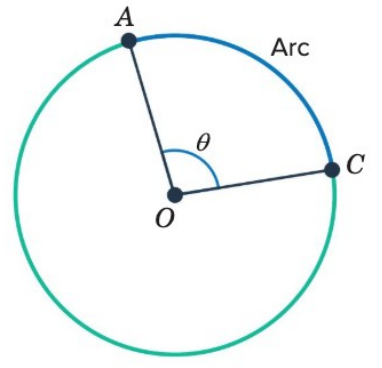
Arc length: The arc length measures the distance along the curved path of an arc. The formula for arc length depends on the radius of the circle and the central angle that the arc subtends (creates) at the centre. When the angle is measured in radians, the formula is:
where is the arc length, is the radius, and is the angle in radians.
Note
The radian formula is remarkably simple compared to the degree formula. This is one reason why radians are often preferred in mathematics and physics.
Sector: A sector is the region of a circle bounded by two radii and the arc between them. Think of it as a "slice of pie" cut from the circle.
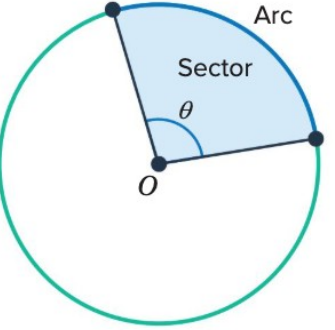
When no specific angle is mentioned, the terms minor arc and major arc distinguish between the shorter and longer arc lengths between two points, respectively.
Calculating arc length
To understand arc length formulas, first recall the basic circle formulas:
where is the circumference and is the area.
An arc is simply a fraction of the complete circumference. The fraction depends on the size of the central angle compared to a full rotation.
When the angle is in degrees
If the central angle is degrees, then the arc represents of the full circle (since one complete revolution is ). Therefore:
Note
Understanding the formula: This formula works because we're taking the fraction of the entire circumference. For example, a angle represents of the circle, so the arc length is one-quarter of the circumference.
When the angle is in radians
If the central angle is radians, then the arc represents of the full circle (since one complete revolution is radians). Therefore:
The radian formula simplifies beautifully to l = rθ, making it the preferred form in many calculations.
Important
Key Insight: When using radians, the arc length formula is simply . This elegant simplicity is why radians are the natural unit for angle measurement in mathematics. Always check whether your angle is in degrees or radians before applying a formula!
Calculating sector measurements
A sector is formed by two radii and the arc between them. Understanding its perimeter and area is crucial for many applications.
Sector perimeter
The perimeter of a sector includes the arc length plus the two radii that form its straight edges. Be careful when reading questions to determine whether you need the perimeter or just the arc length.
For in degrees:
For in radians:
Important
Common Mistake Alert: Students often forget to add the two radii when calculating perimeter. The perimeter is NOT just the arc length - you must include both straight edges (the two radii) as well!
Sector area
Similar to arc length, the area of a sector is found by taking the appropriate fraction of the complete circle's area.
For in degrees:
For in radians:
Again, the radian formula A = ½r²θ is simpler and often preferred.
Note
Pattern Recognition: Notice how all these formulas follow the same pattern - they all involve taking a fraction of the complete circle measurement. For degrees, the fraction is . For radians, it simplifies to much cleaner formulas.
Worked example 1: Circle with radius 10 cm
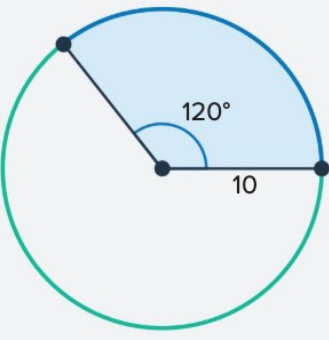
Consider a circle with radius 10 cm.
Example
Worked Example: Complete Sector Calculations
Part a: Determine the exact length of the arc subtended by the angle 120°
Strategy: Convert the angle to radians, then use the formula .
Working:
Converting to radians:
Write the formula:
Substitute and :
Part b: Determine the exact perimeter of the sector subtended by the angle 120°
Strategy: Substitute the angle in radians from part (a) into the formula .
Working:
Write the formula:
Substitute and :
Part c: Determine the exact area of the sector subtended by the angle 120°
Strategy: Substitute the angle in radians from part (a) into the formula .
Working:
Write the formula:
Substitute and :
Evaluate:
Worked example 2: Goat grazing problem
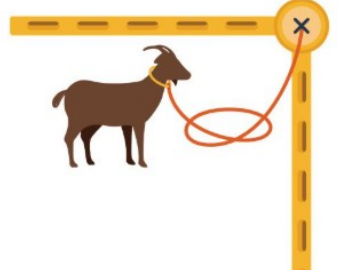
A goat is tethered to a corner of a fenced field. The rope is 9 m long. What area of the field can the goat graze over, rounded to two decimal places?
Example
Worked Example: Real-World Application
Strategy:
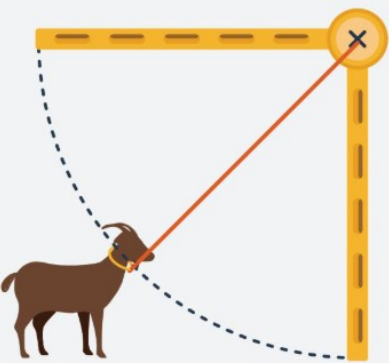
Notice that the angle at the corner of the fence is 90°. The area that the goat can graze over forms a sector with radius m and central angle .
Working:
Given the angle is and :
Write the formula:
Substitute and :
Simplify the fraction and evaluate :
Evaluate the multiplication:
Evaluate and round:
Answer: The goat can graze over an area of approximately 63.62 square metres.
Note
Real-World Connection: This type of problem appears frequently in practical situations involving fencing, landscaping, and agriculture. The key is recognizing that the grazing area forms a sector of a circle.
Worked example 3: Finding an unknown angle
The arc of a circle with radius 13 cm subtends an angle of at the centre of the circle, and measures 11.7 cm in length. Solve for , the angle subtended at the centre.
Example
Worked Example: Reverse Calculation
Strategy:
The arc length is given by , where is the angle at the centre measured in radians. In this case, we are given the arc length and the radius of the circle. We need to determine the value of .
Working:
Write the formula:
Substitute and :
Divide both sides by :
Evaluate and make the subject:
Answer: The angle subtended at the centre is 0.9 radians.
Note
Working Backwards: Sometimes you'll need to find an angle when given the arc length or sector area. Simply rearrange the appropriate formula to make the subject, as shown in this example.
Summary
Key Points to Remember:
-
An arc is a portion of a circle's circumference, while a sector is the wedge-shaped region bounded by two radii and an arc.
-
For angles in radians, use the simpler formulas: arc length and sector area .
-
For angles in degrees, use: arc length and sector area .
-
The perimeter of a sector includes the arc length plus two radii: (radians) or (degrees).
-
Always check whether your angle is in degrees or radians, and convert if necessary. Remember: radians.