Sine and Cosine Rules (HSC SSCE Mathematics Advanced): Revision Notes
📚Revision Notes
Sine and Cosine Rules
Learning objectives
Note
After studying this topic, you should be able to:
- Apply the sine and cosine rules to find unknown sides and angles in non-right-angled triangles
- Use the formula to calculate the area of a triangle
- Identify the ambiguous case of the sine rule and determine all possible solutions
- Choose the most appropriate rule to solve problems involving non-right-angled triangles
Sine rule and area of triangle formula
Understanding the sine rule
The sine rule is a formula that relates the sides of a triangle to the sines of its angles. It is particularly useful for solving problems involving non-right-angled triangles.
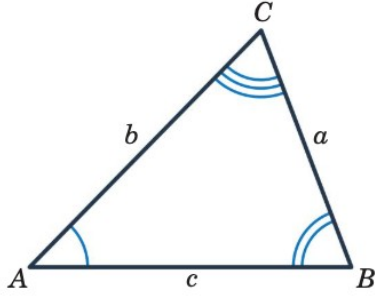
The sine rule states:
where:
- , , and are the lengths of the sides
- , , and are the angles opposite to sides , , and respectively
Note
The sine rule is used for non-right-angled triangles when you know:
- Two angles and one side (AAS or ASA), OR
- Two sides and a non-included angle (SSA)
Important
When using the sine rule, verify that the smallest angle faces the shortest side. This helps confirm your answer is reasonable.
Proof of the sine rule
To understand where the sine rule comes from, we can construct a proof using right-angled triangles.
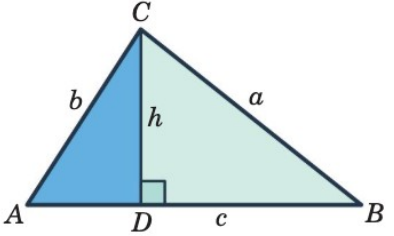
Consider a triangle with sides , , and opposite angles , , and respectively. We draw an altitude (perpendicular line) from vertex to the opposite side , meeting at point . This altitude, labelled , divides the triangle into two right-angled triangles.
Using the definition of sine in right-angled triangles:
In :
Therefore:
In :
Therefore:
Since both expressions equal , we can equate them:
In a non-degenerate triangle, and , so we can divide both sides by :
A similar argument can be applied by constructing an altitude from another vertex (for example, from to ), which gives:
Combining both results leads to the complete sine rule:
Note
This result holds for obtuse angles because .
Area of triangle formula
The area of a triangle can be calculated using two sides and the included angle between them.
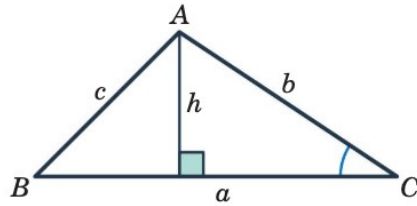
For a triangle with sides and about the angle , the area formula is:
where:
- is the area of the triangle
- and are the sides adjacent to angle
- is the included angle
Note
This formula is particularly useful because it doesn't require you to know the perpendicular height directly.
Proof of the area formula
Consider triangle with base (side ) and height from vertex .
The standard area formula for any triangle is:
In this triangle, the base is and the height is .
Substituting these values:
Similarly, depending on which base and height you use, the area can also be expressed as:
or
Summary of formulas
| Formula | Expression |
|---|---|
| Sine rule | |
| Area of triangle formula |
To apply the sine rule:
- Know one angle-side pair and either another angle (to find a side) or another side (to find an angle)
- Verify the smallest angle faces the shortest side
To compute area:
- Use two sides and the included angle
Example
Worked Example 1: Finding a side using the sine rule
Question: Find side in triangle , with , and , rounded to two decimal places.
Solution:
First, convert to decimal degrees:
Now apply the sine rule:
Check: Since , side should be shorter than , which satisfies.
Example
Worked Example 2: Calculating the area of a triangle
Question: Calculate the area of triangle with , and , rounded to two decimal places.
Solution:
Use the area of triangle formula with the given sides and included angle:
The area of the triangle is 82.79 square units.
Ambiguous case of the sine rule
What is the ambiguous case?
The ambiguous case in trigonometry refers to using the sine rule to calculate the size of an angle in a triangle where there are two possibilities for the angle, one obtuse and one acute. This leads to two possible triangles.
The ambiguous case occurs because, for an acute angle , we have:
This means that both an acute angle and its supplementary obtuse angle have the same sine value.
When does the ambiguous case occur?
The ambiguous case arises in SSA triangles (two sides and a non-included angle) when using the sine rule. In this configuration, may yield two possible angles for a solution.
For triangle with known , , and (acute), the ambiguous case occurs if:
Important
- No solution: (no possible triangle)
- One solution: or
- Two solutions: (two triangles possible)
Finding both solutions
When the ambiguous case produces two valid triangles, we calculate both angles using:
where:
- are the possible angles opposite side in triangle
- are the known side lengths in SSA configuration
- is the known angle in SSA configuration
Important
Always verify the triangle's angle sum () to confirm valid solutions.
Geometric construction of the ambiguous case
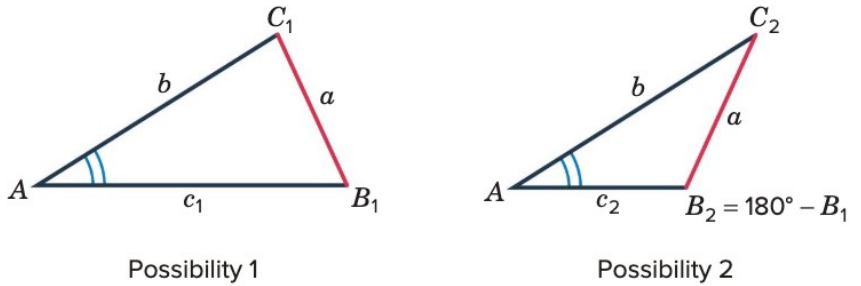
Fix and side at vertex . Draw side from point . Point can lie at two positions (), forming angles and , if .
This creates two different triangles:
- Possibility 1: Triangle with vertices , ,
- Possibility 2: Triangle with vertices , , where
Example
Worked Example 3: Finding all possible angles
Question: In triangle , find all possible given , and , rounded to one decimal place.
Solution:
First, apply the sine rule to find :
For the second solution, use the formula :
Now verify both solutions using the triangle sum:
Verify for :
Verify for :
Since both values produce valid angle sums, the possible values are or .
Check: The conditions and confirm the ambiguous case, supporting two valid triangles.
Cosine rule
Understanding the cosine rule
The cosine rule is a formula that relates the lengths of the sides of a triangle to the cosine of one of its angles.
where:
- is the side opposite to angle
- are the sides adjacent to angle
Note
The cosine rule applies to non-right-angled triangles when:
- Two sides and the included angle are known (SAS), OR
- Three sides are known (SSS)
Unlike the sine rule, the cosine rule does not have an ambiguous case, making it more straightforward in certain situations.
Finding sides and angles with the cosine rule
To find a side:
where:
- is the side opposite to angle
- are the sides adjacent to
To find an angle:
where:
- is the side opposite to angle
- are the other two sides
Proof of the cosine rule
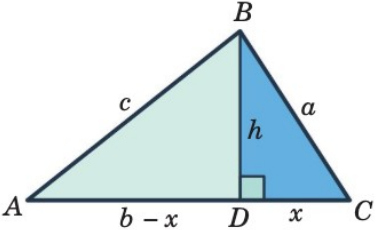
Consider a triangle with sides , , and opposite angles , , and respectively. To establish the cosine rule, we construct an altitude from vertex to the opposite side , intersecting at point . This altitude divides the triangle into right-angled triangles, and .
Let , so that .
Using Pythagoras' theorem:
In :
In :
Expanding the second equation:
Substituting from the first equation:
Simplifying:
In , which has a right angle at point , we know that:
since is the adjacent side and is the hypotenuse.
Therefore:
Substituting into our equation:
Thus, the cosine rule is given by:
Note
Applications:
- Two sides and included angle to find the opposite side
- Three sides to find an angle
Example
Worked Example 4: Finding a side using the cosine rule
Question: In triangle , find side given , and , rounded to two decimal places.
Solution:
Use the cosine rule to find side opposite to :
The length of side is 15.81 units.
Example
Worked Example 5: Finding an angle using the cosine rule
Question: In triangle , find given , and , rounded to one decimal place.
Solution:
Use the cosine rule to find opposite to side :
Check: Since is positive, is acute, consistent with .
Remember!
Summary
Key Points to Remember:
-
The sine rule finds sides or angles in non-right-angled triangles using:
-
The area of triangle formula uses two sides and the included angle.
-
The ambiguous case occurs in SSA triangles when , producing two possible angles: and . Always verify using the triangle sum .
-
The cosine rule is used when you have two sides and the included angle, or three sides: for finding sides, and for finding angles.
-
Choose the sine rule when you have angle-side pairs; choose the cosine rule when you have two sides with an included angle or three sides. The cosine rule has no ambiguous case.