Unit Circle (HSC SSCE Mathematics Advanced): Revision Notes
📚Revision Notes
Unit Circle
What is the unit circle?
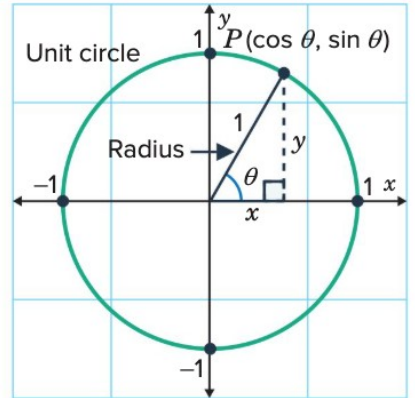
The unit circle is a circle with radius that is centred at the origin of the Cartesian coordinate plane. This special circle allows us to extend the definitions of trigonometric ratios beyond the constraints of right-angled triangles.
When we position a right-angled triangle at the origin of a coordinate plane with a hypotenuse of length , the trigonometric ratios can be expressed directly in terms of the coordinates and .
Note
The unit circle's radius of exactly 1 unit makes all calculations simpler because dividing by 1 doesn't change the value. This is why the coordinates become equal to the trigonometric ratios themselves.
Trigonometric ratios on the unit circle
For any right-angled triangle positioned on the unit circle, with the hypotenuse having length , the three basic trigonometric ratios are:
When we examine any right-angled triangle with hypotenuse of length , the endpoint of the hypotenuse lies on the unit circle. We measure angles from the positive -axis to the radius that extends to any point on the circle.
Coordinates on the unit circle
The angle is formed by rotating anticlockwise from the positive -axis. Since and , we can represent the coordinates of any point on the unit circle as:
The gradient of the line segment from the origin to point can be expressed using the ratio :
Therefore, , where represents the gradient.
Note
This relationship holds true in all four quadrants of the coordinate plane. The tangent ratio always represents the gradient of the radius line, whether positive or negative.
Worked example: Finding exact trigonometric values
Example
Worked Example: Finding exact trigonometric values
Question: The diagram shows an angle with its terminal side intersecting the unit circle at point .
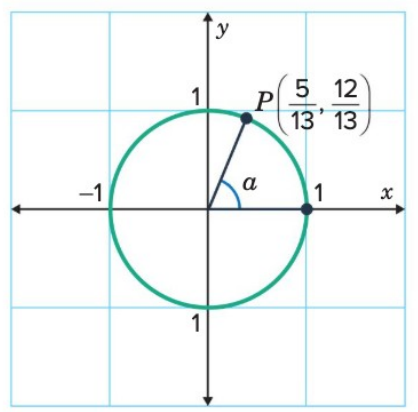
Determine the exact values of , , and .
Solution:
Part a: Finding
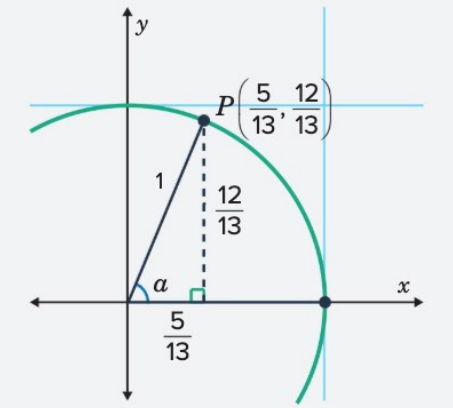
The value of equals the -coordinate of point .
We use .
Part b: Finding
The value of equals the -coordinate of point .
We use .
Part c: Finding
We calculate using the gradient formula .
Substituting and :
Signs of trigonometric ratios
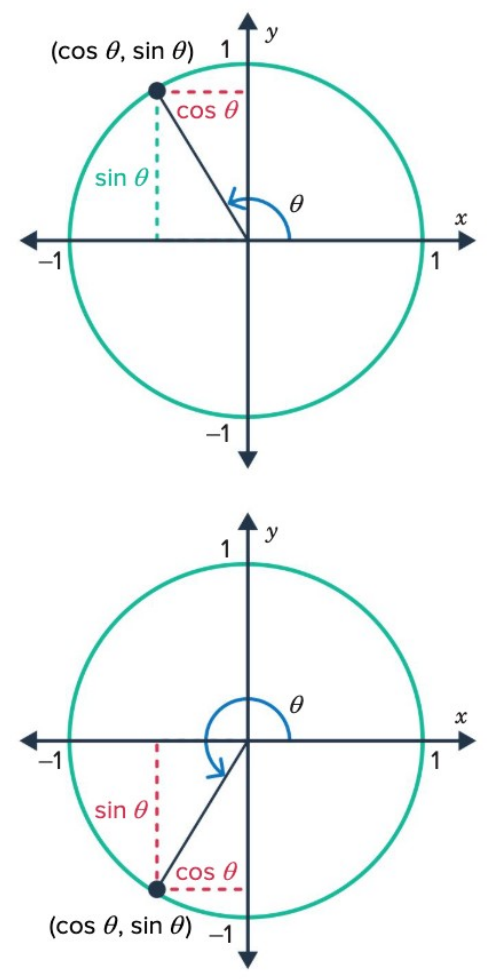
The unit circle demonstrates that , , and are defined for angles extending beyond what can be represented in a right-angled triangle. The sign (positive or negative) of each ratio depends on which quadrant the angle terminates in.
Important
Remember these key relationships:
- equals the -coordinate (height)
- equals the -coordinate (length)
- represents the gradient of the line from the origin to the point
Signs in each quadrant
Second quadrant:
- is positive, so is positive
- is negative, so is negative
- The gradient is negative, so is negative
Third quadrant:
- is negative, so is negative
- is negative, so is negative
- The gradient is positive, so is positive
Fourth quadrant:
- is negative, so is negative
- is positive, so is positive
- The gradient is negative, so is negative
The ASTC rule
A helpful mnemonic for remembering which trigonometric functions are positive in each quadrant is "All Stations To Central" (ASTC).
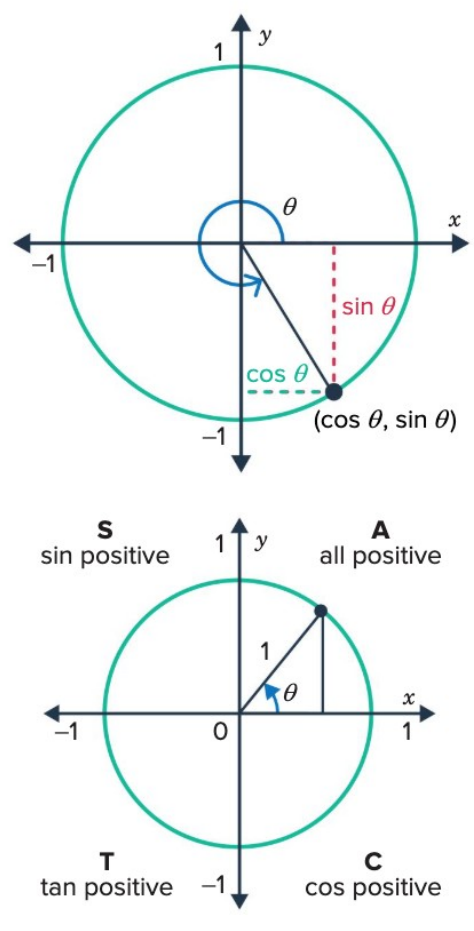
Important
The ASTC Rule:
- Quadrant 1: All ratios are positive (A)
- Quadrant 2: Only Sine is positive (S)
- Quadrant 3: Only Tangent is positive (T)
- Quadrant 4: Only Cosine is positive (C)
This mnemonic helps you quickly determine the signs of trigonometric ratios in each quadrant.
Worked example: Determining the sign of a ratio
Example
Worked Example: Determining the sign of a ratio
Question: Will have a positive or negative answer?
Solution:
First, identify which quadrant contains the angle.
The angle lies between and , placing it in Quadrant 3.
In Quadrant 3, both and coordinates are negative, so:
Therefore, will have a positive answer.
Verification: When the angle is drawn, the ray from the origin slopes upwards from left to right, confirming a positive gradient and thus a positive value for .
Trigonometric ratios for any angle magnitude
The unit circle extends the definitions of trigonometric ratios to include angles of any magnitude. This means we can evaluate , , and for positive angles, negative angles, and angles beyond .

For any point on the unit circle (where the radius ), rotated by angle anticlockwise from the positive -axis:
- (undefined when )
Note
These definitions apply to all angles, including negative angles (measured clockwise) and angles greater than .
Working with angles of any magnitude
We can represent angles of any magnitude by adding or subtracting multiples of :
where is an integer.
For negative angles, we rotate clockwise from the positive -axis. For example, is equivalent to rotating anticlockwise.
When the angle equals , it occupies the same position as , so its related angle is .
Worked example: Evaluating ratios for negative angles
Example
Worked Example: Evaluating ratios for negative angles
Question: Find the exact values of , , and .
Solution:
We need to reduce the angle to an equivalent angle between and by adding multiples of .
Reducing :
At , point is located at on the unit circle (on the negative -axis).
Therefore:
- (undefined)
Thus:
Verification: Rotating clockwise (which is full rotations) lands at , confirming our coordinates of .
Worked example: Finding coordinates for large angles
Example
Worked Example: Finding coordinates for large angles
Question: Determine the coordinates of point on the unit circle for , rounded to two decimal places.
Solution:
First, reduce the angle to fall within the interval by subtracting multiples of .
Reducing :
At (in Quadrant 1):
Therefore, the coordinates are .
Note: Since (two full rotations plus ), the point lands in Quadrant 1 with positive coordinates, confirming our result.
Remember!
Summary
Key Points to Remember:
-
The unit circle has radius and is centred at the origin, allowing us to express trigonometric ratios as coordinates.
-
Any point on the unit circle can be written as , where is the angle measured anticlockwise from the positive -axis.
-
The ASTC rule ("All Stations To Central") helps remember which ratios are positive:
- Quadrant 1: All positive
- Quadrant 2: Sine positive
- Quadrant 3: Tangent positive
- Quadrant 4: Cosine positive
-
For angles outside , reduce them by adding or subtracting multiples of using (where is an integer).
-
Negative angles represent clockwise rotation from the positive -axis.