Continuous Distributions (HSC SSCE Mathematics Advanced): Revision Notes
📚Revision Notes
Continuous Distributions
Introduction to continuous distributions
In a continuous probability distribution, the random variable can take any value within an interval on the number line. Unlike discrete distributions where we can list all possible values, continuous distributions have infinitely many possible values.
Key features of continuous distributions:
- The domain is typically a closed interval like
- There are infinitely many possible values within the interval
- The probability of any single specific value is exactly zero:
- Instead, we calculate probabilities over intervals:
Important
This fundamental difference means we cannot use the tabular methods from discrete probability distributions. Instead, we need to use cumulative frequency and integration techniques.
The cumulative distribution function
The cumulative distribution function (CDF) tells us the probability that a random variable is less than or equal to a particular value.
Definition: For a continuous random variable with values from a closed interval , the cumulative distribution function is:
Note
Properties of the CDF:
- is continuous
- is non-decreasing (never goes down)
- (probability at the start is zero)
- (probability at the end is one)
- Can be used to calculate medians, quartiles, and percentiles
Example: the chook problem
Example
Worked Example: The Chook Problem
A chook wanders randomly in a circular enclosure of radius 6 metres. We want to find the probability distribution for its distance from the centre.
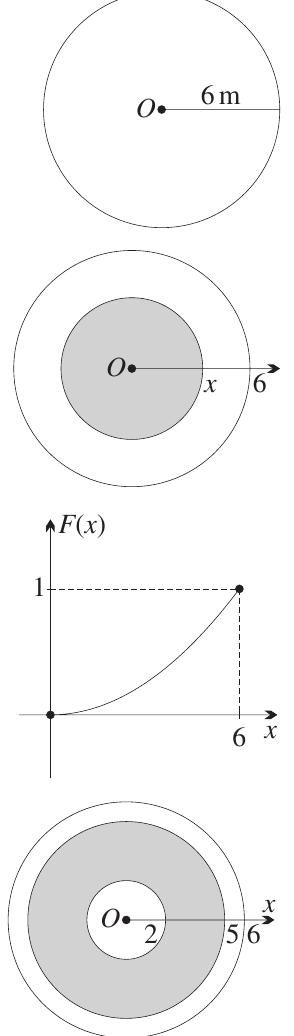
Let be the probability that the chook is no more than metres from the centre:
This function increases smoothly from to .
Using the CDF to find probabilities
We can find the probability of being in a range by subtracting CDF values:
Finding quartiles and median
To find quartiles and median, we solve for specific probability values:
Example
Worked Example: Finding Quartiles and Median
First quartile (): Set
Median (): Set
Third quartile (): Set
The probability density function
The probability density function (PDF) is obtained by differentiating the CDF. It represents the "density" of probability at each point.
From CDF to PDF
Since addition becomes integration in continuous distributions, the CDF is the integral of the PDF. By the fundamental theorem of calculus, the PDF is the derivative of the CDF:
Example
Worked Example: Finding the PDF
For our chook example:
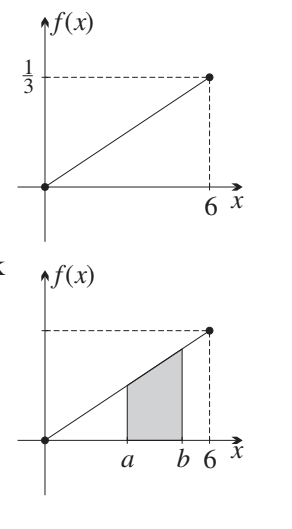
Interpreting the PDF
Important
The PDF does not give the probability at a specific point (which is always zero). Instead, it allows us to calculate probabilities over intervals by integration.
Key principle: The probability over an interval equals the area under the PDF curve:
Calculating probabilities using the PDF
Example
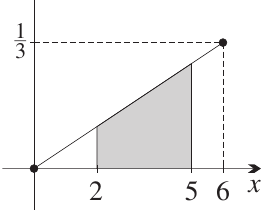
Worked Example 1: Probability the chook is 2-5 metres from centre:
Example
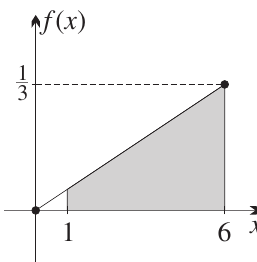
Worked Example 2: Probability the chook is at least 1 metre from centre:
Example
Worked Example 3: Total probability over entire domain:
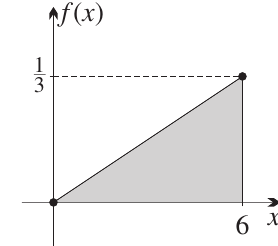
Properties of probability density functions
A function is a probability density function if it satisfies two conditions:
Note
Requirements for a Valid PDF:
1. Non-negative: for all in
2. Total area equals one:
These properties ensure that represents valid probabilities.
Additional concepts
Mode: A global maximum of the PDF is called a mode. It represents the most "dense" region of probability.
Important
Because for any specific value , it doesn't matter whether we use or in interval notation. The intervals and have the same probability.
The CDF as a signed area function
We can now formally define the relationship between PDF and CDF using integration.
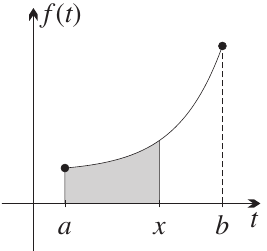
Given a PDF on domain , the CDF is the signed area function:
Conversely, (except possibly at isolated sharp corners).
Note
Remember: Be precise with terminology - "density" means at a point (PDF), and "distribution" means over a range (CDF).
Uniform continuous distributions
A uniform continuous distribution is one where the PDF is constant across the entire domain. This represents situations where all values in the interval are equally likely.
Properties of uniform distributions
For a uniform distribution on interval :
The constant value ensures the total area under the curve equals 1.
Example: train waiting time
Example
Worked Example: Train Waiting Time
Tran arrives at a station at a random time. Trains leave every 15 minutes. What is the probability distribution of his waiting time?
Solution:
The waiting time can be anything from 0 to 15 minutes. Since all waiting times are equally likely:
The CDF is found by integrating:
Finding the median:
Set :
Finding the 45th percentile:
Set :
Probability of waiting 5-10 minutes:
Either integrate the PDF or use the CDF:
Method 1 (using PDF):
Method 2 (using CDF):
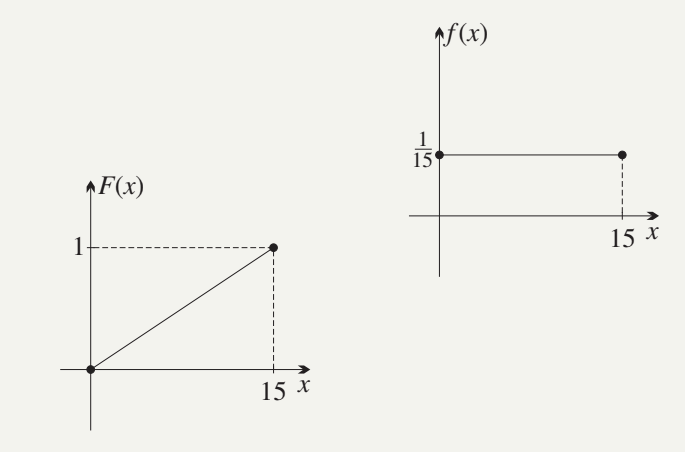
Piecewise-defined probability density functions
Some PDFs are defined differently on different parts of their domain. These require careful handling when integrating.
Example: a symmetric piecewise PDF
Example
Worked Example: Symmetric Piecewise PDF
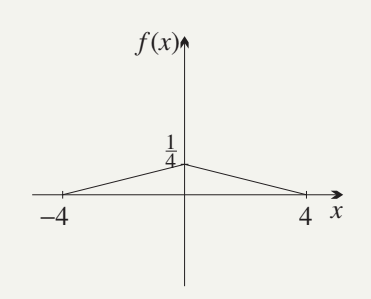
Consider the PDF:
Step 1: Find the constant
The total area under the curve must equal 1. We integrate over both pieces:
Setting this equal to 1:
Therefore:
Step 2: Calculate probabilities
To find , we only need the right-hand branch:
Step 3: Find median and mode
The median is 0 because the areas to the left and right of are equal.
The mode is also because this is where the PDF reaches its maximum value.
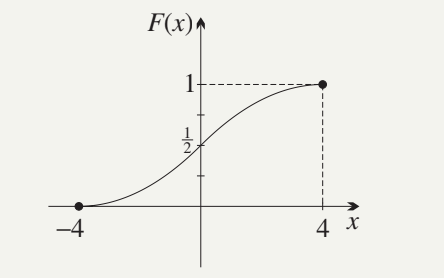
Step 4: Find the piecewise CDF
For :
For , we note that , then:
Distributions with unbounded domains
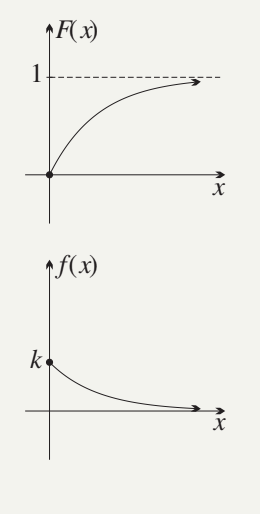
In many real-world situations, the PDF extends to infinity. This happens when there's a horizontal asymptote, meaning values can theoretically extend indefinitely (though with decreasing probability).
Example: radioactive decay
Example
Worked Example: Radioactive Decay
The isotope iodine-131 has a half-life of 8 days. If we observe a single nucleus, the time (in days) before it decays follows an exponential distribution.
Using the half-life property:
This leads to the CDF:
Finding the PDF:
Differentiate the CDF:
Domain: The domain is the unbounded interval because decay could theoretically occur at any time in the future.
Finding the median:
Set :
The median equals the half-life, as expected.
Calculating probabilities:
Probability of decay on first day:
Probability of decay after first day:
Improper integrals (challenge)
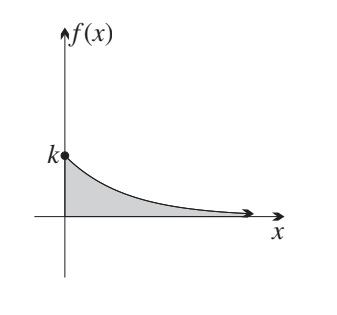
When the domain extends to infinity, we use improper integrals. These involve taking limits as we approach infinity.
Note
Verifying the PDF integrates to 1:
For on :
At : the value is
As : the limit of is
Therefore:
Example
Worked Example: Consider on
At : the value is
As : the limit is
Therefore:
This shows is a valid PDF on .
The CDF would be:
Important
Counter-example with :
As :
This integral does not converge, so cannot be a PDF on .
Key formulas summary
Summary
Key Formulas to Remember:
Cumulative distribution function:
Probability density function:
Properties of PDF:
- for all
Probability over an interval:
Uniform distribution on :
Remember!
Summary
Key Points to Remember:
- In continuous distributions, the probability of any single value is zero
- The CDF starts at 0 and ends at 1, and is always non-decreasing
- The PDF must be non-negative, and its total area must equal 1
- Probability equals area under the PDF curve
- "Density" refers to a point (PDF), "distribution" refers to a range (CDF)
- Quartiles and median are found by setting equal to , , and respectively