Areas of Compound Regions (HSC SSCE Mathematics Advanced): Revision Notes
📚Revision Notes
Areas of Compound Regions
Introduction to compound regions
When working with regions enclosed by multiple curves, you'll need to break down the problem into manageable sections before using integration to find the total area. This process is called dissection.
Drawing a clear, accurate sketch of the region is essential. The sketch helps you:
- Identify which curves form the boundaries
- Determine where curves intersect
- See which sections need separate calculations
- Understand which curve is "on top" in each region
Note
A well-drawn sketch is often the difference between solving the problem correctly and making a costly error. Take time to plot key points and label your curves clearly.
Finding areas under a combination of curves
Some regions are bounded by different curves along different parts of the -axis. In these cases, you need to calculate the area of each section separately, then add them together.
Example
Worked Example: Two parabolas meeting at a point
Question: The curves and intersect at . Find the area of the region bounded by these curves and the -axis.
Solution:
First, sketch both curves on the same axes. You can verify that lies on both curves by substitution.
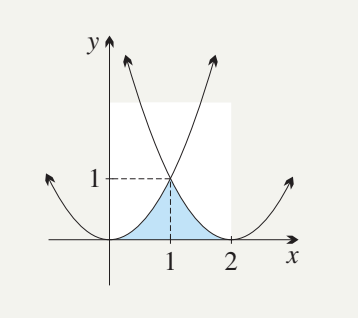
The complete region sits above the -axis, but we need to find the areas to the left and right of separately.
For the left section (bounded by ):
For the right section (bounded by ):
Combining both sections:
Total area square units
Note
The second parabola is the first shifted 2 units to the right. Because parabolas are symmetric about their axis of symmetry, both sections have equal area. This symmetry can sometimes be used as a check for your calculations.
Finding areas between two curves
When one curve lies completely below another curve in a given interval, you can find the area between them using a single integral.
The key formula
Important
If for all in the interval , then:
In simple terms: Integrate the top curve minus the bottom curve.
Critical condition: This formula assumes the curves don't cross within the interval. If they do cross, you'll need separate integrals for each section.
Example
Worked Example: Parabola and straight line
Question: Find the area between the curve and the line .
Part a: Find intersection points
Set the equations equal:
Therefore or
The curves intersect at (1, 1) and (4, 4).
Part b: Calculate the area
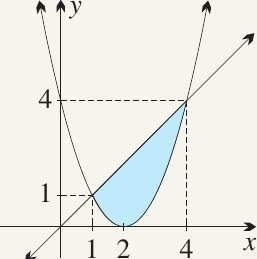
In the shaded region, the straight line sits above the parabola.
When the region crosses the x-axis
The formula for area between curves works even when the region crosses the -axis. Here's the same problem shifted down by 2 units.
Example
Worked Example: Region crossing the x-axis
Question: Find the area between the curves and .
Part a: Find intersection points
Set equations equal:
Therefore or
The curves intersect at (1, -1) and (4, 2).
Part b: Calculate the area
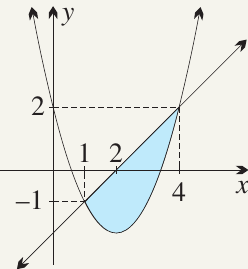
The line remains above the parabola throughout the interval.
Note
Notice the area is identical to the previous example! The formula automatically accounts for regions below the -axis. You don't need to treat areas above and below the axis separately when using this approach.
Finding areas when curves cross each other
Important
Critical Rule: When one curve is sometimes above and sometimes below another curve in the relevant interval, you must calculate separate integrals for each section. Otherwise, areas from different sections will cancel each other out, giving an incorrect (often zero) result.
When curves cross within the region of interest, identify all crossing points and split your calculation at each one. Calculate the area for each section where the relative positions of the curves remain constant, then add all sections together.
Example
Worked Example: Two parabolas that cross
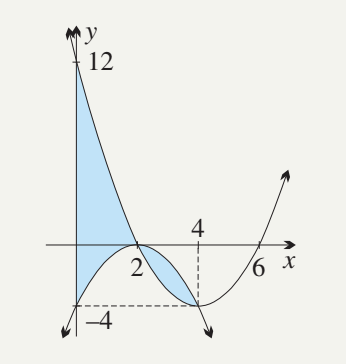
Question: The curves and meet at and . Find the shaded area between them.
Solution:
In the left-hand region (from to ), the second curve sits above the first.
Left area:
In the right-hand region (from to ), the first curve sits above the second.
Right area:
Total area square units
Exam tips
Note
Essential Strategies for Success:
- Always sketch the region first, even if the question doesn't explicitly ask for it
- Mark intersection points clearly on your sketch
- Check which curve is on top in each section
- When curves cross, split your calculation at the crossing point
- Use brackets carefully when subtracting one function from another
- Consider using technology to verify your sketch for complex problems
Summary
Key Points to Remember:
-
Sketch first: Always draw the region before calculating. This prevents costly errors and helps you understand the problem.
-
Top minus bottom: The area between two curves is found by integrating (top curve) − (bottom curve).
-
Multiple sections: When different curves form boundaries along different parts of the -axis, or when curves cross each other, calculate each section separately and add the results.
-
Crossing the x-axis: The formula works correctly even when the region crosses the -axis—you don't need to worry about regions below the axis.
-
Find intersections: Always solve for intersection points algebraically to get exact values for your integration limits.