The Fundamental Theorem of Calculus (HSC SSCE Mathematics Advanced): Revision Notes
📚Revision Notes
The Fundamental Theorem of Calculus
Introduction
The fundamental theorem of calculus provides a powerful method for evaluating definite integrals. This theorem connects two major concepts in calculus: differentiation (finding rates of change) and integration (finding areas). The connection between these seemingly different processes is remarkable and forms the foundation for much of calculus.
What is a primitive?
A primitive (also called an anti-derivative) is a function that reverses the process of differentiation.
Note
Definition: A function is called a primitive of a function if differentiating gives us .
In mathematical notation: is a primitive of if
Finding primitives of power functions
For any power function where , we can find the primitive using this rule:
If , then
where is a constant.
Memory aid: "Increase the index by 1 and divide by the new index."
Example
Finding a Primitive of a Power Function
If we want the primitive of :
- Increase the power from 2 to 3
- Divide by the new power (3)
- The primitive is
Important
This rule does not work when because it would require dividing by zero, which is undefined. We will learn how to handle this special case when studying logarithmic functions.
The fundamental theorem of calculus
Important
Statement of the Theorem:
Let be a function that is continuous in a closed interval . Then:
where is any primitive of .
What this means: To evaluate a definite integral, find any primitive of the function, substitute the upper limit, substitute the lower limit, and then subtract the second result from the first.
This theorem tells us that finding areas under curves and finding tangents to curves are inverse operations, even though this connection is not immediately obvious.
How to use the fundamental theorem
Notation
The standard way to show this working is to use square brackets:
The lower limit is written as a subscript and the upper limit as a superscript after the square bracket containing the primitive.
Basic examples
Example
Evaluate
Step 1: Find a primitive of
A primitive of is (because differentiating gives )
Step 2: Write in square brackets with limits
Step 3: Substitute upper limit (2), then lower limit (0), and subtract
Verification: This represents the area of a triangle with base 2 and height 4.
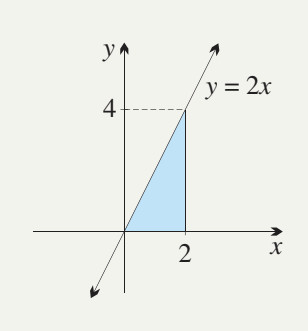
Area ✓
Example
Evaluate
Solution:
A primitive of is (take the primitive of each term)
This represents the area of a trapezium with parallel sides of length 1 and 5, and width 2.
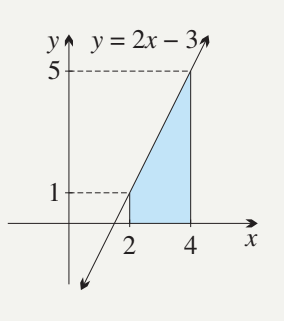
Area ✓
Working with polynomial functions
Evaluate these integrals:
a)
Solution:
Increase the index from 2 to 3, then divide by 3
b)
Solution:
Take the primitive of each term
Substitute :
Substitute :
c)
Solution:
Note: Never omit substituting 0, even though it often equals zero
Important
When the primitive contains two or more terms, always use brackets when substituting the upper and lower limits. This prevents errors in calculations.
Expanding brackets in the integrand
Important
Since there is no product rule for integration, we must expand brackets before finding the primitive.
Example
Expand the brackets then evaluate:
a)
Solution:
First expand:
b)
Solution:
Expand:
Note
Fractions commonly appear in definite integrals because of the division in the primitive formula. Take care with common denominators and simplifying fractions.
Writing the integrand as separate fractions
Important
Since there is no quotient rule for integration, when the integrand is a fraction with multiple terms in the numerator, we must split it into separate fractions.
Example
Write as separate fractions then evaluate:
a)
Solution:
Divide each term in the numerator by :
b)
Solution:
Divide both terms by :
Working with negative indices
The fundamental theorem works equally well with negative powers. However, we need to carefully convert between negative powers and fractions.
Example
Use negative indices to evaluate:
a)
Solution:
Increase the index from to , then divide by
Rewrite as before substituting
b)
Solution:
First rewrite as a negative power:
Increase the index to and divide by
Rewrite as a fraction before substituting
Why n = -1 is special
Important
The power rule for primitives does not work when because it would require division by zero:
This special case requires logarithmic functions, which you will study later.
Warning: do not integrate across an asymptote
Important
This is extremely important: You cannot integrate across a point where the function is undefined (has an asymptote).
Incorrect example:
Consider this calculation:
Following the usual method would give:
Why this is nonsense: The function has a vertical asymptote at . The function is not defined at , so we cannot integrate from to because this interval includes .
Additionally, since is always positive, how could the integral (which represents area) be negative?
Always check: Before integrating, check whether there are any asymptotes or discontinuities between the limits of integration.
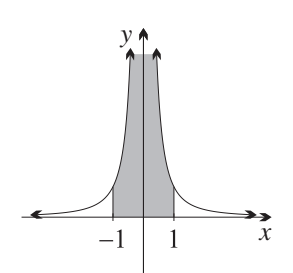
Remember!
Summary
Key Points to Remember:
-
A primitive of a function satisfies . Finding primitives reverses differentiation.
-
The fundamental theorem of calculus states that , where is any primitive of . This connects the processes of differentiation and integration.
-
To evaluate a definite integral: Find a primitive, write it in square brackets with limits, substitute the upper limit, substitute the lower limit, then subtract.
-
Expand brackets first when products appear (no product rule for integration), and split fractions when the numerator has multiple terms (no quotient rule for integration).
-
With negative indices: Convert between negative powers and fractions carefully. The rule works for all .
-
Never integrate across an asymptote where the function is undefined. Always check for discontinuities within the interval of integration.