Geometric Sequences (HSC SSCE Mathematics Advanced): Revision Notes
📚Revision Notes
Geometric Sequences
What is a geometric sequence?
A geometric sequence is a special type of sequence where each term relates to the previous term by multiplication. Consider this example:
Notice that each term is exactly times the previous term. This constant multiplier is called the common ratio.
The key feature of geometric sequences is that the ratio between any term and the term before it stays the same throughout the sequence. We can generate all terms by starting with the first term and repeatedly multiplying by this common ratio.
Note
Important terminology:
- Geometric sequence (also called a geometric progression or GP for short)
- Common ratio (): the constant value we multiply by to get from one term to the next
- First term (): the starting value of the sequence
Formal definition
In mathematical terms, when we talk about the ratio of successive terms in a sequence, we mean dividing any term by the previous term:
A sequence is called a geometric sequence if:
where is a non-zero constant called the common ratio.
We can also express this relationship in another useful way. Each term equals the previous term multiplied by the common ratio:
This is called the recursive formula because it defines each term based on the previous one.
Testing for geometric sequences
To determine whether a sequence is geometric, calculate the ratio between consecutive terms. If all these ratios are equal, the sequence is a GP.
Example
Worked Example: Testing for Geometric Sequences
Test whether each sequence is a GP. If it is, find the first term and the common ratio .
a)
Calculate the ratios:
All ratios equal , so this is a GP with and .
b)
Calculate the ratios:
The ratios are not all equal (), so this sequence is not a GP.
Formula for the nth term
Let's look at how a geometric sequence develops when the first term is and the common ratio is :
Important
Do you see the pattern? The power of is always one less than the term number. This gives us the general formula:
where:
- is the first term
- is the common ratio
- is the term number
This formula allows us to find any term in the sequence without calculating all the previous terms.
Example
Worked Example: Finding Terms Using the Formula
Write out the first five terms, and calculate the 10th term, of the GP with:
a) and
b) and
Solution:
a)
b)
Special properties of geometric sequences
Zero terms are impossible
Important
An important restriction: no term of a geometric sequence can be zero. Here's why: if , then the ratio would be undefined (we cannot divide by zero). This contradicts the definition that requires .
Similarly, the common ratio itself cannot be zero. If , then would equal zero, which we've just shown is impossible.
Negative ratios and alternating signs
When the common ratio is negative, something interesting happens. Consider this sequence:
Here, , which is negative. This causes the terms to alternate between positive and negative values. Each multiplication by the negative ratio flips the sign.
Example
Worked Example: Negative Common Ratio
a) Show that is a GP and find its first term and ratio .
b) Find a formula for the nth term, and hence find and .
Solution:
a) Calculate the ratios:
All ratios equal , so this is a GP with and .
b) Using the formula for the nth term:
For the sixth term:
For the fifteenth term:
Note: Since is even, (the negative signs cancel out in pairs).
Using a switch to alternate signs
Two useful sequences with ratio are:
These sequences act as "switches" that alternate between negative and positive. We can use them to write any alternating GP in a form that emphasises the sign pattern.
Note
For example, the sequence can be written as:
This separates the magnitude () from the alternating sign ().
Similarly, can be written as:
Solving problems involving geometric sequences
The nth term formula allows us to solve many practical problems by setting up and solving equations.
Example
Worked Example: Finding Specific Terms
a) Find a formula for the nth term of the geometric sequence
b) Hence find whether and are terms of this sequence.
Solution:
a) The sequence is a GP with and .
Using the formula:
b) To test if is in the sequence, set :
Since we get a whole number, is the seventh term ().
c) To test if is in the sequence, set :
But is not a power of , so is not a term of this sequence.
Example
Worked Example: Finding the Common Ratio
The first term of a GP is and the seventh term is . Find the common ratio and write out the first seven terms.
Solution:
From the given information:
This means .
We also know:
Using the formula for the seventh term:
Substituting :
This gives us two possible sequences:
If :
If :
Both sequences satisfy the given conditions.
Connection to exponential functions
Geometric sequences are closely related to exponential functions. Consider the exponential function:
If we substitute positive integers for , we get:
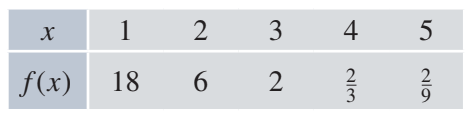
This produces the geometric sequence:
The formula for the nth term of this GP is:
Notice this is the same equation as the exponential function, just with the variable name changed from to .
Note
Key insight: A geometric sequence is simply the set of positive integer points on the graph of an exponential function. Just as arithmetic sequences correspond to linear functions, geometric sequences correspond to exponential functions.
Summary
Key Points to Remember:
-
A geometric sequence has a constant ratio between consecutive terms: divide any term by the previous term to find .
-
The nth term formula is , where is the first term and is the common ratio.
-
Zero cannot appear in a geometric sequence, and the common ratio cannot be zero.
-
A negative common ratio creates an alternating sequence where terms switch between positive and negative.
-
Geometric sequences are the discrete version of exponential functions - they represent exponential growth or decay at integer points only.