Surface Area of Cylinders and Spheres (HSC SSCE Mathematics Standard): Revision Notes
📚Revision Notes
Surface Area of Cylinders and Spheres
Understanding surface area
Surface area refers to the total area covering all the outer surfaces of a three-dimensional object. When calculating surface area, we add together the areas of each individual surface that makes up the solid shape. For cylinders and spheres, we use specific formulas depending on whether the shape is open or closed.
Note
Think of surface area as the amount of material you would need to completely wrap or cover an object. For example, the surface area of a cylinder tells you how much paper you'd need to cover it entirely.
Calculating surface area of cylinders
A cylinder is a three-dimensional shape with two parallel circular ends connected by a curved surface. The key measurements we need are:
- Radius (): the distance from the centre to the edge of the circular end
- Height (): the distance between the two circular ends
Important
Remember that if you're given the diameter, you must divide it by 2 to find the radius before using any formula.
Open cylinders
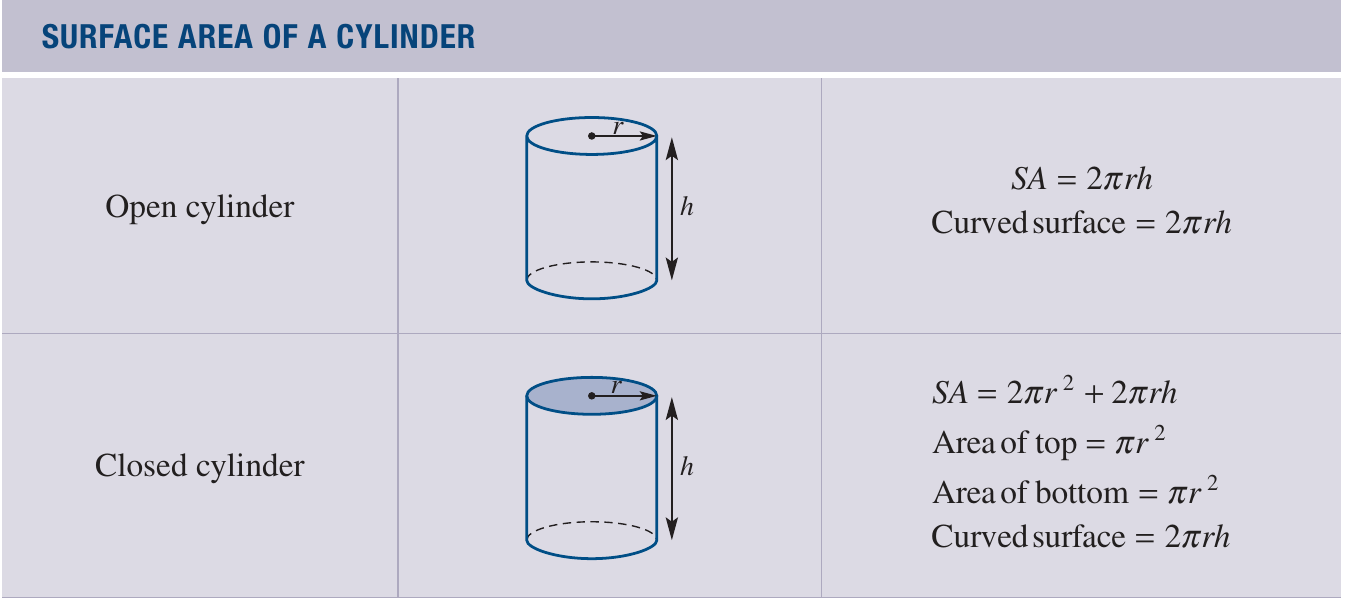
An open cylinder has only the curved surface, with no top or bottom circles. Think of it like a tube or pipe with both ends open.
Formula for open cylinder:
This formula calculates only the curved surface area.
Closed cylinders
A closed cylinder includes both circular ends (top and bottom) as well as the curved surface. This gives us the complete, total surface area.
Formula for closed cylinder:
Note
Understanding the formula breakdown:
This breaks down into three parts:
- Area of top circle:
- Area of bottom circle:
- Curved surface:
The term represents both circular ends combined!
Worked example: Finding the surface area of a cylinder
Example
Worked Example: Cylinder Surface Area Calculation
Problem: A closed cylinder has a diameter of mm and a height of mm.
Part a: Find the area of the curved surface.
Part b: Find the total surface area of this cylinder. Answer in square millimetres correct to two decimal places.
Solution:
Part a: Curved surface area
- First, identify what we know: diameter = mm, so radius mm, height mm
- Write the formula for the curved surface (open cylinder):
- Substitute the values:
- Calculate:
- Round to two decimal places: mm²
- Answer: The area of the curved surface is 5026.55 mm²
Part b: Total surface area
- Write the formula for a closed cylinder:
- Substitute the values:
- Calculate:
- Round to two decimal places: mm²
- Answer: The total surface area of the cylinder is 6635.04 mm²
Important
Common Mistake to Avoid:
Always check whether the question asks for curved surface area only (open cylinder) or total surface area (closed cylinder). Read the question carefully and identify which type is required!
Calculating surface area of spheres and hemispheres
A sphere is a perfectly round three-dimensional object, like a ball. A hemisphere is exactly half of a sphere. We need to know the radius () to calculate surface area.
Spheres
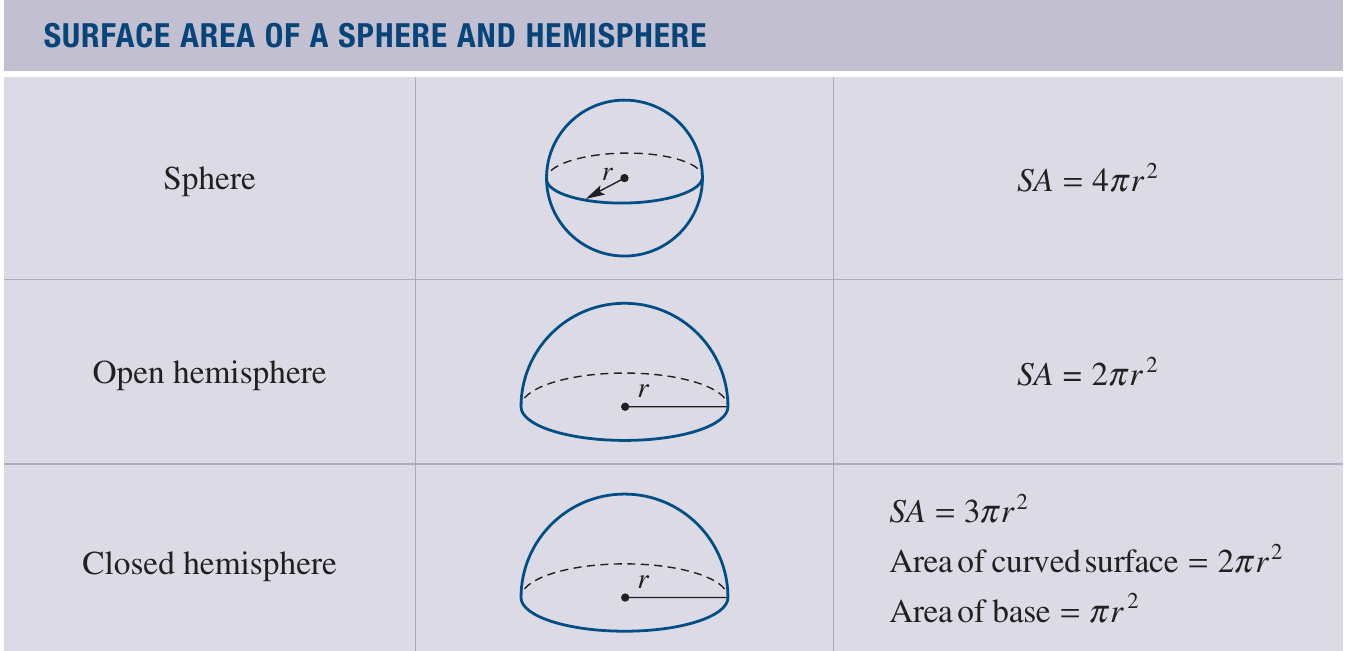
A complete sphere has a smooth, curved surface all around.
Formula for sphere:
Open hemispheres
An open hemisphere is half of a sphere with no flat base. It's like a dome shape.
Formula for open hemisphere:
Note
Notice this is exactly half the surface area of a complete sphere. Since a hemisphere is half a sphere, its curved surface area is also half!
Closed hemispheres
A closed hemisphere includes the curved surface plus the circular base at the bottom.
Formula for closed hemisphere:
This breaks down into two parts:
- Curved surface area:
- Area of circular base:
Worked example: Finding the surface area of a sphere
Example
Worked Example: Multiple Spheres
Problem: What is the total surface area of one dozen tennis balls? Each ball has a radius of cm. Answer correct to the nearest square centimetre.
Solution:
- Write the formula for the surface area of a sphere:
- Substitute the radius value:
- Calculate the surface area of one ball: cm²
- One dozen means balls, so multiply by : balls
- Calculate:
- Round to the nearest whole number: cm²
- Answer: The total surface area of 12 tennis balls is 1847 cm²
Important
Problem-Solving Strategy:
When working with multiple identical objects, calculate the surface area of one object first, then multiply by the total number of objects. This approach reduces calculation errors and makes your working clearer.
Remember!
Summary
Key Points to Remember:
Open vs Closed Shapes:
- Open shapes have no caps or bases (only curved surfaces)
- Closed shapes include all surfaces including flat ends or bases
Cylinder Formulas:
- Open cylinder: (curved surface only)
- Closed cylinder: (includes both circular ends)
Sphere and Hemisphere Formulas:
- Complete sphere:
- Open hemisphere:
- Closed hemisphere:
Essential Tips:
- Diameter to radius: Always divide the diameter by to get the radius before substituting into formulas
- Units matter: Express your final answer with the correct square units (mm², cm², m²) and round to the required decimal places as stated in the question