Tables and Tree Diagrams (HSC SSCE Mathematics Standard): Revision Notes
📚Revision Notes
Tables and Tree Diagrams
When you need to work out all possible outcomes for an experiment with multiple stages, tables and tree diagrams are your best tools. These organized methods help you visualize and count every possible result systematically.
Understanding multistage events
A multistage event is an experiment that involves two or more separate events happening in sequence. For example:
- Tossing a coin and then rolling a die
- Selecting three cards from a deck one after another
- Spinning a spinner twice
The key feature is that you're performing multiple actions, and you want to know all the possible combinations of results.
Note
Why Multistage Events Matter
In real-world probability problems, we often need to consider multiple events happening together. Understanding how to organize these outcomes systematically is essential for calculating probabilities accurately and avoiding missing any possible results.
What is a sample space?
The sample space is the complete set of all possible outcomes for an experiment. We usually write it using set notation with curly brackets. For instance, when tossing two coins, the sample space is .
Tables for multistage events
How tables work
A table arranges information in a grid with rows and columns. Each box (called a cell) in the table represents one possible outcome.
Here's how to construct a table for a multistage event:
- List all possible outcomes from the first event down the first column (the leftmost column)
- List all possible outcomes from the second event across the top row
- Fill in each cell by combining the outcome from its row with the outcome from its column
Important
Table Construction Rule: "First Down, Second Across"
Always place the first event's outcomes down the leftmost column and the second event's outcomes across the top row. This consistent approach helps you avoid confusion and ensures you don't miss any outcomes.
Example: Tossing two coins
Let's see how this works with a simple example of tossing two coins:
| Head | Tail | |
|---|---|---|
| Head | HH | HT |
| Tail | TH | TT |
The table shows there are four possible outcomes:
Notice that:
- The first coin's outcomes (Head, Tail) go down the left column
- The second coin's outcomes (Head, Tail) go across the top
- Each cell shows the combined result
Worked example: Card selection with replacement
Problem: Two red cards and one black card are placed in a box. Two cards are selected at random with replacement (this means you put the first card back before selecting the second one).
Example
Worked Example: Card Selection with Replacement
Part a: Construct a table to list the sample space.
Solution:
Step 1: List the outcomes of the first card selection down the first column.
The three possible outcomes are:
Step 2: List the outcomes of the second card selection across the top row.
The three possible outcomes are:
Step 3: Fill in each cell using the intersection of the row and column.
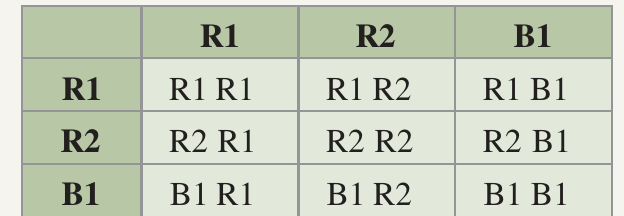
This table shows all nine possible outcomes when selecting two cards with replacement.
Part b: What is the probability of selecting or ?
Solution:
Step 1: Write the probability formula.
Step 2: Count the favourable outcomes.
Looking at the table, we can see that:
- appears once (top-left cell)
- appears once (middle cell)
- So there are 2 favourable outcomes
Step 3: Count the total outcomes.
The table has cells, so
Step 4: Calculate the probability.
Note
Understanding "With Replacement"
When selecting "with replacement", each selection is independent, so the same item can appear twice in your outcome. This is why and are possible outcomes. If we selected "without replacement", these outcomes would be impossible.
Tree diagrams for multistage events
How tree diagrams work
A tree diagram shows outcomes as branches that grow from left to right. Each stage of the experiment creates a new set of branches. The final outcomes (your sample space) are listed on the right-hand side.
Structure of a tree diagram
- Each stage of the experiment forms a new level of branches
- Each branch represents one possible outcome at that stage
- You follow a path along the branches to find each combined outcome
- The sample space is written down the right side where the branches end
Example: Tossing two coins
Let's look at the tree diagram for tossing two coins:
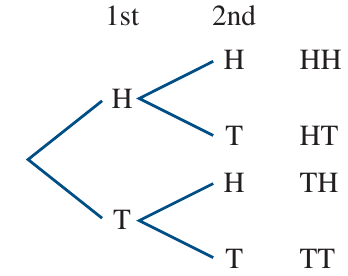
Reading this diagram:
- The first toss has two branches: (heads) and (tails)
- From each first toss outcome, two more branches show the second toss: or
- Following each complete path gives an outcome:
Note
Following the Path
To find any outcome in a tree diagram, simply trace along the branches from left to right. Each complete path from the starting point to an endpoint represents one possible outcome. Count all the endpoints to find the total number of outcomes.
Worked example: Coin and die
Problem: A coin is tossed and a die is rolled.
Example
Worked Example: Coin and Die
Part a: Construct a tree diagram of these two events to show the sample space.
Solution:
Step 1: Draw branches for the first event (tossing a coin).
Start with a single point on the left side of your page.
Step 2: A coin has two outcomes (head or tail), so draw two branches.
Label the upper branch and the lower branch .
Step 3: Draw branches for the second event (rolling a die).
From the end of each coin branch, you need to show the die outcomes.
Step 4: A die has six outcomes , so draw six branches from each coin outcome.
Draw six branches from and six branches from .
Step 5: List the sample space on the right-hand side.
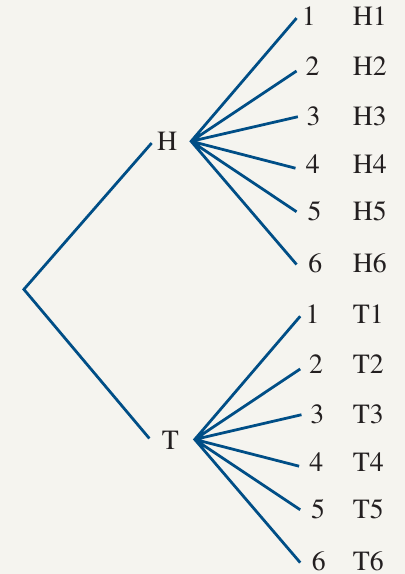
The complete sample space has 12 outcomes:
Part b: What is the probability of getting a head and a ?
Solution:
Step 1: Write the probability formula.
Step 2: Identify the favourable outcome.
We want (head and a one).
Looking at the tree diagram, occurs once, so
Step 3: Count the total number of outcomes.
From the tree diagram, the total number of outcomes is , so
Step 4: Calculate the probability.
Important
Counting Total Outcomes
Always count the total number of endpoints on your tree diagram to find . Each complete path through the tree represents exactly one outcome. This is your denominator in probability calculations.
Key tips for success
Note
Strategies for Tables and Tree Diagrams
For tables:
- Remember: first event goes down, second event goes across
- Each cell represents exactly one outcome
- Count the cells to find the total number of outcomes
- Tables work well when both events have a small number of outcomes
For tree diagrams:
- Draw your diagrams large and clear
- Label each stage of the experiment
- List all outcomes on the right-hand side
- Follow each complete path to identify an outcome
- Tree diagrams work well for any number of stages
General tips:
- Both methods give you the same sample space
- Choose whichever method feels clearer to you
- Always show your working clearly in exams
- Check your answer: does the number of outcomes make sense?
Summary
Key Points to Remember
-
Multistage events involve two or more separate events happening in sequence, like tossing a coin then rolling a die
-
Tables organize outcomes in rows and columns, with the first event down the left and the second event across the top
-
Tree diagrams use branches to show all outcomes, growing from left to right with the sample space listed on the right side
-
The probability formula is where is the number of favourable outcomes and is the total number of possible outcomes
-
Both methods help you find every possible outcome systematically, making it easier to calculate probabilities accurately