Constructing a Network Diagram Given an Activity Chart (HSC SSCE Mathematics Standard): Revision Notes
📚Revision Notes
Constructing a Network Diagram Given an Activity Chart
What is a network diagram?
A network diagram is a visual tool used in project management to show all the tasks needed to complete a project. It displays:
- The activities required to complete the project
- The time needed for each activity
- How different activities relate to each other
Note
In critical path analysis, network diagrams have a special structure. The activities are shown as arrows (edges), not as points. The vertices (nodes) are not labelled - only the arrows connecting them are labelled with activity names.
Understanding activity charts
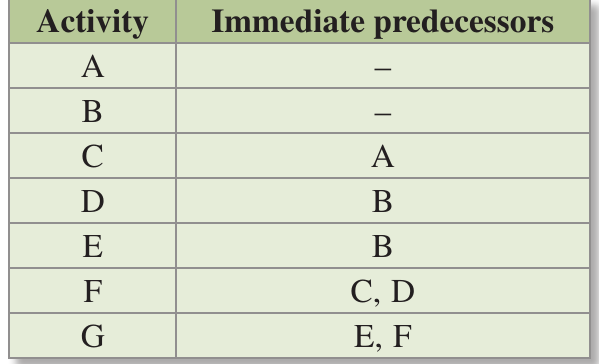
An activity chart is a table that lists all project activities and shows which activities must be completed before others can begin. These required activities are called immediate predecessors.
Here's what an activity chart looks like:
Note
Key terms:
- Activity: A task that needs to be completed as part of the project
- Immediate predecessor: An activity that must be finished before another activity can start
- "—" symbol: Indicates an activity has no immediate predecessors (it can start right away)
Rules for constructing network diagrams
When building a network diagram from an activity chart, follow these three important rules:
Important
Rule 1: Activities with no immediate predecessors start from the start vertex
Look for activities marked with "—" in the immediate predecessors column. These activities can begin immediately when the project starts. Draw arrows for these activities coming from the start node.
Important
Rule 2: Activities that are not immediate predecessors for any other activities lead to the finish vertex
These are the final activities in the project. Once these are complete, the entire project is finished. Draw arrows for these activities pointing to the finish node.
Important
Rule 3: For all other activities, identify:
- Which activities must be completed before this activity can start (its immediate predecessors)
- Which activities require this activity to be completed first (activities for which it is an immediate predecessor)
Method 1: Building from start to finish
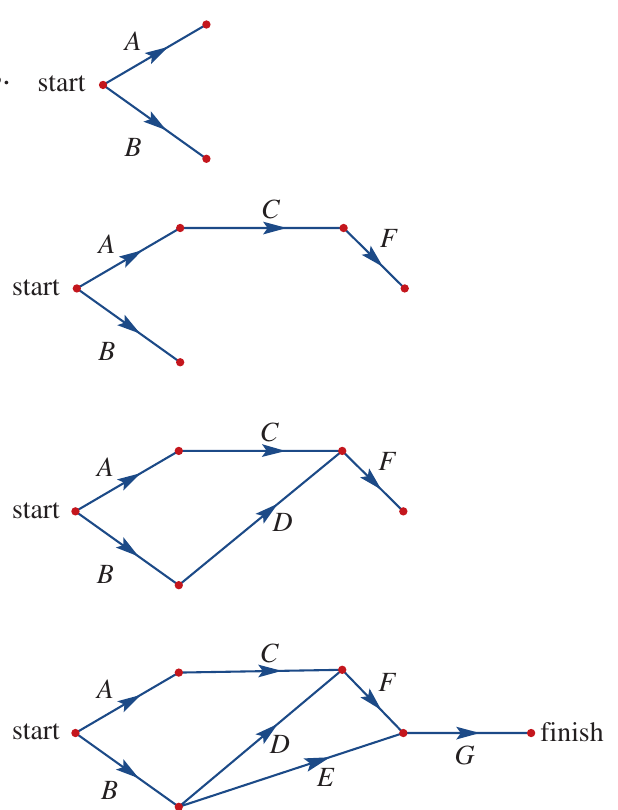
This method constructs the network diagram by beginning at the start vertex and working forward through the project. Let's work through an example step by step.
Example
Worked Example: Forward Construction Method
Step 1: Identify starting activities
- Activities A and B have no immediate predecessors (marked with "—")
- Both can start immediately
- Draw both activities as arrows coming from the start vertex
Step 2: Add activity C
- Activity A is an immediate predecessor of activity C
- Activity C must follow immediately after activity A
- Activity C is also an immediate predecessor of activity F
- Draw activity C following A, and note that F will follow C
Step 3: Add activity D
- Activity D has immediate predecessor B
- Activity D follows immediately after B
- Activity D is an immediate predecessor of activity F
- Activity F must come after both C and D are complete
Step 4: Add activities E and G
- Activity E has immediate predecessor B
- Activity E follows immediately after B
- Activity G requires both activities F and E to be completed first
- Activity G must follow after both activities converge
Step 5: Complete the diagram
- Activity G is not an immediate predecessor for any other activity
- This means G leads to the finish vertex
- The project is complete when activity G finishes
Method 2: Building from finish to start
An alternative approach is to start at the finish vertex and work backwards. This can be particularly helpful when a project has multiple paths that converge at the end.
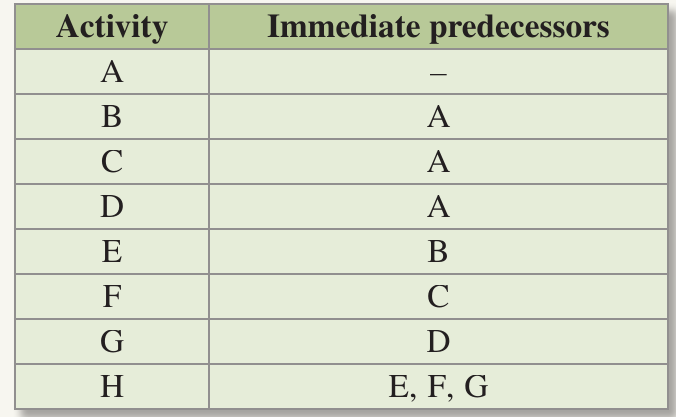
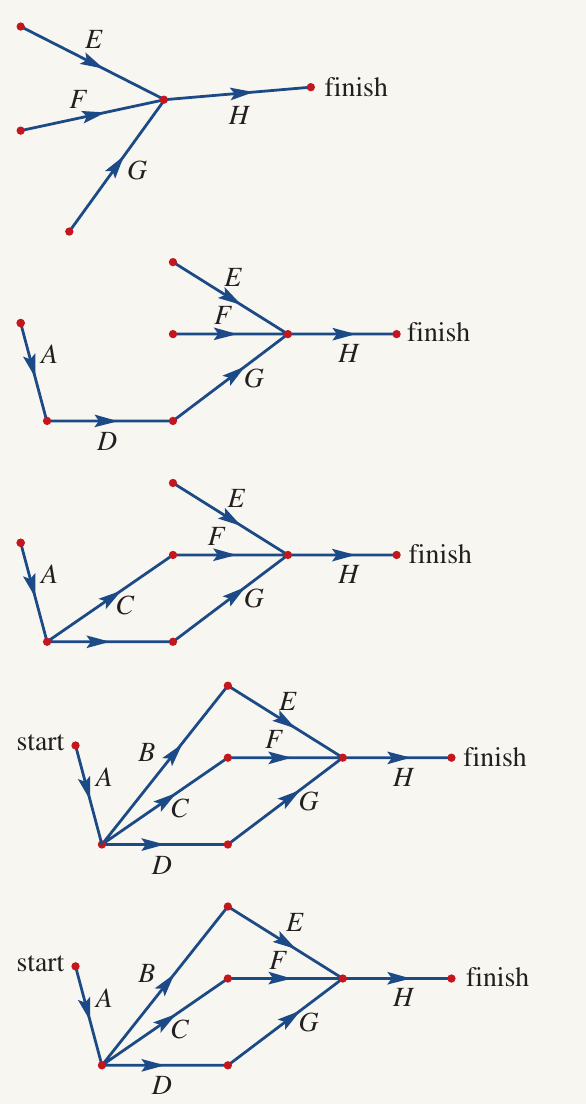
Here's a different example using the backward method:
Example
Worked Example: Backward Construction Method
Step 1: Identify the final activity
- Activity H is not an immediate predecessor for any other activity
- This means H is the last activity before the project finishes
- Draw H leading to the finish vertex
Step 2: Find what leads to H
- H has immediate predecessors E, F, and G
- All three activities must be completed before H can start
- Draw E, F, and G as three separate arrows leading into H
Step 3: Add the path through D and G
- Activity D is an immediate predecessor of G
- Activity A is an immediate predecessor of D
- Create a path: A → D → G
Step 4: Add the path through C and F
- Activity C is an immediate predecessor of F
- Activity A is an immediate predecessor of C
- Create a path: A → C → F
Step 5: Add the path through B and E
- Activity B is an immediate predecessor of E
- Activity A is an immediate predecessor of B
- Create a path: A → B → E
Step 6: Complete the diagram
- Activity A has no immediate predecessors
- A must be at the start of the project
- Connect A to the start vertex
Notice that activity A branches into three separate paths (B, C, and D), and all three paths eventually converge at activity H before reaching the finish.
Exam tips
Note
Tips for Success:
- Always check both columns: For each activity, check what it depends on AND what depends on it
- Look for branching: Multiple activities can share the same immediate predecessor
- Look for converging: Multiple activities can be immediate predecessors for the same activity
- Verify start and finish: Make sure only activities with no predecessors connect to start, and only activities with no successors connect to finish
- Draw neatly: Keep your diagram organised with clear, labelled arrows
Remember!
Summary
Key Points to Remember:
- Network diagrams show project activities as labelled arrows (edges), not as labelled points (vertices)
- Activities with no immediate predecessors begin at the start vertex - they can start right away
- Activities that don't lead to other activities end at the finish vertex - they're the final tasks
- You can build network diagrams in two ways: forward (from start to finish) or backward (from finish to start) - choose whichever feels more natural for the problem
- Every activity must connect properly: each activity must either come from the start, lead to the finish, or connect to other activities based on its immediate predecessors