Introduction to Critical Path Analysis (HSC SSCE Mathematics Standard): Revision Notes
📚Revision Notes
Introduction to Critical Path Analysis
What is critical path analysis?
Critical path analysis is a project management technique that helps you plan and complete complex tasks efficiently. It works by:
- Identifying all the activities needed to complete a project
- Determining how long each activity will take
- Understanding the relationships between activities
- Predicting whether the project will finish on time
This technique is essential for managing large projects where many tasks depend on each other. For example, when building a house, you cannot plaster the walls until the house is sealed from the weather. When organising a wedding, you cannot finalise table seating until guests have accepted their invitations.
Note
Critical path analysis is particularly valuable in construction, event planning, software development, and manufacturing industries where timing and task dependencies are crucial for project success.
Activity charts
What is an activity chart?
An activity chart (also called a precedence table) is a systematic way to organise information about a project. It displays all the activities required for a project in a table format with four key columns:
- Activity: A letter label (A, B, C, etc.) for each task
- Task: A description of what needs to be done
- Duration: How long the activity takes to complete
- Immediate predecessors: Which activities must be completed before this activity can begin
Important
The four columns of an activity chart work together to provide a complete picture of your project. Missing information from any column can make scheduling impossible.
Simple examples of activity charts
Let's look at some everyday projects to understand how activity charts work.
Project 1: Making a phone call

This simple project has four sequential activities. Each activity must be completed before the next one can begin. Activity A has no predecessor (shown by the dash), meaning it can start immediately.
Note
A dash (–) in the immediate predecessors column indicates that an activity can begin right away without waiting for any other activities to complete.
Project 2: Making old-style lemonade
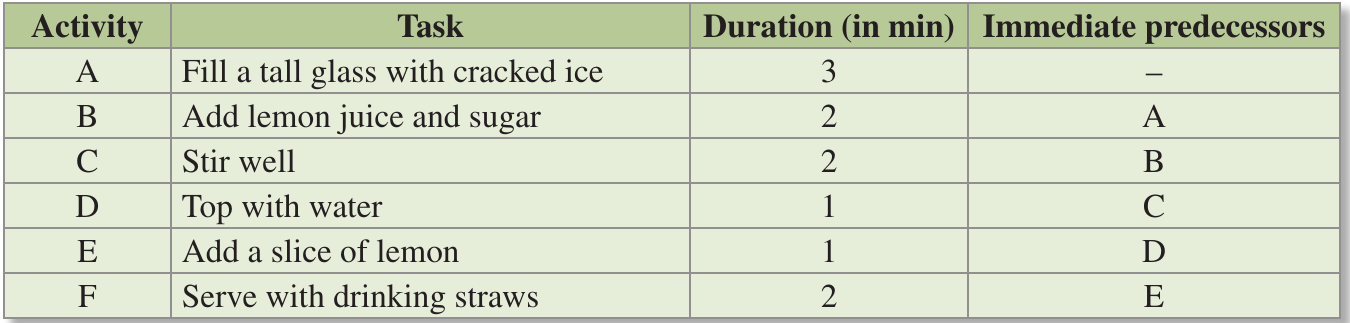
This project involves six activities that must be completed in order. Notice how each activity depends on the completion of the previous one, creating a clear sequence from start to finish.
Immediate predecessors and scheduling
Understanding immediate predecessors
An immediate predecessor is an activity that must be finished before another activity can start. Here are the key points to understand:
- If Activity A must be completed before Activity B can begin, then Activity A is an immediate predecessor of Activity B
- Some activities have no immediate predecessors (marked with a dash), meaning they can start right away
- Some activities can have multiple immediate predecessors, meaning several activities must all be completed before the next one can begin
Important
When an activity has multiple immediate predecessors, ALL of those activities must be finished before the next activity can begin. This is a common source of confusion in exams.
What is scheduling?
Scheduling is the process of allocating time to complete activities in a project. A time schedule shows:
- The duration of each activity
- The order in which activities must be completed
- Which activities depend on others
Example: Sandra's morning routine
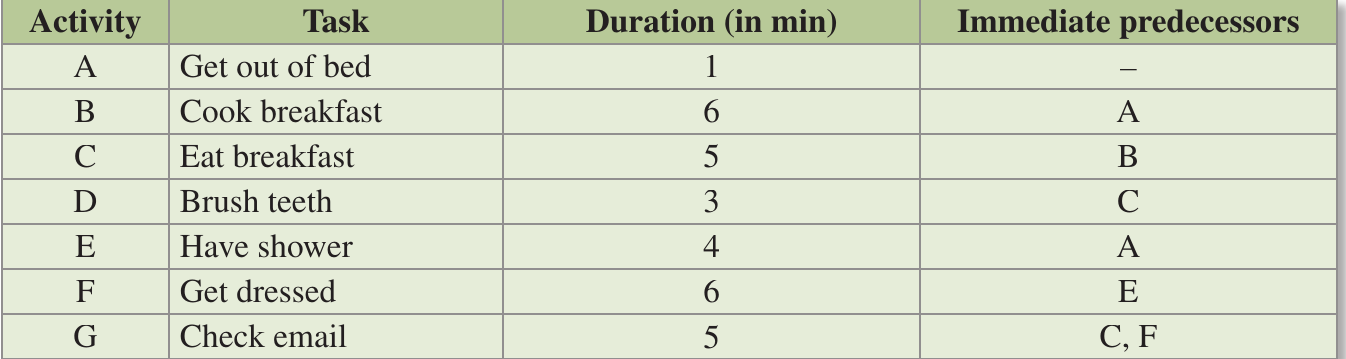
In this example, notice that Activity G (check email) has two immediate predecessors: C and F. This means Sandra cannot check her email until she has both eaten breakfast (C) and gotten dressed (F). This is an example of multiple immediate predecessors.
Worked example 1: Constructing an activity chart
When you need to create an activity chart, follow these steps systematically.
Example
Worked Example: Catching a Train
Project description: Suppose you have these unsorted tasks:
- Wait for train (8 minutes)
- Go to the correct platform (2 minutes)
- Scan your Opal card (1 minute)
- Board the train (1 minute)
- Travel to the train station (5 minutes)
Step 1: Analyse the tasks and sort them into logical order
The correct sequence is:
- Travel to the train station
- Scan your Opal card
- Go to the correct platform
- Wait for train
- Board the train
Step 2: Create the activity chart
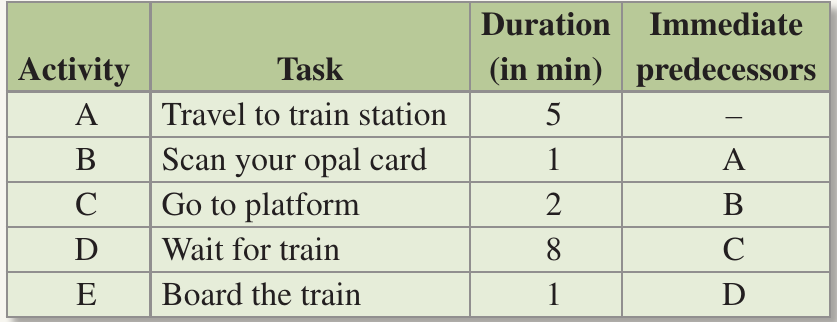
Key steps in constructing an activity chart:
- Draw a table with four columns: Activity, Task, Duration, Immediate predecessors
- Label activities with letters (A, B, C, etc.) in sequential order
- Write the sorted tasks in the task column
- Record the duration for each activity
- Determine which activity must come before each one (the immediate predecessor)
- Use a dash (–) for activities with no predecessors
Note
When constructing activity charts, always think about the logical order of tasks. Ask yourself: "What must I complete before I can start this task?" This will help you identify immediate predecessors correctly.
Worked example 2: Reading an activity chart
Being able to interpret activity charts is just as important as creating them.
Example
Worked Example: Creating a Garden Patio
Joshua wants to create a patio in his garden. Here is his activity chart:
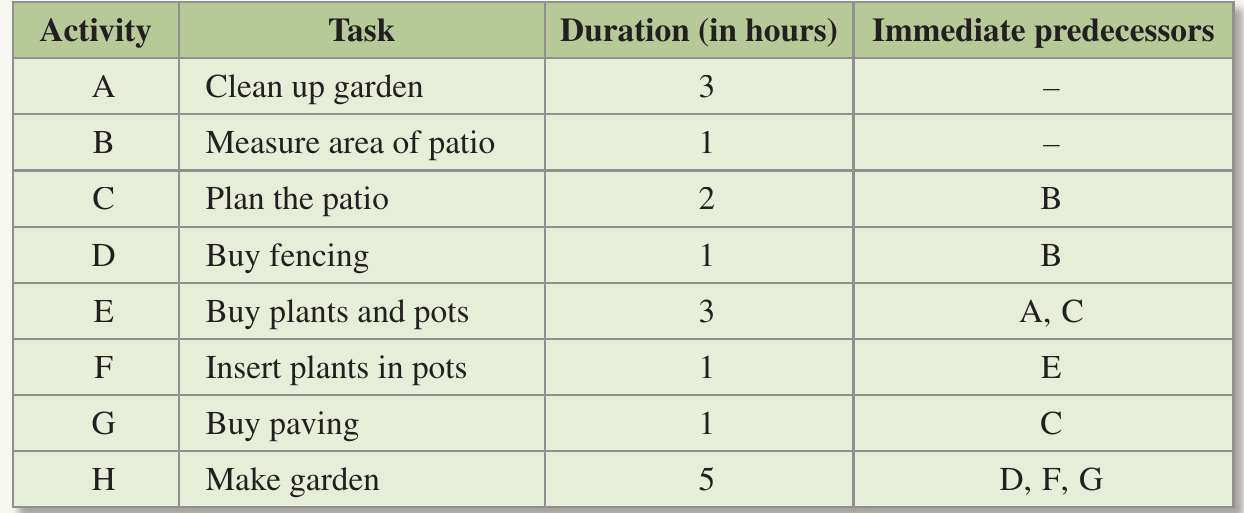
Notice that Activity A (clean up garden) is an immediate predecessor of Activity E (buy plants and pots) because it determines how many plants are needed to fill the space.
Questions and answers:
a) How many activities in the project?
- Count the activities from A to H
- There are 8 activities
b) What are the first activities?
- Look for activities with no immediate predecessors (marked with –)
- Activities A and B are the first activities
c) Which activity has the longest time interval?
- Find the largest number in the duration column
- Activity H (make garden) takes 5 hours
d) What is the total time for Joshua to complete this project?
- Add all the durations: hours
e) What is the immediate predecessor for Activity C?
- Look at the immediate predecessors column for Activity C
- Activity B is the immediate predecessor
f) What is the immediate predecessor for Activity G?
- Look at the immediate predecessors column for Activity G
- Activity C is the immediate predecessor
g) Why are there three immediate predecessors for Activity H?
- Activity H cannot be completed until Joshua has all the materials
- He needs fencing (D), plants in pots (F), and paving (G)
- All three must be ready before he can make the garden
Important points when reading activity charts:
- Activities with no immediate predecessors can start immediately
- Some activities can run in parallel if they don't depend on each other (like Activities A and B in Joshua's project)
- The total time shown in the duration column is NOT necessarily the project completion time (we'll learn about this in later topics)
- Multiple immediate predecessors mean ALL those activities must be complete before the next one can begin
Important
Common Mistake: Students often confuse "total duration" with "project completion time." The total duration is simply the sum of all individual activity times, but the actual project completion time depends on which activities can run in parallel. These are different concepts!
Exam tips
Important
Exam Success Tips:
- Always check the immediate predecessors column carefully when answering questions
- Remember that a dash (–) means no predecessors
- When constructing an activity chart, think logically about which tasks must come first
- Don't confuse "total duration" with "project completion time" – they are different concepts
- Pay attention to activities with multiple predecessors
Remember!
Summary
Key Points to Remember:
- Critical path analysis is a technique for planning projects by identifying activities, their durations, and relationships between them
- Activity charts organize project information with four columns: Activity, Task, Duration, and Immediate predecessors
- Immediate predecessors are activities that must be completed before another activity can begin
- Scheduling is the process of allocating time to activities in a project
- Activities can have multiple immediate predecessors, meaning several activities must all be finished before the next one can start
- Always work through activity charts systematically, checking each column carefully