Area of a Triangle (HSC SSCE Mathematics Standard): Revision Notes
📚Revision Notes
Area of a Triangle
Introduction
When working with triangles that don't have a right angle, we can still calculate their area using a special formula. To use this method, you need to know two sides of the triangle and the angle between them (called the included angle).
Note
The included angle is the angle that lies between the two sides you're using in your calculation. This is a crucial concept when applying the area formula for non-right-angled triangles.
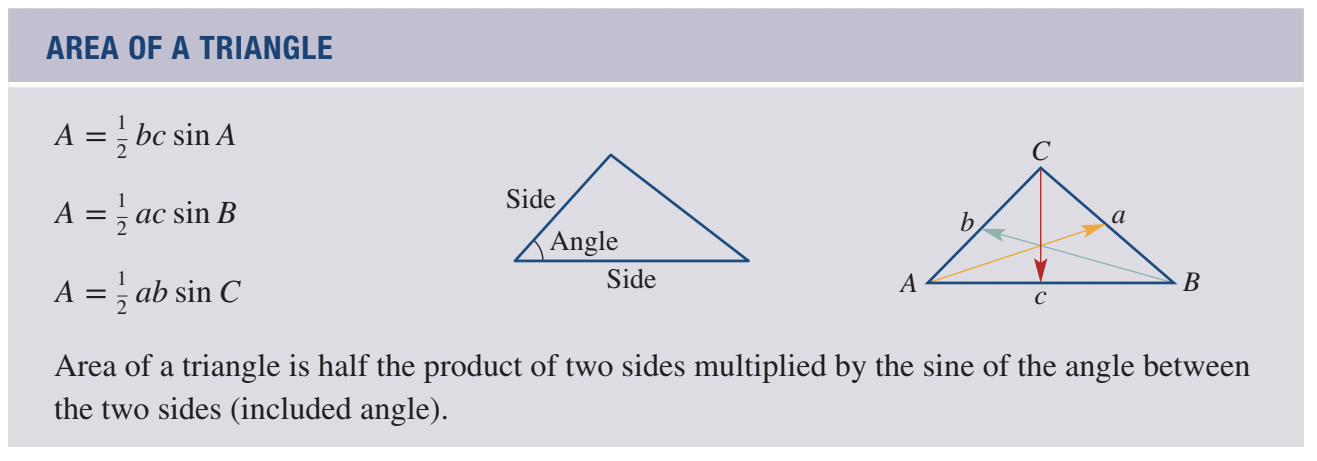
The key principle is: the area of a triangle equals half of the product of two sides multiplied by the sine of the angle between those sides.
Deriving the formula
To understand where this formula comes from, we start by drawing a perpendicular line from one vertex to the opposite side. This creates a right-angled triangle within our original triangle.
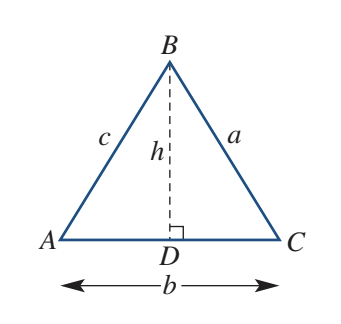
Starting with the basic area formula:
where is the perpendicular height.
In the right-angled triangle , we can use the sine ratio:
Rearranging this gives us:
Now we substitute this expression for into the area formula:
Note
By constructing perpendiculars from different vertices, we can derive similar formulas for the other combinations of sides and angles. This is why there are three equivalent versions of the area formula.
The three area formulas
There are three equivalent ways to express the area formula, depending on which two sides and included angle you know:
Important
In each formula, the angle must be the one between the two sides you're using. This is called the included angle. Using the wrong angle will give you an incorrect result!
Using the formula - a worked example
Example
Worked Example: Finding the Area of a Triangle
Let's find the area of a triangle with sides of cm and cm, with an included angle of .
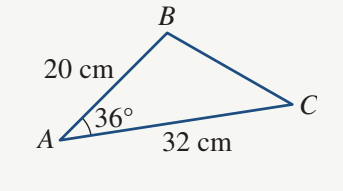
Given information:
- Two sides: cm and cm
- Included angle:
Step 1: Identify which formula to use.
Since we have sides and with the included angle , we use:
Step 2: Substitute the known values.
Step 3: Calculate the result.
Step 4: Round to the appropriate precision.
Answer: The area of the triangle is 188 square centimetres (to the nearest square centimetre).
Exam tips
Note
Tips for Success:
- Always check that the angle you're using is between the two sides you've chosen
- Make sure your calculator is in degree mode when calculating sine values
- Label your triangle clearly with the letters , , for vertices and , , for opposite sides
- Remember that the formula only works when you have two sides and the included angle - this is sometimes called the SAS (Side-Angle-Side) case
Remember!
Summary
Key Points to Remember:
- The area of a non-right-angled triangle can be found using:
- You must know two sides and the angle between them (the included angle) to use this formula
- There are three versions of the formula: , , and
- The formula is derived by using the sine ratio in a right-angled triangle created by drawing a perpendicular height
- Always ensure your calculator is in degree mode and round your final answer appropriately