Perimeter, Area, and Volume (HSC SSCE Mathematics Standard): Revision Notes
📚Revision Notes
Perimeter, Area, and Volume
Introduction to aerial measurements
Aerial photographs, like those from satellite imaging services, provide a fast and efficient way to measure land without physically visiting the site. These overhead views allow us to calculate perimeter, area, and volume using mathematical scales and formulas.
Note
This approach saves time and gives accurate results for land surveying, construction planning, and property assessment. You can measure large areas of land from your computer without the need for physical site visits.
Understanding perimeter from aerial views
Perimeter is the total distance around the boundary of a shape or piece of land. When working with aerial photographs, we can determine perimeter without walking around the property with a measuring tape.
Steps to find perimeter using aerial photographs
- Step 1: Identify and mark the borders of the land area you want to measure
- Step 2: Access the aerial photograph using online mapping tools
- Step 3: Use digital tools to click along the perimeter points of the land
Calculating perimeter with scale
To find the actual perimeter from an aerial photograph, multiply the measured length on the image by the scale factor. The scale tells us the relationship between distances on the photograph and real-world distances.
Important
Formula: Real distance = Photo measurement × Scale factor
Always ensure your measurements are in the same units before applying the scale. Convert to centimetres or metres first to avoid calculation errors.
Example
Worked Example 16: Calculating distance using a scale
An aerial view shows a Olympic swimming pool outlined with measurement tools.
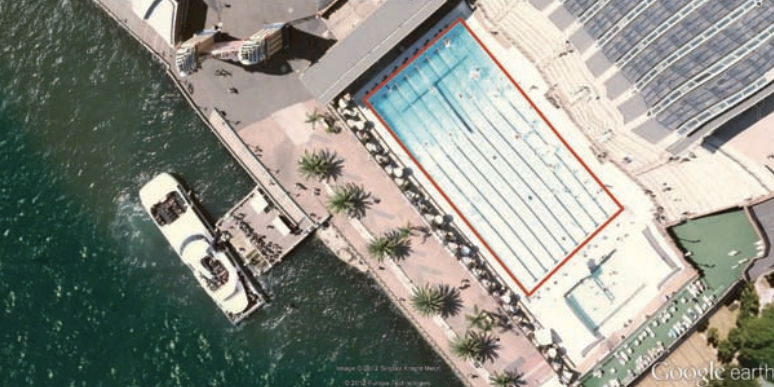
Part a: What is the scale used on the image?
Part b: Use the scale to determine the length of a boat in the image.
Solution:
Part a:
- Measure the length of the swimming pool on the image
- Swimming pool length on photo =
- We know the actual pool length = =
- Express as a ratio: :
- Simplify by dividing both sides by :
- :
- :
- Scale is
Part b:
- Measure the boat length on the photograph
- Boat length on photo =
- Multiply by the scale factor
- Real boat length =
- Real boat length =
- Convert to metres:
- Round to appropriate precision:
- The boat is metres long
Exam tip: Always check that your measurements are in the same units before calculating the scale. Convert everything to the same unit (usually centimetres or metres) to avoid errors.
Understanding area from aerial views
Area measures the surface size of a shape or piece of land in square units (like square metres, ). Aerial photographs allow us to calculate land area using two different approaches.
Methods for finding area
Method 1: Estimation using grids
Overlay a square grid on the aerial photograph and count how many squares the land covers. This gives an approximate area.
Method 2: Exact calculation using formulas
For more precision, use geometric formulas. Break complex shapes into simpler forms like rectangles, triangles, and trapezoids. Calculate each section's area separately, then add or subtract as needed.
Note
For composite shapes (shapes made from multiple simple shapes combined):
- Divide the shape into recognizable geometric forms
- Measure the dimensions of each part using the scale
- Calculate the area of each section using appropriate formulas
- Combine the areas (add or subtract) to find the total
Example
Worked Example 17: Calculating the area of land
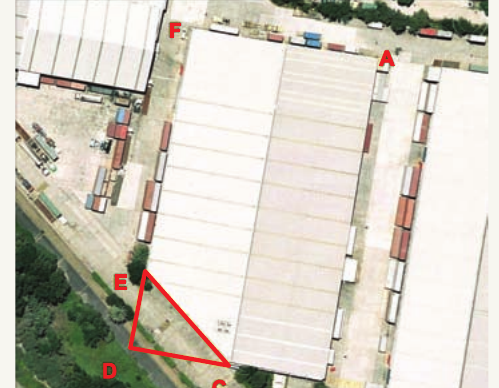
A warehouse building is shown on an aerial photograph. The red scale bar represents on the ground.
Part a: Calculate the dimensions of the land using the scale. Answer to the nearest metre.
Part b: Calculate the area of land occupied by the warehouse building. Answer to the nearest square metre.
Solution:
Part a:
-
Measure the scale bar on the image
-
Scale bar length on photo =
-
Scale bar represents = on ground
-
Calculate scale: represents
-
Therefore represents
-
Scale is to (or )
-
Measure each side of the warehouse on the photograph
-
Multiply each measurement by the scale factor
-
-
-
-
-
-
-
Part b:
-
The warehouse shape is composite (not a simple rectangle)
-
Divide into a large rectangle minus a triangular section
-
Rectangle area:
-
Triangle area:
-
Total warehouse area:
-
Round to nearest square metre
-
Area of warehouse is
Exam tip: For composite shapes, sketch the division into simpler shapes on your working. This helps you keep track of which areas to add and which to subtract.
Volume of water in pools and reservoirs
When water fills a container like a pool, tank, or reservoir to a uniform depth, we can calculate its volume using a simple formula.
The volume formula: V = Ah
For bodies of water with constant depth (uniform thickness throughout), use:
Where:
- = volume (in cubic units like )
- = area that the water covers (in square units like )
- = depth or height of the water (in linear units like )
Note
This formula works because water in a pool or reservoir forms a right prism - a three-dimensional shape with the same cross-sectional area throughout its height.
Example: If a pool has a surface area of and a constant depth of , then:
Rainfall application: If metres of rain falls on a reservoir with area square metres (and no water flows in or out), the volume increases by cubic metres.
The trapezoidal rule for irregular shapes
Many bodies of water have irregular boundaries - curved or uneven edges that don't form perfect rectangles or circles. For these shapes, we use the trapezoidal rule to estimate the area, then apply to find volume.
The trapezoidal rule formula:
Where:
- = area of the shape (approximate)
- = width between the parallel sides
- = distance along the first parallel side
- = distance along the last parallel side
This formula estimates the area by treating the irregular shape as if it were a trapezoid (a four-sided shape with two parallel sides).
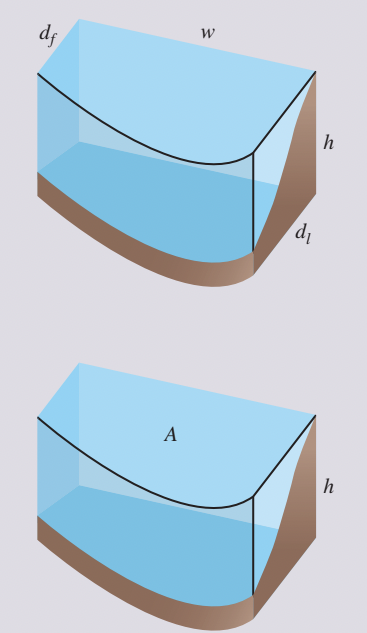
Important
Key Limitations:
- The trapezoidal rule gives an approximation, not an exact answer
- Any volume calculations using this area estimate will also be approximate
- This method applies only to bodies of water or prisms with uniform thickness - the depth must be the same throughout the entire shape
Example
Worked Example 18: Calculate volume with the trapezoidal rule
The shape of water in a pool of constant depth with an irregularly-shaped bottom and top surface is shown below. Dimensions are in metres.
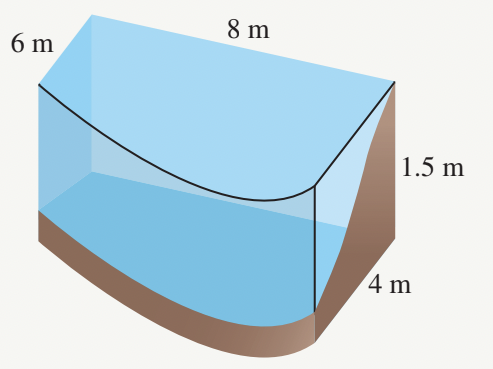
Part a: Apply the trapezoidal rule to approximate the volume of water in this pool.
Part b: of rain falls on the pool. The pool has vertical walls that extend above the water surface, so no water runs out. By how much does the volume increase?
Solution:
Part a:
- Write the trapezoidal rule formula
- Identify the values from the diagram
- (width between parallel sides)
- (first parallel side)
- (last parallel side)
- (depth of pool)
- Substitute into the formula
- Now find the volume using
- The volume of water in the pool is approximately cubic metres
Part b:
- Rainfall adds water over the same area as the pool surface
- Convert rainfall depth to metres
- Use with the new height
- The volume increases by approximately cubic metres
Note: Since we used the trapezoidal rule (an approximation) to find area, our volume calculations are also approximations. This is acceptable for practical purposes.
Exam tip: Always check your units carefully. Rainfall might be given in millimetres while other measurements are in metres. Convert everything to the same unit before calculating.
Summary
Key Points to Remember:
-
Perimeter from aerial photos: Multiply measurements from the photograph by the scale factor to get real-world distances
-
Scale calculation: Express photo length to actual length as a ratio in the same units, then simplify to the form
-
Area estimation vs calculation: Use grid counting for quick estimates, or break composite shapes into simpler forms and use geometric formulas for exact areas
-
Volume formula: For uniform depth water, use where is the surface area and is the depth
-
Trapezoidal rule: Use to estimate area of irregular shapes with two parallel sides, but remember this gives an approximation only