Are Protons and Neutrons Fundamental Particles? (HSC SSCE Physics): Revision Notes
📚Revision Notes
Are Protons and Neutrons Fundamental Particles?
Introduction to fundamental particles
A fundamental principle in physics is that we can understand complex systems by studying their simpler components. By breaking systems into smaller and smaller parts, we eventually reach the most basic building blocks - components that cannot be divided further. These are called fundamental particles (also known as elementary particles).
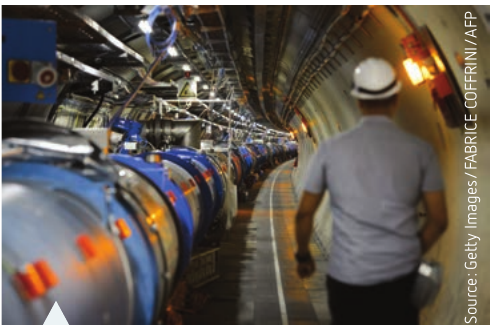
The concept of fundamental building blocks has evolved significantly throughout history:
- Ancient Greeks believed the Universe consisted of four basic elements: earth, air, fire and water
- Democritus introduced the concept of the atom
- Later discoveries revealed that atoms themselves contain smaller components
- Scientists like Thomson, Rutherford, Bohr and de Broglie developed models showing atoms contain protons, neutrons and electrons
- Current understanding: protons and neutrons are themselves made of even smaller fundamental particles
Note
This understanding is described by the Standard Model of matter, which represents our current knowledge of particle physics and the fundamental constituents of the universe.
The atomic model by 1932
By 1932, scientists had developed a clear picture of atomic structure:
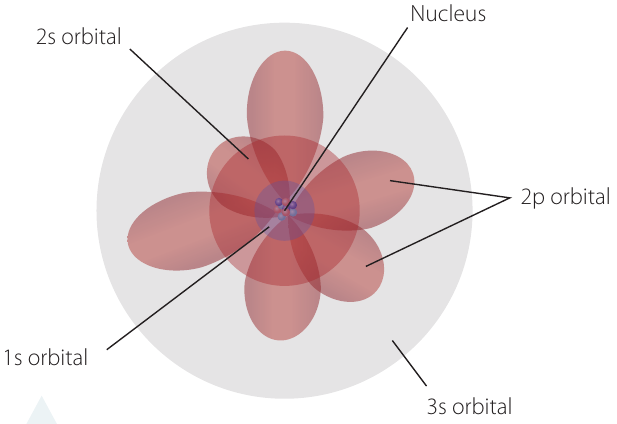
The atom consists of:
- A tiny, massive nucleus containing positively charged protons and neutral neutrons
- A surrounding cloud of negatively charged electrons
- A fourth particle, the photon, was also known by this time
The photon
Important
The photon is a particle of light with unique properties:
- No mass
- No charge
- Quantised energy and momentum (dependent on frequency)
Both the electron and photon appear to be fundamental particles.
Point particles versus internal structure
When considering forces between objects, we can sometimes treat them as point masses or point charges. For example, when calculating gravitational force between the Sun and Earth, we can treat Earth as if all its mass were concentrated at a single point. However, this simplification only works at large distances. Close to Earth's surface, its internal structure becomes important.
Similarly, a charged object can be treated as a point charge when interacting with distant objects, but at close range its internal structure matters.
Note
Key observation about electrons: The electric field of an electron behaves exactly as expected for a point charge. This suggests it has no internal structure, strongly supporting the idea that electrons are fundamental particles.
Evidence that protons and neutrons are not fundamental particles
Evidence from the neutron
Although the neutron has no net charge, experimental evidence shows it possesses its own intrinsic magnetic field. This is significant because magnetic fields result from:
- Moving charged particles, or
- Changing electric fields
Important
Since the neutron has a magnetic field but no net charge, it must contain internal charged components that sum to zero total charge. This indicates the neutron has internal structure and is therefore not a fundamental particle.
Evidence from beta decay
Because protons have similar mass to neutrons and behave similarly, scientists questioned whether protons might also have internal structure.
Evidence came from studying radioactivity. When certain nuclei decay, they emit particles called β⁻ and β⁺ particles:
- β⁻ particles are electrons
- β⁺ particles are positively charged electrons (later called positrons)
Observations from beta decay:
Example
Worked Example: Particle Conversions in Beta Decay
When a nucleus emits a β⁻ particle:
- The proton number increases by one
- The neutron number decreases by one
- Result: A neutron has converted into a proton
When a nucleus emits a β⁺ particle:
- The proton number decreases by one
- The neutron number increases by one
- Result: A proton converts into a neutron
This interconversion between protons and neutrons through electron emission suggests that neither the neutron nor the proton is a fundamental particle.
Antimatter
Dirac's theoretical prediction
In the 1920s, physicist Paul Dirac developed a relativistic version of the Schrödinger equation (the wave equation describing particle behaviour). This equation successfully explained the origin of the electron's spin and magnetic moment.
Key terms:
- Spin: A quantum number that can take half-integer or integer values
- Magnetic moment: A vector quantity (has direction and sign) that describes a particle's interaction with magnetic fields. It depends on the particle's spin, charge and mass.
The antimatter prediction
Dirac's equation had an unexpected feature: it produced two solutions:
- First solution: Correctly described electrons with their known mass, charge and spin
- Second solution: Described a particle with the same mass as an electron but opposite charge and magnetic moment
Important
The theory also predicted that if these two particles met, they would both be destroyed in a process called annihilation, producing a burst of energy.
This second particle was the "anti-electron" or antiparticle to the electron.
Discovery of the positron
In 1932, Carl Anderson discovered this predicted antiparticle while studying cosmic rays using a cloud chamber. He named it the positron.
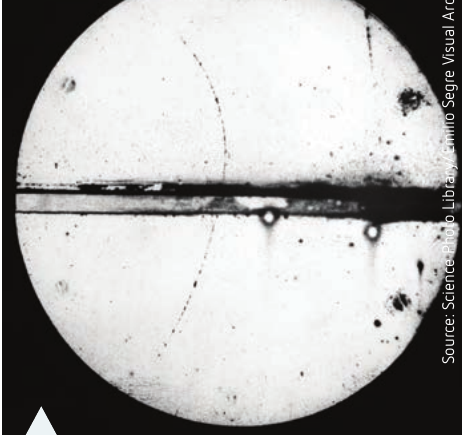
How cloud chambers work:
A cloud chamber is a particle detector that uses supersaturated vapour (like fog). When a charged particle passes through:
- It ionises the vapour
- The electrically charged vapour particles act as condensation sites
- A visible trail of condensation forms along the particle's path
Anderson's experimental setup:
Anderson placed his cloud chamber in a magnetic field. This caused moving charged particles to follow curved paths. The curvature revealed:
- The particle's charge (direction of curve)
- The particle's mass (sharpness of curve/radius of curvature)
Note
Anderson observed tracks with electron-like curvature but deflected in the direction corresponding to positive charge. He had discovered the positron and received the Nobel Prize for Physics in 1936.
Annihilation and energy release
When an electron meets a positron, both particles are destroyed and their mass converts to energy according to Einstein's mass-energy relationship:
Example
Worked Example: Energy Released in Electron-Positron Annihilation
For an electron-positron annihilation, the total mass converted is twice the electron mass:
The energy is released as a pair of gamma ray photons moving away at 180° to each other. Each photon carries half the total energy:
Energy per photon = J
Using to find the photon frequency:
Properties of antiparticles
Dirac's theory suggests that an antiparticle exists for every particle. This has been verified experimentally - almost every known particle has a distinct antiparticle.
For charged particles:
- The antiparticle has the same mass
- Opposite charge
- Opposite sign for magnetic moment
For uncharged particles:
- More complex to describe
- For neutral particles with magnetic moments (like neutrons), the antiparticle can be defined by the opposite sign of its magnetic moment
- Some particles (like photons) are their own antiparticle
Note
Notation for antiparticles:
We can represent antiparticles in two ways:
- Place a bar over the symbol: for antineutron
- Show reversed sign: for positron (antielectron)
Particles and their antimatter equivalents
| Particle | Antimatter Equivalent |
|---|---|
| proton, | antiproton, |
| neutron, | antineutron, |
| electron, | positron, |
Investigation: Building a cloud chamber to detect cosmic rays
Cloud chambers allow us to directly observe high-energy particles, including cosmic rays from space. While most particle physics experiments require expensive equipment, you can build a simple cloud chamber with readily available materials.
Safety considerations
Hazards and safety measures:
| What are the risks? | How can you stay safe? |
|---|---|
| Isopropyl alcohol is flammable and requires safety data sheet (SDS) consultation | - Wear lab coat, safety glasses and gloves - Use in well-ventilated space or fume cupboard - Dispose of gloves and wash hands thoroughly - Keep away from all heat and flame sources |
| Dry ice is extremely cold and can cause cold burns | - Wear thick gloves - Use tongs to handle dry ice |
Materials required
- Clear glass or plastic tank (approximately 15 cm tall, 15 cm wide, 30 cm long)
- Strong light source (overhead or slide projector)
- Metal sheet for lid (same size as tank)
- Cardboard sheet (cut to fit metal lid)
- Three sheets of felt (30 cm × 30 cm each)
- Whole roll of black electrical tape
- Foam padding (approximately 5 cm thick, same dimensions as tank)
- Cardboard box (slightly bigger than clear tank)
- Glue not soluble in alcohol (such as silicon sealant)
- Isopropyl alcohol/isopropanol (pure, approximately 500 mL)
- Dry ice (approximately 500 g)
- Disposable gloves
- Heat/cold-proof gloves
- Scissors
- Tongs
- Lab coats and safety glasses
- Strong magnet (optional)
Method
Building the chamber (allow one full lab period):
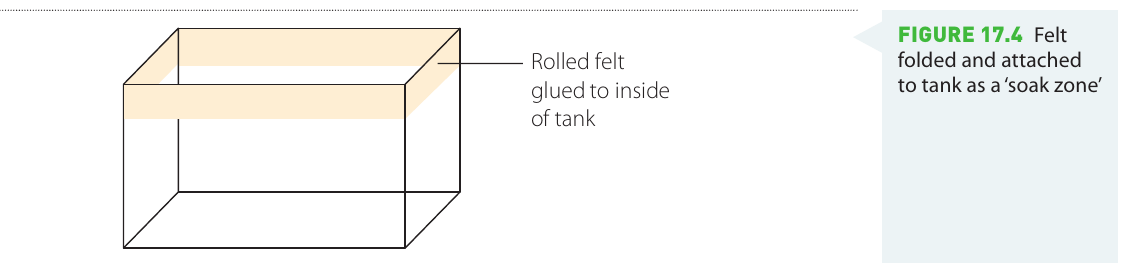
- Roll the felt into strips approximately 5 cm wide and 30 cm long. Attach these to the inside of the clear container using glue or sealant to form a ring around the bottom (the "soak zone"). Allow glue to dry completely - ideally do this the day before.
- Cover one side of the cardboard sheet with black electrical tape as neatly as possible. This dark background makes particle tracks easier to see.
- Attach the cardboard (tape side out) to the metal lid so the black tape faces into the tank when assembled.
- Cut the cardboard box down to approximately 7 cm tall and place foam in the bottom.
- Check that everything fits together properly:
- Metal lid sits on top of foam with black tape facing upward
- Tank sits upside-down on top, with felt ring at the top
- Everything fits tightly and is well sealed (air currents will make tracks hard to see)
Note
Tip: Ensure all seals are tight and secure. Air currents are one of the most common reasons for poor track visibility in cloud chambers.
Operating the chamber:
- Remove tank and metal lid. Using tongs, place a layer of dry ice on top of the foam. (Your teacher may do this step.)
- Soak the felt strips with isopropyl alcohol. (Your teacher may do this step.)
- Seal the metal lid to the tank with electrical or duct tape.
- Place the tank upside-down on top of the dry ice so the metal lid contacts the dry ice.
- Arrange the light source to shine horizontally through the side of the tank. You need bright light to illuminate particle tracks clearly.
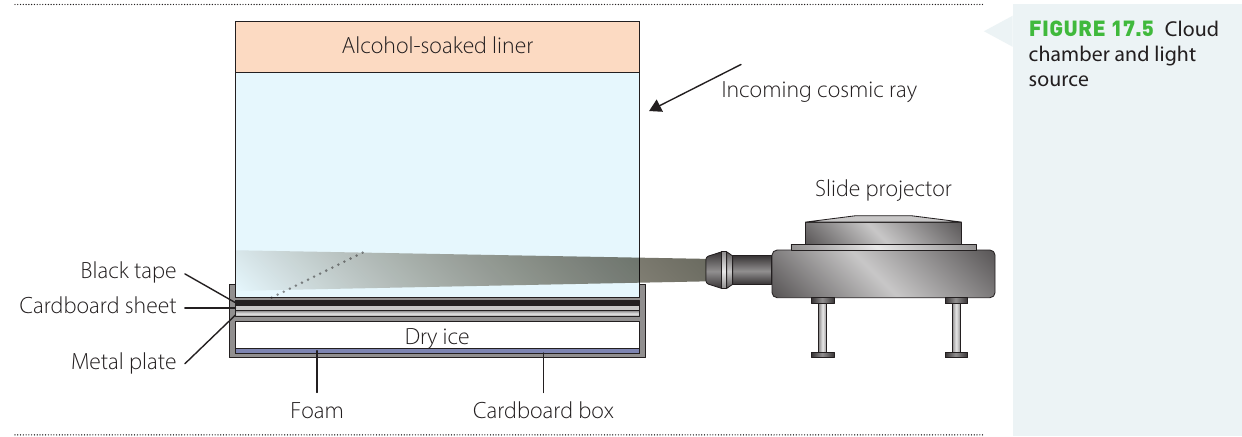
- Turn on the light and observe the chamber for at least 10-20 minutes.
You should see a mist-like fog form inside the chamber, most obvious near the bottom. Even a thin layer is sufficient for detecting particles.
Expected results
During the observation period, you should see fine tracks forming randomly in your chamber. These result from cosmic rays passing through the supersaturated vapour. The tracks:
- Form at any time
- Last only briefly before disappearing
- Require careful, continuous observation
What to look for:
- Straight tracks with sudden direction changes: Could be muon decays (incoming track = muon, outgoing track = electron)
- Y-shaped branching tracks: Usually due to collisions (stem = incoming particle, branches = particles moving off after collision)
Note
Optional experiment: Place a strong magnet on one side and observe how it affects new particle tracks. A very strong magnet is needed to produce significant path curvature.
Magnetic field effects on charged particles
When a charged particle moves through a magnetic field, it experiences a force that curves its path. This principle allowed Anderson to identify the positron.
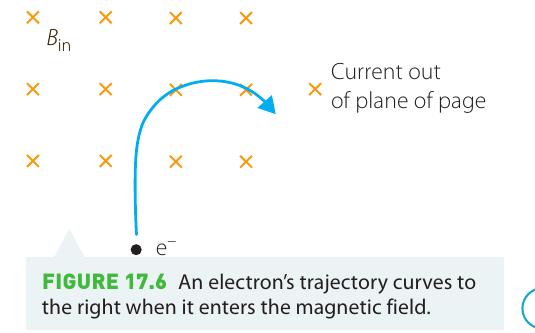
The diagram shows an electron entering a magnetic field directed into the page (represented by × symbols). The electron's path curves to the right due to the magnetic force.
Important
If a positron followed the same initial trajectory, it would curve to the left (opposite direction) because it has opposite charge. The radius of curvature would be the same because the positron has the same mass as an electron.
A proton would also curve to the left (same charge sign as positron), but with a much larger radius of curvature because it has much greater mass.
Remember!
Summary
Key Points to Remember:
- Protons and neutrons are NOT fundamental particles - evidence from their magnetic properties and beta decay shows they have internal structure
- Electrons ARE fundamental particles - they behave as point charges with no internal structure
- All particles have antimatter equivalents with the same mass but opposite charge and magnetic moment
- The positron () is the antimatter equivalent of the electron, discovered by Carl Anderson in 1932
- Annihilation occurs when a particle meets its antiparticle - both are destroyed and their mass converts to energy as gamma rays:
- Cloud chambers detect ionising radiation by creating visible condensation trails along particle paths through supersaturated vapour