The Expanding Universe (HSC SSCE Physics): Revision Notes
📚Revision Notes
The Expanding Universe
Introduction
In the early 20th century, astronomers made a remarkable discovery about the enormous size of galaxies and the vast distances between them. This raised an important question: why hasn't the Universe collapsed in on itself under the force of gravity? Understanding how the Universe expands has been crucial to answering this question.
Distances in the Universe
Note
Space is so vast that using everyday units like metres or kilometres becomes impractical. The nearest star to Earth (apart from the Sun), Proxima Centauri, is about m away - that's a 4 followed by 16 zeros! To make these enormous distances easier to work with, astronomers use special units.
The light year
A light year is the distance that light travels through a vacuum in one Earth year. This equals m.
Important
Remember that although it has the word "year" in it, a light year measures distance, not time. This is a common misconception!
Light travels at a speed of in a vacuum. At this incredible speed:
- Light takes just over 1 second to reach the Moon
- Light from the Sun takes 8 minutes and 20 seconds to reach Earth
- Light from Proxima Centauri takes 4.3 years to reach us
Using the Hubble Space Telescope, astronomers have observed light that has travelled for nearly 14 billion years across the Universe.
Other distance units
Astronomers also use other units such as the parsec (approximately 3.26 light years) and the astronomical unit (AU), which is the distance between Earth and the Sun.
Early theoretical predictions
Einstein's static Universe
In 1916, Albert Einstein published his General Theory of Relativity. At that time, he firmly believed the Universe was static - neither expanding nor contracting. This seemed like common sense to many scientists.
Friedmann's mathematical solutions
In 1922, Russian mathematician Alexander Friedmann discovered something surprising. When he worked through the mathematical equations of Einstein's General Theory of Relativity, he found solutions suggesting the Universe could either be expanding or contracting.
Note
This was purely theoretical work based on the mathematics, not on observational evidence. Friedmann showed that the equations themselves predicted a dynamic Universe, even though this contradicted the prevailing belief of the time.
Lemaître's expanding Universe
Independently, in 1927, Georges Lemaître, a Belgian priest, mathematician and astronomer, reached similar conclusions to Friedmann. However, Lemaître went further. He proposed that the early Universe was like a "primeval atom" containing all the mass in the Universe. This primeval atom then expanded, spreading mass throughout the Universe.
Importantly, Lemaître used actual observational data from cosmology to support his ideas. He correctly worked out that the Universe must be expanding at a speed that is proportional to the distance from Earth:
The value Lemaître calculated for this expansion rate was remarkably similar to the rate later measured by Edwin Hubble in 1929.
Einstein's changing view
Einstein initially didn't accept these ideas. He thought Friedmann's work was mathematically interesting but didn't represent physical reality. He also rejected Lemaître's expanding Universe theory at first, even after Lemaître showed him the observational evidence. However, by the early 1930s, Einstein accepted that the expanding Universe solution was correct and acknowledged that Friedmann had been right. Sadly, Friedmann had already died from typhoid by this time.
Measuring cosmic distances
To confirm whether the Universe really was expanding, astronomers needed reliable ways to measure the enormous distances to faraway galaxies. They also needed to measure how fast these galaxies were moving.
Luminosity and stellar brightness
Stars radiate energy outward in all directions. The radiation we observe on Earth comes from the surface of stars. By carefully measuring this radiation, we can work out the distance to stars.
Luminosity (symbol , measured in watts, W) is the total rate of energy output from a star's surface. This is also called absolute brightness - it's how bright the star actually is.
Apparent brightness (symbol , measured in watts, W) is how bright a star appears to us when we observe it from Earth. The difference between apparent and absolute brightness tells us how far away the star is.
The Stefan-Boltzmann Law
Luminosity is related to a star's surface temperature (measured in kelvin, K) and its surface area (measured in square metres, ). This relationship is called the Stefan-Boltzmann Law:
where is the Stefan-Boltzmann constant.
The intensity of a star's output is the luminosity per unit area of the star's surface:
Note
We can determine a star's temperature from its colour, and we can find its area by measuring its diameter. This allows us to calculate the star's absolute brightness without needing to know how far away it is.
Calculating distance from brightness
Energy from a star radiates outward in all directions (spherically). At a distance (metres) from the star, this energy is spread over a spherical surface with area . Therefore, the apparent brightness (W) of a star with luminosity (W) is:
Important
If we measure the apparent brightness and have calculated the absolute brightness, we can work out the distance to the star. This is one of the fundamental techniques for measuring cosmic distances.
Cepheid variables - cosmic distance indicators
In 1912, Henrietta Leavitt made a crucial discovery whilst analysing a group of stars called Cepheid variables. These are stars whose apparent brightness changes periodically (they pulse).

Leavitt was one of many women employed to analyse astronomical photographs. At the time, they received low wages whilst men operated the telescopes. Despite these conditions, Leavitt made a groundbreaking observation: the period of a Cepheid variable star is directly related to its luminosity.
Important
This discovery was revolutionary. If you observe a Cepheid variable and measure how long its brightness cycle takes (its period), you can calculate its luminosity. Once you know the luminosity and measure the apparent brightness, you can work out how far away it is. This made Cepheid variables extremely valuable tools for measuring cosmic distances.
Hubble's observations and law
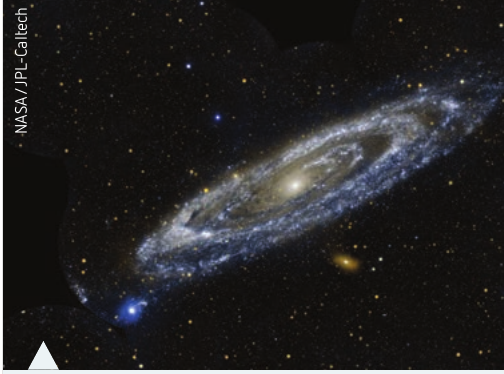
Edwin Hubble knew about Leavitt's discovery when he began observing stars in the nearby Andromeda galaxy (known as M31).
Measuring the distance to M31
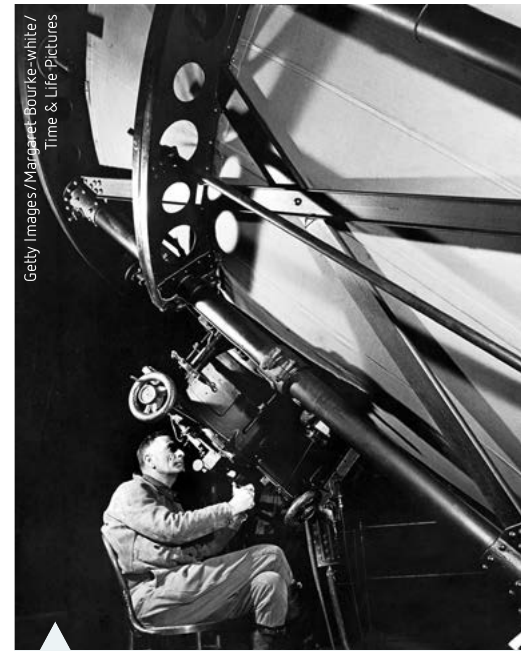
In 1923, Hubble identified a Cepheid variable in M31, which he later used to measure the galaxy's distance. In 1929, Hubble calculated that M31 was around 900,000 light years away. This was later refined - in 1953, Walter Baade showed that M31 is actually 2.5 million light years away.
The Doppler effect and spectral shifts
Hubble's calculation of this enormous distance prompted him to observe the spectra of other similar galaxies. By carefully comparing the wavelengths of spectral lines (particularly hydrogen) from distant galaxies to the same spectral lines produced in laboratories on Earth, he could determine how fast these galaxies were moving relative to Earth.
This technique uses the Doppler effect:
- If wavelengths are shortened (shifted towards the blue end of the spectrum), the galaxy is approaching us - this is called blueshift
- If wavelengths are lengthened (shifted towards the red end of the spectrum), the galaxy is receding from us - this is called redshift
Hubble's crucial discovery
Hubble measured the speeds of several galaxies. He quickly realised they were moving much faster than any object within our own galaxy. He concluded they must be separate galaxies in their own right, located far from our own.
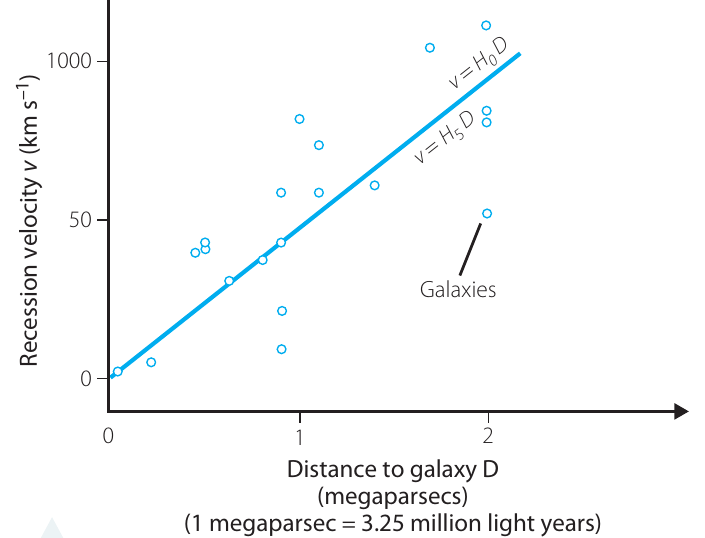
He made a remarkable observation: in general, the further away a galaxy is, the faster it is moving away from us. By plotting recession speed against distance, he discovered a linear relationship.
Hubble's Law
This relationship is now known as Hubble's Law:
where:
- = recession speed (how fast the galaxy is moving away)
- = distance to the galaxy
- = Hubble's constant
Note
The unit for Hubble's constant is (per second). This means the inverse of , written as , gives us an estimate of the age of the Universe.
Many refinements have been made to the value of over the years, and with each refinement, our estimate of the Universe's age changes. Currently, astronomers estimate the Universe is approximately 13.7 billion years old.
An important exception
Note
Interestingly, M31 (the Andromeda galaxy), which is the closest major galaxy to our Milky Way, is actually moving towards us rather than away. This is likely due to the mutual gravitational attraction between our two galaxies. This shows that local gravitational effects can override the general expansion of the Universe.
Understanding the expansion
If the Universe is expanding, where did it originate from? The remarkable thing about this expansion is that from wherever you observe the Universe, it appears to be expanding away from that point. There is no identifiable "centre" of the Universe that we can point to.
The balloon analogy
Note
The Balloon Analogy
A helpful way to understand the expanding Universe is to imagine dots drawn on the surface of a balloon. As the balloon inflates, the dots move further apart from each other - not because the dots themselves are moving, but because the surface of the balloon (the space between them) is expanding.
Similarly, in the Universe, it's the space between galaxies that is expanding, rather than the galaxies themselves moving through space. This is a subtle but important distinction.
Connection to the Big Bang Theory
If we imagine running time backwards, the expanding Universe means that everything must have been closer together in the past. Eventually, we reach a point where everything came together at the very beginning. This gives further support to the Big Bang Theory, which explains the origin of the Universe.
Remember!
Summary
Key Points to Remember:
-
A light year is a unit of distance ( m), not time - it's how far light travels in one year.
-
Friedmann (1922) and Lemaître (1927) independently predicted that the Universe could be expanding or contracting, based on Einstein's General Theory of Relativity.
-
Lemaître used observational evidence to support the expanding Universe hypothesis and deduced two years before Hubble.
-
Henrietta Leavitt discovered that Cepheid variable stars have a period-luminosity relationship, making them invaluable for measuring cosmic distances.
-
Hubble's Law () shows that galaxy recession speed is proportional to distance - the further away a galaxy is, the faster it's moving away from us.
-
The Hubble constant () has units of , and its inverse () gives the age of the Universe (approximately 13.7 billion years).
-
The Universe is expanding because space itself is expanding, not because galaxies are moving through space - like dots on an inflating balloon.