The Electron (HSC SSCE Physics): Revision Notes
📚Revision Notes
The Electron
The discovery of the electron emerged from decades of careful experimentation with cathode rays. This breakthrough was made possible by technological advances in the 19th century, particularly the development of improved vacuum pumps that allowed scientists to study electrical phenomena in near-vacuum conditions.
Note
The development of improved vacuum technology was crucial for studying cathode rays. Without the ability to create near-vacuum conditions, the observations that led to the discovery of the electron would not have been possible.
The nature of cathode rays
In 1855, Heinrich Geissler invented the first glass vacuum tube using his mercury air pump. During the 1870s, William Crookes modified this design to investigate mysterious rays that appeared inside evacuated tubes.
What is a cathode ray tube?
A cathode ray tube (CRT) is an experimental apparatus consisting of an evacuated glass tube with two metal electrodes embedded at opposite ends. These electrodes connect to a power source, typically through an induction coil.
The electrode attached to the negative terminal is called the cathode, whilst the electrode connected to the positive terminal is called the anode. When the power is switched on, cathode rays flow from the negative cathode toward the positive anode inside the tube, similar to current flowing through an electric circuit.
Note
The terms "cathode" and "anode" come from Greek origins. Remember: cathode rays always flow from the negative cathode to the positive anode, similar to conventional current but in the opposite direction.
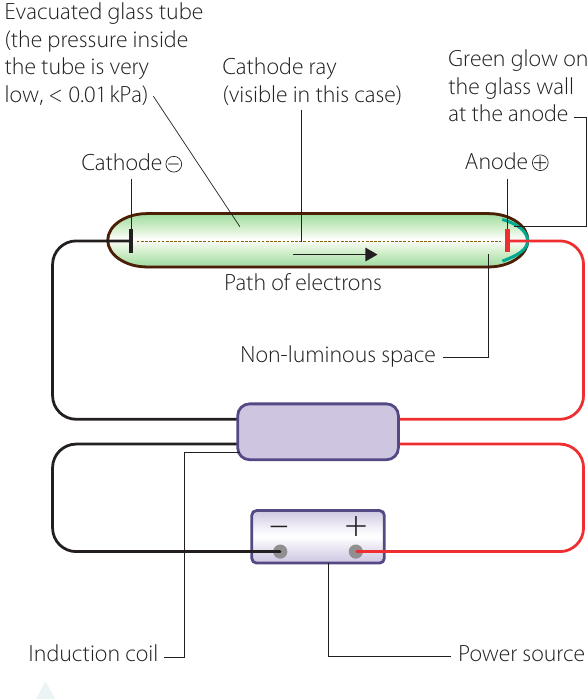
How cathode ray tubes operate
For a cathode ray tube to function properly, two critical requirements must be met:
Important
Two Critical Requirements for CRT Operation:
- Low pressure (below 0.01 kPa)
- High DC voltage
Both conditions must be satisfied simultaneously for the cathode ray tube to operate effectively.
Low pressure
The glass tube must be evacuated to very low gas pressure, preferably close to vacuum (below kPa). This low pressure is essential because the cathode and anode are separated by a large distance. With minimal gas molecules present, the electrons (cathode rays) experience fewer collisions as they travel from cathode to anode, allowing them to maintain their energy and direction.
High voltage
Low pressure alone cannot make electricity "jump" across such a large gap. Extremely high voltage is required to pull electrons off the cathode surface and give them sufficient kinetic energy to reach the anode.
Note
Why Use an Induction Coil?
Cathode ray tubes only operate on DC (direct current). Transformers cannot step up the voltage to the required level because they only work with AC (alternating current). Therefore, an induction coil is used to increase the voltage to the necessary value.
Early observations
With improved vacuum pumps, Crookes and other scientists made systematic observations of cathode ray behaviour using various tube designs. These observations were crucial in understanding the nature of electrons.
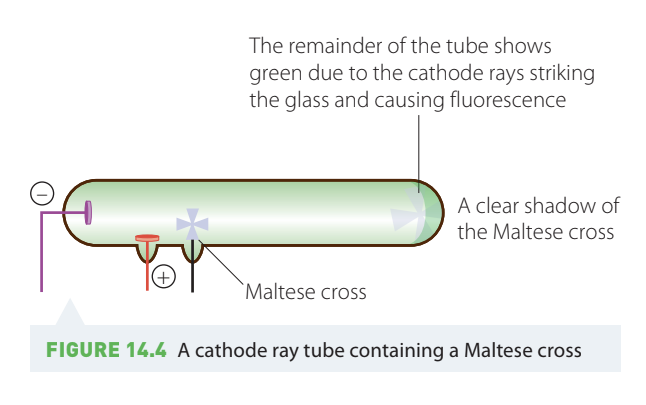
1. Cathode rays travel in straight lines
Using a CRT containing a Maltese cross placed between the electrodes, scientists observed that cathode rays cast a sharp, well-defined shadow on the opposite end of the tube. This demonstrated that the rays travel in straight lines, rather than spreading out in all directions.
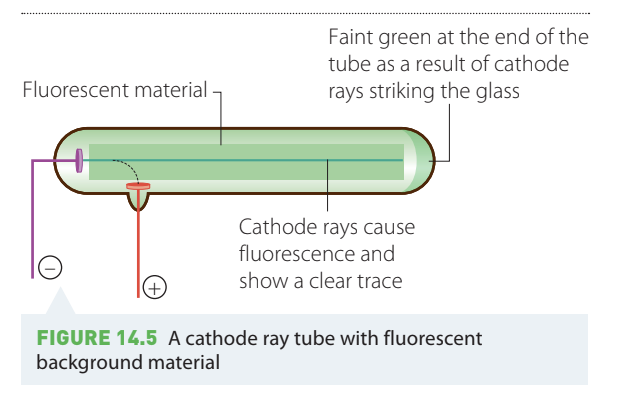
2. Cathode rays cause fluorescence
When a cathode ray tube contains fluorescent background material, the cathode rays cause this material to glow as they pass through it, leaving a visible trace. The rays also cause the glass walls of the tube to fluoresce, producing a characteristic green glow.
Fluorescence is the emission of light when a substance is struck by energetic particles or radiation.
Note
This fluorescence property proved useful not only in understanding cathode rays but also in developing practical applications like fluorescent screens and early display technologies.
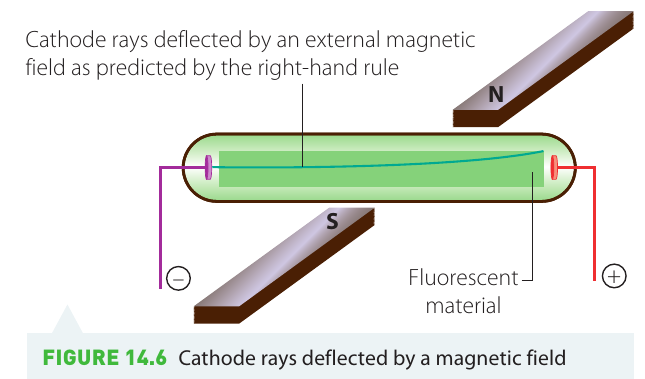
3. Cathode rays are deflected by magnetic fields
When bar magnets are placed on either side of a cathode ray tube, the path of the cathode rays bends. The direction of deflection matches what the right-hand rule predicts for negatively charged particles moving through a magnetic field.
Important
This observation was significant because it suggested that cathode rays consist of charged particles rather than waves. This was a crucial piece of evidence in determining the true nature of cathode rays.
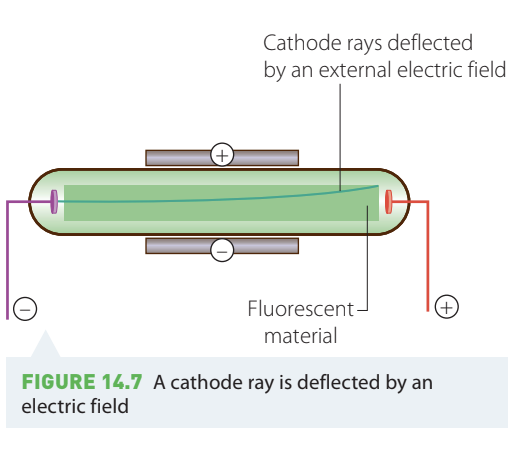
4. Cathode rays are deflected by electric fields
When oppositely charged metal plates are positioned on either side of the tube, the cathode rays deflect toward the positive plate and away from the negative plate. This behaviour is exactly what we expect for negatively charged particles in an electric field.
Note
Interestingly, early experiments failed to demonstrate electric deflection because the electric charge dissipated too quickly. This led to debates about whether cathode rays were particles or waves. Only after improvements to the vacuum technology did scientists successfully observe electric deflection, settling the debate in favour of the particle theory.
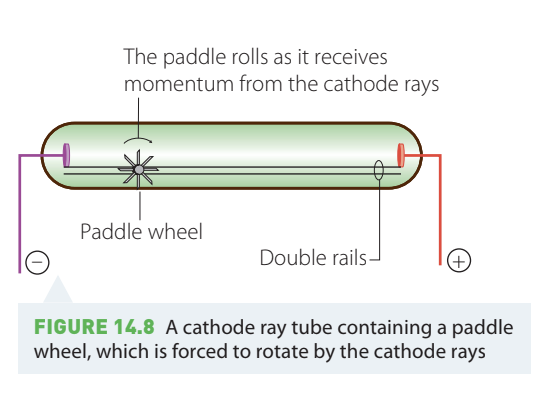
5. Cathode rays carry and transfer momentum
A cathode ray tube containing a small paddle wheel on rails demonstrated that cathode rays possess momentum. When cathode rays strike the paddle wheel, they transfer some of their momentum to it, causing the wheel to roll in the same direction as the cathode rays are travelling.
Important
This observation proved that cathode rays have mass and are not simply a form of electromagnetic radiation. Electromagnetic waves do not carry momentum in the same way that particles with mass do, making this definitive evidence for the particle nature of cathode rays.
6. Cathode rays are identical regardless of cathode material
No matter what element or material was used to make the cathode, the cathode rays produced always behaved identically. This suggested that cathode rays are fundamental particles present in all types of atoms.
Cathode rays also facilitate certain chemical reactions and can expose photographic film, providing additional evidence of their energetic nature.
Thomson's plum pudding model of the atom
Collectively, these observations pointed strongly toward a particulate nature for cathode rays. Scientists began calling them cathode ray particles, and importantly, they appeared to be common components of all atoms. This was revolutionary: for the first time, evidence suggested that atoms themselves are composed of smaller particles.
Before these discoveries, the prevailing model was Dalton's "billiard ball" atom – a simple, structureless sphere. This model clearly needed updating.

J.J. Thomson proposed a new atomic model, nicknamed the "plum pudding" model. In this model:
- The atom remains roughly spherical in shape
- Discrete negatively charged particles (electrons) are embedded randomly throughout the atom
- The rest of the atom consists of a uniformly distributed positive charge with low density
- The total positive charge exactly balances the total negative charge, making the atom electrically neutral overall
Note
Why "Plum Pudding"?
The model was called "plum pudding" because it resembled a traditional English dessert where pieces of fruit are scattered throughout a pudding matrix. In Thomson's atom, electrons were like the fruit pieces distributed through a "pudding" of positive charge.
Summary
Key Points to Remember:
-
Cathode ray tubes require low pressure (< kPa) and high DC voltage to operate, with cathode rays flowing from cathode (negative) to anode (positive)
-
Six key observations established the particulate nature of cathode rays: straight-line travel, fluorescence, magnetic deflection, electric deflection, momentum transfer, and universality across all elements
-
Cathode rays are negatively charged particles (electrons) that deflect toward positive charges and away from negative charges
-
Thomson's plum pudding model proposed that atoms consist of negatively charged electrons embedded in a uniform sphere of positive charge, replacing the earlier billiard ball model
-
The discovery of electrons revealed that atoms are not fundamental particles but are themselves composed of smaller subatomic particles