The Nucleus (HSC SSCE Physics): Revision Notes
📚Revision Notes
The Nucleus
Introduction to atomic structure
Before Rutherford's groundbreaking work, the prevailing model of the atom was J.J. Thomson's plum pudding model. In this model, the atom's mass was distributed evenly throughout its entire volume. Thomson envisaged the atom as a sphere of positive charge (the "pudding") with negatively charged electrons (the "fruit") embedded within it. However, new experimental evidence would soon challenge this view and revolutionise our understanding of atomic structure.
The Geiger-Marsden experiment
Background and purpose
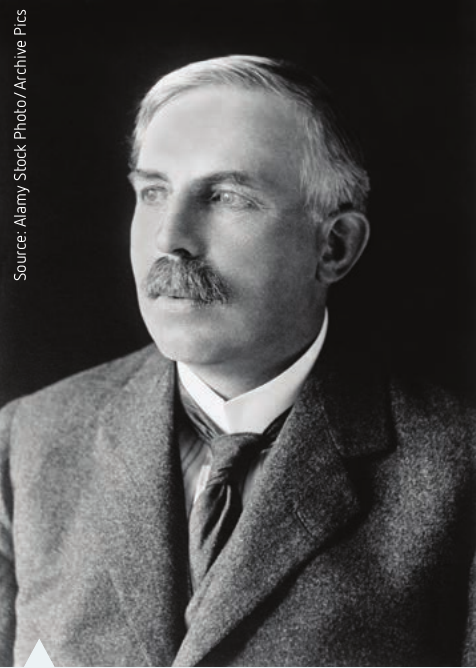
In 1911, Ernest Rutherford directed his assistants Hans Geiger and Ernest Marsden to conduct a crucial experiment. Their aim was to test Thomson's plum pudding model using newly discovered alpha particles. Alpha particles are positively charged particles emitted by certain radioactive isotopes. We now know they consist of two protons and two neutrons, making them essentially helium nuclei.
Experimental prediction
Important
Based on Thomson's model, Rutherford made a specific prediction. Since the positive charge in Thomson's model was spread throughout the entire volume of the atom, it would have a relatively low density. Therefore, when alpha particles were fired at a thin gold foil, they should either:
- Pass straight through with no deflection, or
- Experience only very small deflections
Experimental setup
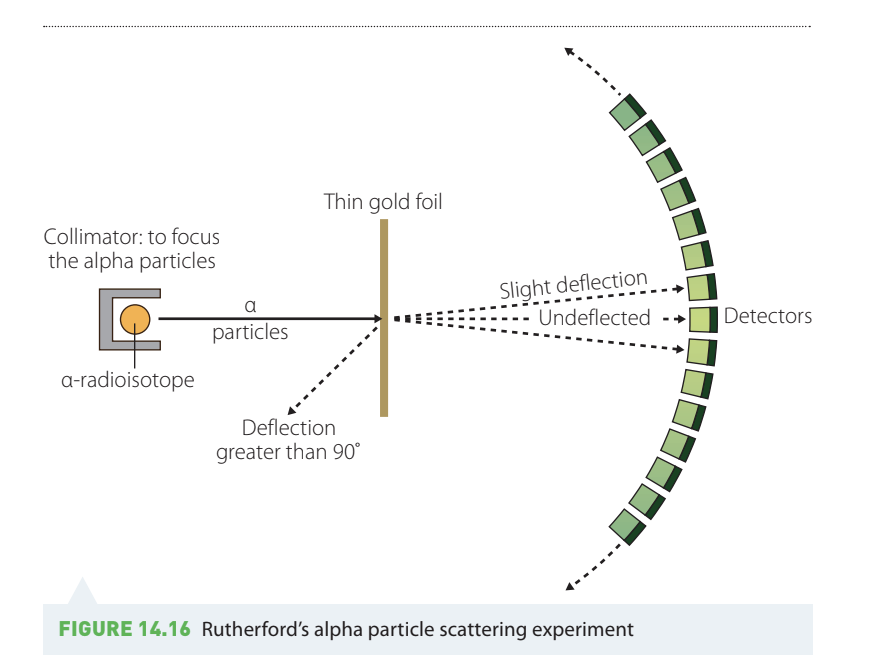
The apparatus was designed with several key components:
- An alpha-radioisotope source to emit alpha particles
- A collimator to focus the alpha particles into a narrow beam
- A thin gold foil target
- An array of detectors arranged in a semicircle to detect scattered particles
Surprising results
The experimental results were dramatically different from what Rutherford had expected. Whilst most alpha particles did indeed pass through the foil with little or no deflection, approximately 1 in 8000 alpha particles were deflected back at angles greater than . This was completely unexpected and suggested something remarkable about atomic structure.
Note
Rutherford expressed his astonishment with the now-famous statement: "It was almost as incredible as if you had fired a 15-inch shell at a piece of tissue paper and it came back and hit you."
The experiment was repeated multiple times, and the same surprising results were consistently obtained.
Rutherford's model of the atom
Interpreting the results
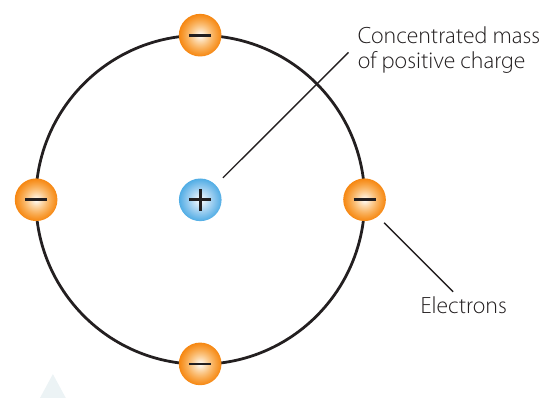
From careful analysis of the experimental data, Rutherford concluded that Thomson's model required significant modification. The only way to explain the large-angle deflections was if the atom's positive charge and nearly all of its mass were concentrated in an extremely small region. This tiny, dense region became known as the nucleus.
Key features of the model
Rutherford proposed a radically new atomic structure:
- The nucleus contains nearly all the atom's mass and all of its positive charge
- The nucleus is extremely small compared to the overall size of the atom
- Electrons orbit around the nucleus in a circular fashion, similar to planets orbiting the Sun
- Most of the atom consists of empty space
Explaining the observations
This new model elegantly explained all the experimental observations:
Example
Explaining the Scattering Results
Most alpha particles passing through: The majority of alpha particles travel through the empty space between the nucleus and electrons, experiencing no deflection.
Slight deflections: When alpha particles pass close to the nucleus or collide with electrons, their paths are altered slightly.
Large-angle deflections: The rare cases where alpha particles are deflected back at angles greater than occur when they collide directly with the tiny, dense, positively charged nucleus. Since the nucleus is so small compared to the atom's overall size, the probability of such collisions is very low, explaining why only 1 in 8000 particles experienced this deflection.
Revolutionary aspects of Rutherford's model
Breaking with previous atomic theory
For over 50 years during the 1800s, John Dalton's "billiard ball" model dominated scientific thinking. This model portrayed atoms as indivisible, solid spheres with no internal structure. Dalton's atomic theory explicitly stated that atoms occupy all the space in matter, leaving no room for "empty space."
Thomson's work in 1897 first suggested atoms might be divisible, as electrons appeared to be components of atoms. He proposed the plum pudding model to accommodate this discovery. Another scientist, Philipp Lenard, suggested a different model with positive and negative charge pairs distributed throughout the atom.
Rutherford's breakthrough
Important
Rutherford's "planetary" model was the first to propose:
- A concentrated nucleus containing almost all the mass
- All positive charge confined to this nucleus
- Electrons in separate motion around the nucleus
- Vast amounts of empty space within the atom
This model proved particularly valuable for chemistry, as it provided insights into how electrons from different atoms interact with each other during chemical reactions.
Impact on scientific thinking
Challenging classical physics
Rutherford's model presented a significant problem: according to classical physics, the motion of electrons orbiting the nucleus should be impossible. Electrons moving in circular orbits experience centripetal acceleration, and accelerating charged particles are known to emit electromagnetic radiation. This energy emission should cause electrons to lose kinetic energy, spiral inward, and eventually collapse into the nucleus. Every atom should therefore be unstable and short-lived.
Note
Rather than discarding Rutherford's model due to this contradiction with classical physics, scientists recognised it as evidence that new physics was needed. This paradox became a driving force in the development of quantum physics.
Leading to quantum theory
Rutherford's model triggered further investigations by Niels Bohr and other physicists. They proposed that electrons could exist in stable states without emitting radiation, leading to the development of quantum mechanics. This represented a fundamental shift in how scientists understood matter at the atomic scale.
Significance of Rutherford's work
Rutherford's experiments and analysis paved the way for major changes in scientific thinking:
- Introduction of the concept of a nuclear atom
- Recognition that atoms consist largely of empty space
- Foundation for quantum theory development
- New framework for explaining the nature of matter
Investigation: Modelling the alpha particle scattering experiment
Aim
To model Rutherford's alpha particle scattering experiment using everyday objects.
Materials
- Golf ball
- Table tennis ball
- Metre ruler
- Device to record the motion of the balls (e.g., camera or smartphone)
Safety considerations
| What are the risks? | How to manage them |
|---|---|
| Balls may roll onto the floor and cause someone to slip or fall | Account for all balls and ensure they do not roll away on the floor |
Method
- On an even surface, roll the table tennis ball towards the golf ball from approximately 2 m away
- Observe the motion of both balls when the table tennis ball collides with the golf ball
- Repeat steps 1 and 2 approximately 20 times
- Record how many times the table tennis ball:
- Missed the golf ball and passed straight by
- Collided head-on with the golf ball and rebounded back the way it came
Analysis points
When analysing your results, consider:
- How the balls represent alpha particles and gold atoms in Rutherford's experiment
- Why rolling the table tennis ball from a significant distance improves the model
- What modifications could make this analogy more accurate
- How your results compare to the 1 in 8000 ratio observed in the actual experiment
Note
This investigation helps visualise why most alpha particles pass through the gold foil whilst a small number rebound. The golf ball represents the dense nucleus, whilst the table tennis ball models the lighter alpha particles.
Limitations of Rutherford's model
Whilst Rutherford's model successfully explained the surprising experimental results, it had several significant limitations:
Unknown nuclear composition
Rutherford could not explain what the nucleus actually contained. Although he proposed that nearly all the atom's mass and positive charge were concentrated in this tiny region, the existence of protons and neutrons was not yet known. He therefore could not provide a detailed picture of nuclear structure.
Uncertain electron arrangement
Rutherford knew electrons should be positioned around the nucleus, but he could not determine their precise arrangement. His description of electrons orbiting "like planets around the Sun" was more of an analogy than a detailed model. The actual organisation of electrons in atoms remained unclear.
The stability problem
Important
The Atomic Stability Paradox
The most significant limitation concerned atomic stability. According to classical electromagnetic theory:
- Electrons orbiting the nucleus undergo centripetal acceleration
- Accelerating charged particles emit electromagnetic radiation
- This radiation represents energy loss
- The energy must come from the electrons' kinetic energy
- As electrons lose kinetic energy, they should slow down
- Slower electrons cannot maintain their orbits
- Eventually, electrons should spiral into the nucleus
This theoretical prediction suggested every atom should be unstable and collapse almost immediately. However, atoms in reality are stable and long-lived. Rutherford's model provided no explanation for this stability, representing a fundamental problem that required new physics to resolve.
Remember!
Summary
Key Points to Remember:
-
The Geiger-Marsden experiment involved firing alpha particles at thin gold foil. Most passed through, but approximately 1 in 8000 rebounded at angles greater than .
-
Rutherford's nuclear model proposed that atoms have a tiny, dense, positively charged nucleus containing nearly all the atom's mass, with electrons orbiting in the surrounding empty space.
-
Revolutionary concept: Rutherford's model was the first to propose a nucleus and to recognise that most of an atom's volume is empty space, fundamentally changing our understanding of matter.
-
Classical physics problem: The model could not explain why orbiting electrons don't emit radiation and spiral into the nucleus, highlighting the need for quantum physics.
-
Legacy: Despite its limitations, Rutherford's model paved the way for quantum theory and modern atomic physics, demonstrating how unexpected experimental results can revolutionise scientific understanding.