Thomson and Millikan's Experiments (HSC SSCE Physics): Revision Notes
📚Revision Notes
Thomson and Millikan's Experiments
Thomson's charge-to-mass ratio experiment
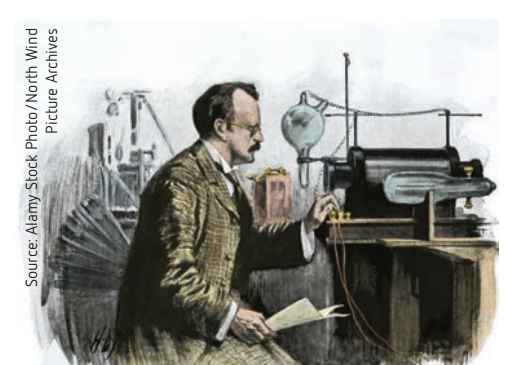
In the late 1890s, scientists debated whether cathode rays were waves or particles. J.J. Thomson designed a clever experiment to resolve this question and measure a key property of cathode rays.
Purpose of the experiment
Thomson's experiment aimed to measure the charge-to-mass ratio (denoted as ) of cathode rays. Before beginning, Thomson hypothesised that cathode rays consisted of negatively charged particles emitted from the cathode.
Note
Thomson's hypothesis was revolutionary for its time – suggesting that cathode rays were particles rather than electromagnetic waves, which was a contentious debate in the scientific community.
The experiment consisted of two distinct parts, each building on the previous one.
Part 1: Selecting particles with specific velocity
Thomson needed cathode rays travelling at a known, consistent velocity. He achieved this using a technique called velocity selection with crossed electric and magnetic fields.
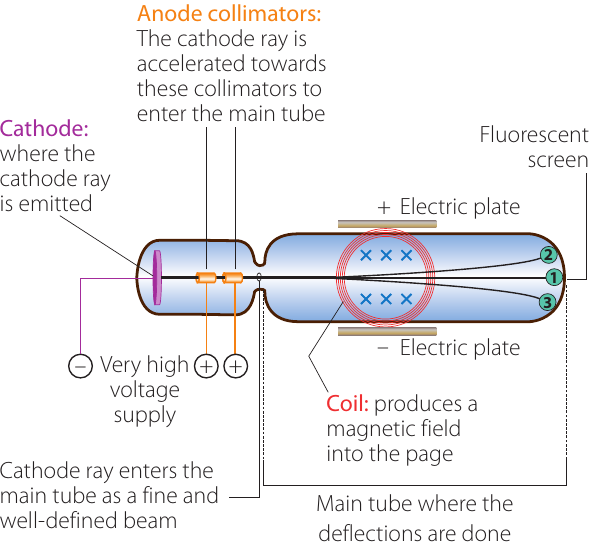
The experimental setup worked as follows:
A cathode ray beam emerged from the cathode and accelerated towards collimators (narrow openings) that shaped it into a well-defined, narrow beam. This beam then entered the main chamber of the cathode ray tube.
With no fields applied, the beam travelled straight through the tube and struck the centre of the fluorescent screen at the far end.
Thomson then applied an electric field by connecting a voltage supply to two parallel metal plates positioned above and below the beam. The electric field strength was . Because the cathode rays were negatively charged, they deflected away from the negative plate (upward in the diagram).
Next, he activated a magnetic field by passing current through a coil wrapped around the tube. The magnetic field strength was . He oriented this field perpendicular to the electric field, causing the beam to deflect in the opposite direction (downward in the diagram).
Note
The key insight here is that the electric and magnetic fields deflect the beam in opposite directions. By carefully balancing these opposing forces, Thomson could select only particles with a specific velocity to pass through undeflected.
Thomson carefully adjusted the strengths of both fields until the two deflections exactly cancelled each other out. When perfectly balanced, the beam travelled straight through undeflected and again hit the centre of the screen.
Mathematical relationship for velocity
When the forces from both fields balanced perfectly:
The electric force on a particle with charge is:
The magnetic force on a particle moving with velocity perpendicular to field is:
Setting these equal:
Dividing both sides by and :
Important
Key Formula for Velocity Selection
This elegant result shows that only particles with velocity pass through undeflected. This formula is fundamental to understanding how Thomson selected particles with known velocity.
Thomson now knew the exact velocity of the cathode rays entering the main chamber.
Part 2: Measuring the charge-to-mass ratio
With the velocity determined, Thomson moved to the second phase of his experiment.
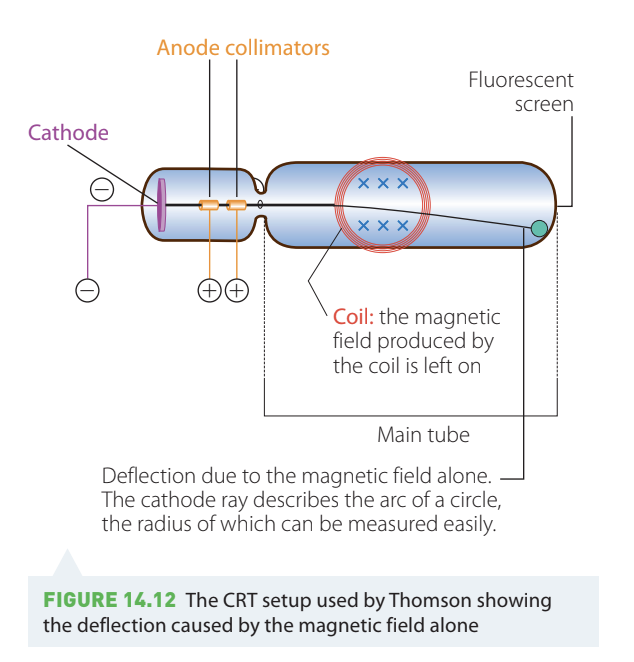
He switched off the electric field but kept the magnetic field active. Now only the magnetic force acted on the cathode rays, causing them to curve downward in a circular arc.
Note
The curved path occurred because the magnetic force provided the centripetal force needed for circular motion. The radius of this circular arc () could be measured from the position where the beam struck the fluorescent screen.
Deriving the charge-to-mass ratio
Example
Worked Example: Deriving Thomson's Charge-to-Mass Ratio Formula
For circular motion, the centripetal force equals:
This must equal the magnetic force:
Simplifying by cancelling one from each side:
Rearranging for :
Substituting from Part 1:
Thomson could measure all the quantities on the right side of this equation:
- (electric field strength, calculated from the applied voltage)
- (radius of the arc, measured from the screen)
- (magnetic field strength, calculated from the current in the coil)
Therefore, he successfully calculated the charge-to-mass ratio.
Key findings and significance
Thomson's experiment yielded several groundbreaking discoveries:
Proof of particle nature: The fact that cathode rays had a measurable charge-to-mass ratio proved they were particles, not waves. Waves do not possess mass, so measuring a mass-related property definitively settled the debate about the nature of cathode rays.
Unusually large ratio: The ratio Thomson measured was remarkably large compared to known particles like ions. This indicated the cathode ray particles had either enormous charge or very tiny mass (or both).
Universal particles: When Thomson repeated the experiment using cathodes made from different materials, he consistently obtained the same ratio. This suggested cathode ray particles were fundamental components common to all types of atoms, not properties of specific materials.
Important
Thomson's Revolutionary Conclusions
These findings led Thomson to propose that cathode rays were a new type of subatomic particle, which later became known as electrons. This discovery:
- Proved atoms are not indivisible
- Contributed to Thomson's development of the "plum pudding" atomic model
- Earned him the Nobel Prize in Physics in 1906
Millikan's oil drop experiment
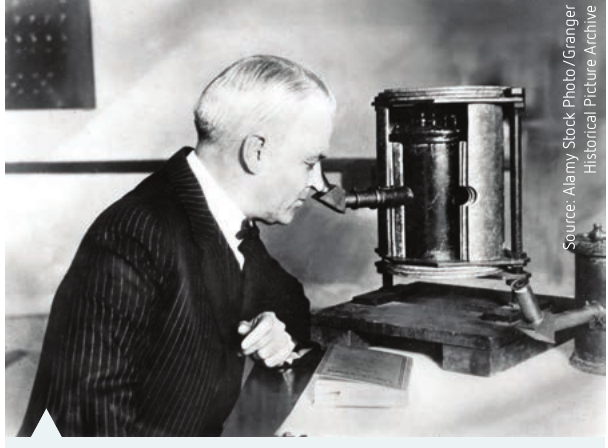
While Thomson had determined the charge-to-mass ratio of electrons, neither the individual charge nor the mass was known separately. American physicist Robert Millikan designed an elegant experiment to measure the charge of an electron directly.
Purpose of the experiment
Millikan's experiment, conducted in 1909, aimed to measure the fundamental unit of electric charge. His work ultimately demonstrated that electric charge is quantised – it exists only in discrete amounts rather than as a continuous quantity.
Experimental apparatus and method
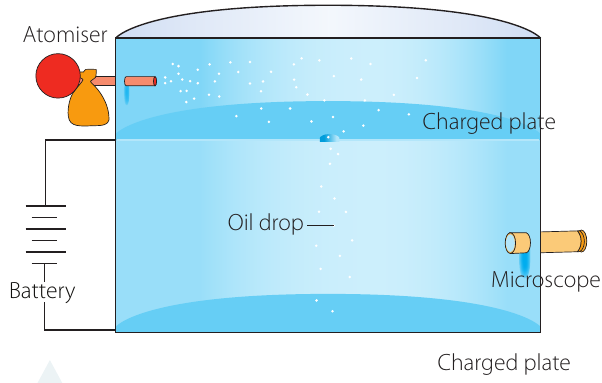
Millikan's apparatus consisted of two horizontal metal plates in a chamber. He could apply a voltage across these plates to create a uniform electric field between them.
The experimental procedure worked as follows:
Tiny droplets of oil were sprayed into the chamber using an atomiser. As the oil passed through the atomiser nozzle, friction caused some droplets to gain electric charge.
Without any voltage applied, the oil droplets simply fell downward under gravity. Millikan observed them through a microscope.
Note
The Balancing Act
He then applied a voltage across the plates, creating an electric field between them. The strength of this field was:
where is the applied voltage and is the separation between the plates.
By carefully adjusting the voltage, Millikan could make specific oil droplets stop falling and remain suspended in mid-air. This occurred when the upward electric force on the droplet exactly balanced its weight.
Calculating the charge
Example
Worked Example: Calculating the Charge on an Oil Droplet
For a suspended droplet, the forces balanced:
The weight of the droplet is:
Substituting the expression for electric field:
Rearranging to solve for charge:
Millikan calculated the mass () of each droplet from its size (determined by observing its fall rate), and he knew the values of and from his apparatus. Therefore, he could determine the charge on each droplet.
Discovery of charge quantisation
When Millikan performed this calculation for many different oil droplets, he made a remarkable discovery. The charges didn't vary randomly – instead, they always appeared as integer multiples of a smallest value.
The minimum charge Millikan measured was approximately:
This value is about 6% lower than the currently accepted value of the elementary charge ( C), representing remarkably accurate work for 1909.
Important
The Pattern of Quantisation
Other droplets had charges of , , , and so on, but never values like or . This pattern occurred because droplets with higher charges had captured multiple electrons from the air.
This was the first direct experimental proof that charge is quantised!
Significance of the results
Millikan's findings had profound implications:
Charge is quantised: The experimental results proved that electric charge exists only in discrete packets. You cannot have a fraction of the elementary charge – charge comes in whole number multiples only, like counting coins rather than pouring liquid.
Note
Think of charge quantisation like currency: you can have $1, $2, or $3, but never $1.37 worth of individual coins if your smallest denomination is $1. Similarly, charge comes in units of , never fractions of .
Validation of Thomson's work: Millikan's results confirmed that Thomson's cathode rays were indeed particles carrying a specific unit of negative charge.
Calculation of electron mass: Combining Millikan's charge value with Thomson's charge-to-mass ratio enabled scientists to calculate the mass of an electron:
This yielded a mass of approximately kg, about the mass of a proton. These incredibly tiny, negatively charged particles were electrons.
Nobel Prize recognition: Millikan received the Nobel Prize in Physics in 1923 for this work and other contributions.
Combined impact of both experiments
Thomson and Millikan's experiments together revolutionised our understanding of matter and electricity:
- They provided conclusive evidence that atoms contain smaller, subatomic particles
- They demonstrated that electrons are universal components of all atoms
- They enabled precise determination of electron properties (charge and mass)
- They showed that charge is quantised, establishing a fundamental principle of physics
- They supported the development of increasingly sophisticated atomic models
Note
The collaboration between these two discoveries – one measuring and the other measuring – exemplifies how scientific progress often builds through complementary experiments by different researchers.
Remember!
Summary
Key Points to Remember:
- Thomson used crossed electric and magnetic fields to select cathode rays with specific velocity:
- He then measured deflection in a magnetic field alone to determine the charge-to-mass ratio:
- Thomson's unusually large value indicated cathode rays were very light, negatively charged particles (electrons) common to all atoms
- Millikan suspended charged oil droplets between electric plates and found charge existed only in integer multiples of a base unit
- Millikan's measurement of the elementary charge ( C) proved charge is quantised, not continuous
- Together, these experiments determined the electron mass ( kg) and established electrons as fundamental subatomic particles