Einstein’s Mass-Energy Equivalence Relationship (HSC SSCE Physics): Revision Notes
📚Revision Notes
Einstein's Mass-Energy Equivalence Relationship
Introduction to mass-energy equivalence
One of the most famous equations in physics is Einstein's mass-energy equivalence relationship: . This elegant formula reveals a profound truth about the universe: mass and energy are fundamentally the same thing, just in different forms. Energy can be converted into mass, and mass can be converted into energy.
Note
This relationship has enormous practical consequences in modern technology and science:
- Nuclear power generation produces electricity by converting mass to energy
- Medical imaging techniques like PET scans rely on matter-antimatter annihilation
- Particle accelerators use energy to create new particles with mass
- Understanding stellar processes and how stars produce energy
The thought experiment: deriving E = mc²
To understand how Einstein arrived at this relationship, we can examine a thought experiment involving photon momentum. Although photons are massless, they do carry momentum. The relationship between a photon's energy and momentum is:
where is momentum, is energy, and is the speed of light. This means:
The spacecraft scenario
Imagine a spacecraft floating in deep space, far from any gravitational fields. Inside, a pilot fires a laser gun that emits a single photon towards the rear of the spacecraft, which is a distance away.
The photon travels at the speed of light, so the time taken to reach the back of the ship is:
Important
Because photons carry momentum, the law of conservation of momentum requires that the spacecraft experiences a recoil when the photon is fired. The pilot, spacecraft, and gun all recoil together with velocity , travelling a distance in time .
Applying conservation of momentum
The magnitude of momentum that the spacecraft (with mass ) receives is . This must equal the magnitude of the photon's momentum:
Rearranging for velocity:
Since distance travelled is , we can substitute:
We also know that , so:
When the photon hits the rear of the spacecraft, its momentum is transferred, causing the craft to stop. Remarkably, although no external force was applied to the system, the ship has moved. This movement represents a redistribution of mass within the system.
The final step
The photon behaves as if it has a relativistically corrected mass . If this were true, its momentum would be (since the photon moves at speed and ), which must equal the spacecraft's momentum (where ). Therefore:
Simplifying:
We now have two equations for . Setting them equal:
Cancelling and from both sides gives us:
This demonstrates that mass and energy are equivalent. Mass is simply a manifestation of energy.
Rest energy
The energy associated with a mass at rest is called rest energy. The formula is:
where represents the rest mass of an object.
Example
Worked Example: Rest Energy of an Electron
An electron has a mass of approximately kg. Calculate its rest energy in both joules and electron-volts.
Solution:
Using :
In particle physics, it's common to express energies in electron-volts (eV) rather than joules. Since J:
Note
Scientists working in particle physics often express particle masses directly in eV rather than kilograms, since energy is what matters in particle collisions. This makes calculations more intuitive when dealing with high-energy processes.
Nuclear fission: splitting atoms
Nuclear fission occurs when a large atomic nucleus splits into smaller fragments. The total mass of the fragments is less than the original nucleus - this difference is called the mass defect. The missing mass has been converted into energy, typically appearing as kinetic energy of the fragments and high-energy gamma rays.
Uranium-235 fission
A common example occurs in nuclear reactors, such as Australia's OPAL reactor in Sydney. When a neutron is absorbed by a uranium-235 () nucleus, it becomes unstable and splits.
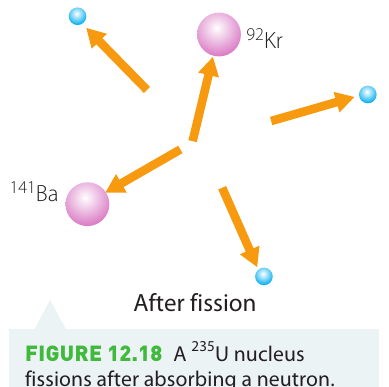
The fission process can be written as:
The uranium-236 nucleus is unstable and quickly splits into barium-144, krypton-89, three neutrons, and releases energy.
Calculating energy release
To find how much energy is released, we compare the total mass before and after the reaction.
| Nucleus | Mass (unified atomic mass units, u) |
|---|---|
| 235.044 | |
| 1.009 | |
| 140.908 | |
| 91.905 |
Note
The unified atomic mass unit (u) is defined such that kg. This unit makes nuclear calculations much more convenient than working directly with kilograms.
Example
Worked Example: Energy Released in Uranium-235 Fission
Calculate the energy released when one uranium-235 nucleus undergoes fission.
Solution:
Step 1: Calculate mass of reactants
Step 2: Calculate mass of products
Step 3: Find the mass defect
Step 4: Convert to kilograms
Step 5: Calculate energy using
This is an enormous amount of energy from a single atom.
Nuclear fusion: combining atoms
Nuclear fusion is the opposite process - two or more light nuclei combine to form a heavier nucleus. The mass of the product is less than the combined mass of the reactants, and the mass defect is converted to energy. Fusion powers the Sun and other stars.
Fusion in the Sun
Inside stars like our Sun, four protons are forced together under extreme pressure and temperature to form a helium nucleus (also called an alpha particle, ) plus two positrons. Let's calculate the energy released:
Example
Worked Example: Energy Released in Solar Fusion
Calculate the energy released when four protons fuse to form a helium nucleus.
Given data:
- Proton mass: kg
- Positron mass: kg
- Alpha particle mass: kg
Solution:
Step 1: Calculate mass before reaction
Step 2: Calculate mass after reaction
Step 3: Find the change in mass
Step 4: Calculate energy released
Although this is smaller than the fission result, the reactants are much lighter.
When comparing energy per unit mass, fusion is actually more powerful than fission
.
The Sun's energy output
The Sun radiates energy at a rate of approximately W (watts), or J per second.
Using , we can calculate how much mass the Sun converts to energy each second:
Note
This means the Sun converts about 4 million tonnes of mass into energy every second! Despite this enormous rate, the Sun has enough hydrogen fuel to continue burning for billions of years.
Positron emission tomography (PET)
Antimatter and pair annihilation
In the 1920s, British physicist Paul Dirac predicted that every fundamental particle with mass has an antiparticle. The antiparticle of the electron is called the positron, which has the same mass as an electron ( kg) but opposite charge ( C).
When a particle meets its antiparticle, they undergo pair annihilation - both particles cease to exist, and their rest energy is converted into two gamma rays (high-energy photons). These gamma rays travel in exactly opposite directions to conserve momentum.
Calculating photon energy from annihilation
When an electron and positron with negligible kinetic energy collide:
Important
Since momentum must be conserved and the two gamma rays travel in opposite directions, each photon carries half the total rest energy. Therefore, each photon has energy equal to the rest energy of one electron:
Medical imaging with PET
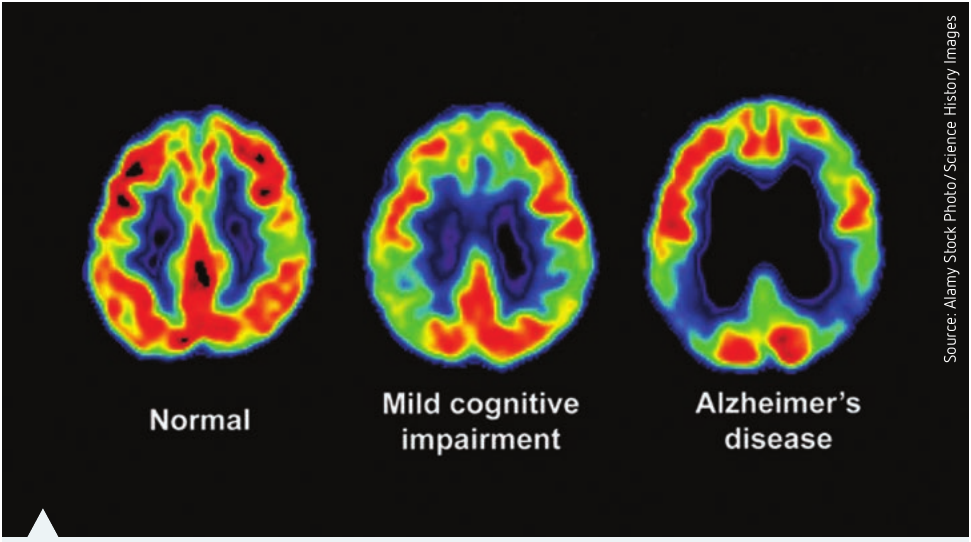
Positron emission tomography (PET) is a medical imaging technique that exploits pair annihilation. Radioactive atoms that emit positrons are attached to glucose molecules and injected into a patient's body. Since electrons are abundant, each emitted positron quickly encounters an electron and annihilates.
The resulting gamma ray pairs travel in opposite directions. By placing the patient inside a ring-shaped detector, we can track many gamma ray pairs and work backwards to identify where they originated. Active tissues (such as the brain or tumours) use more glucose, so they emit more gamma rays.
Note
PET Scan Applications
PET scans are particularly useful for:
- Detecting tumours (which metabolise large amounts of glucose)
- Studying brain activity and neural processes
- Diagnosing conditions like Alzheimer's disease
- Monitoring treatment response in cancer patients
Comparison with chemical reactions
Chemical reactions involve the exchange or sharing of electrons between atoms but do not affect atomic nuclei. As a result, the energies involved in chemical reactions are vastly smaller than those in nuclear reactions.
Energy comparison: uranium vs oil
Let's compare the energy from nuclear fission with energy from burning oil:
Example
Worked Example: Nuclear vs Chemical Energy Density
Compare the energy density of uranium-235 with crude oil.
Given information:
- 1 barrel of crude oil releases J when burned
- Oil density: kg·m
- Volume per barrel: L
- 1 kg of releases kW·h of energy when completely fissioned
Part a: Mass of uranium needed to match one barrel of oil
Step 1: Convert the uranium energy to joules
Step 2: Calculate the mass ratio
Therefore, only 70 micrograms of uranium-235 produces the same energy as one barrel of oil.
Part b: Mass comparison for equal energy output
Step 1: Calculate mass of oil in one barrel
Step 2: Find the ratio of masses
This means we would need to burn 1.8 million kilograms of oil to obtain the same energy as fissioning just 1 kg of uranium-235.
This demonstrates the enormous energy density advantage of nuclear reactions over chemical reactions.
Summary
Key Points to Remember:
- Mass-energy equivalence: Einstein's equation shows that mass and energy are different forms of the same thing
- Rest energy: The energy associated with a mass at rest is
- Mass defect: In nuclear reactions, the difference between reactant and product masses is converted to energy:
- Nuclear fission: Heavy nuclei split into lighter fragments, releasing energy (used in nuclear power stations)
- Nuclear fusion: Light nuclei combine to form heavier nuclei, releasing energy (powers the Sun and stars)
- Nuclear vs chemical: Nuclear reactions release millions of times more energy than chemical reactions for the same mass of fuel
- PET scans: Medical imaging using positron-electron annihilation to identify active tissues in the body