Black Body Radiation (HSC SSCE Physics): Revision Notes
📚Revision Notes
Black Body Radiation
Introduction to quantum physics
The nature of light puzzled scientists for centuries. In the 17th century, both Robert Hooke and Christiaan Huygens proposed that light behaves as a wave, while Isaac Newton argued for a particle or "corpuscular" theory. By the 19th century, experiments on light speed in different media showed Newton's particle theory was incorrect.
In the early 20th century, the particle idea returned, but with a crucial difference. Scientists discovered that light has a dual nature – sometimes behaving like a wave, sometimes like a particle. This chapter explores the particle picture of light.
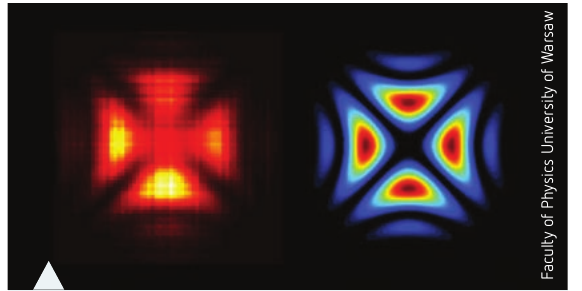
Phenomena like diffraction and refraction are best explained using wave theory. However, other observations, such as how heated objects emit light, required a completely new approach. These observations led to the development of quantum physics, which underlies modern technology from computers to smartphones.
Light particles are called photons. Although photons have no mass, they do carry energy.
What is black body radiation?
All objects continuously emit electromagnetic radiation. At any temperature above absolute zero ( K), atoms and molecules possess energy. In solids, this energy causes atoms to vibrate back and forth. Since these vibrating atoms contain charged particles (protons and electrons), and accelerating charges produce electromagnetic radiation, all objects constantly emit and absorb electromagnetic radiation.
For example, when you warm yourself by a fire, you absorb more radiation than you emit. Both you and the fire are emitting and absorbing radiation simultaneously.
Important
Important distinction: The radiation we discuss here results from an object's temperature. This differs from light production in devices like LEDs or fluorescent lights, which use different mechanisms to generate light.
At any non-zero temperature, an object emits electromagnetic radiation across all wavelengths. However, the intensity distribution across the spectrum depends on the object's temperature. Very hot objects emit visible light – think of glowing coals or an old-fashioned light bulb filament. Cooler objects emit mainly in the infrared region, which you cannot see but may feel as warmth on your skin.
Note
Key observation: Hotter objects emit more electromagnetic radiation overall, with more of that radiation at shorter wavelengths.
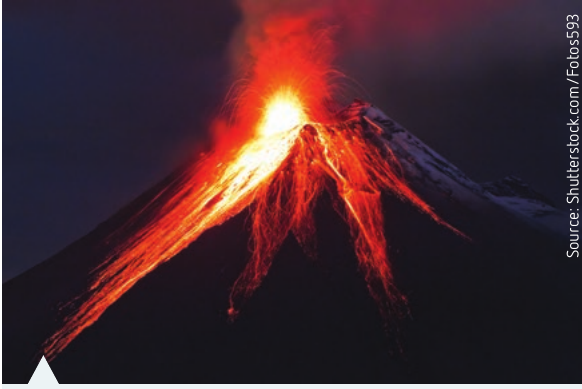
Consider heating a piece of metal. Initially it glows dim red, then bright yellow, and eventually very bright white (before melting). The apparent colour indicates which wavelengths are emitted most strongly. In the volcano image above, hotter lava appears white, cooler lava appears red, and the coolest appears black – too cool to emit visible light, though it may still emit strongly in the infrared.
The emission forms a continuous spectrum – a distribution of all wavelengths from infrared through visible to ultraviolet.
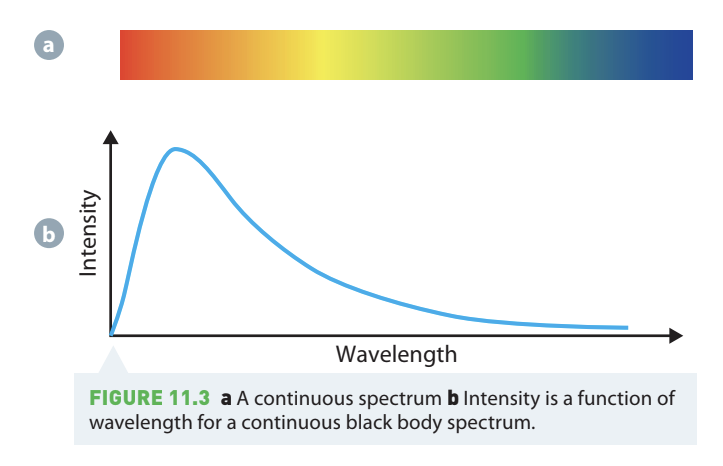
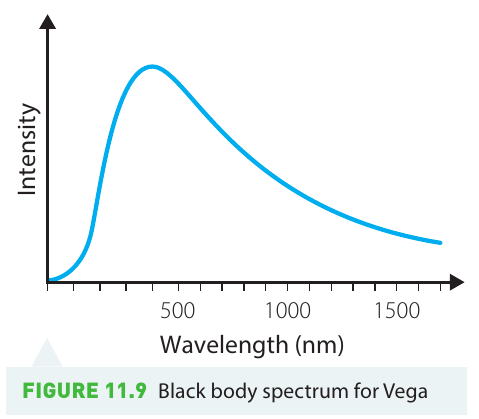
The graph shape in the figure above depends only on the object's temperature, not on what the object is made of. Classical physics could not explain this curve, which became a major problem.
Defining a black body
A black body is an idealised surface that completely absorbs all wavelengths of electromagnetic radiation falling on it. The term "black" reflects this perfect absorption – the object appears black because it absorbs all light hitting it.
Key properties of a black body:
- Perfect absorber at all wavelengths
- Perfect emitter at all wavelengths
- Emitted radiation depends only on temperature, not on material composition
- At room temperature, strongest emissions are in the infrared region
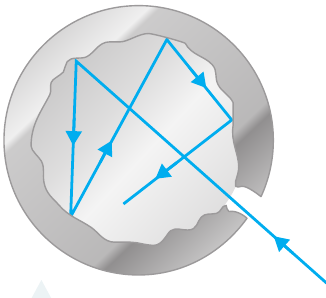
Although true black bodies are theoretical, we can approximate them in the laboratory using a cavity model.
Note
A cavity with blackened interior walls and a small hole acts as a black body. Radiation entering through the hole undergoes multiple reflections and is absorbed by the interior surfaces. When the cavity reaches thermal equilibrium with its surroundings, the interior surfaces emit radiation at the same rate they absorb it. The radiation escaping through the hole depends only on the cavity temperature, not on the cavity size or material.
Materials that absorb most incident light are good black body approximations. This explains the term "black body" – black objects absorb most light regardless of wavelength.
The black body spectrum
The black body model helps us determine temperatures of distant objects. For example, we can estimate the Sun's surface temperature by measuring its electromagnetic spectrum.
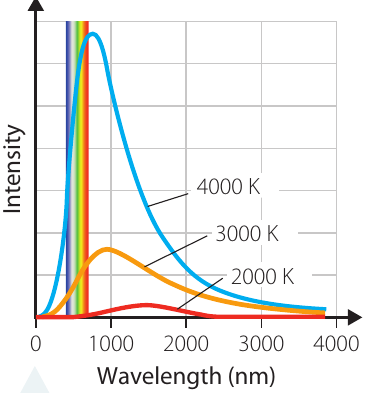
The figure above shows black body spectra at various temperatures. Notice several important patterns:
- As temperature increases, the peak shifts to shorter wavelengths
- As temperature increases, the peak intensity becomes higher
- As temperature increases, the total area under the curve (representing total radiated power) increases
- The rainbow bands show where visible light falls on the wavelength scale
These observations mean: as increases, objects emit more radiation overall, with shorter average wavelength.
Wien's law
In 1893, Wilhelm Wien derived a mathematical relationship between the peak wavelength and temperature of a black body. This relationship, called Wien's displacement law or simply Wien's law, states:
where:
- is the wavelength at which the spectrum peaks (in metres)
- is the absolute temperature (in kelvin)
- is Wien's constant = m K
Note
The units "m K" mean metre-kelvin, not millikelvin. The constant relates a length to a temperature.
We can use Wien's law to estimate an object's temperature based on the colour (frequency or wavelength) of its brightest emitted light.
Example
Worked Example: The Sun's peak wavelength
Problem: The Sun's surface temperature is approximately K. Treating the Sun as a black body, what is the peak wavelength of emitted radiation?
| Answer | Logic |
|---|---|
| K | Identify the relevant data |
| Relate wavelength to temperature | |
| Substitute values with correct units | |
| m nm | Calculate the final value. Round to two significant figures because the temperature has two significant figures |
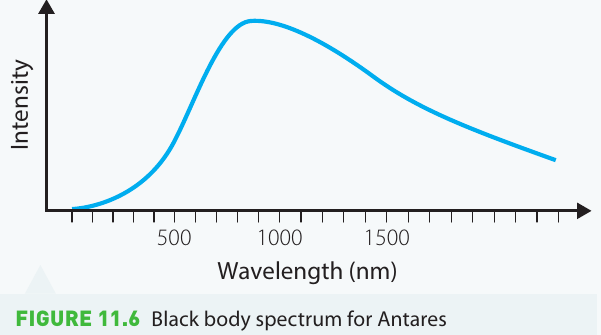
Practice: The figure above shows the black body spectrum for the star Antares. What is Antares' surface temperature?
Investigation: Black body radiation from a light globe filament
Aim
To observe black body radiation from a light globe filament as the temperature of the filament changes.
Materials
- V incandescent light globe
- Continuously variable V DC power supply, or steady voltage supply with variable resistor
- Voltmeter (or multimeter)
- Alligator leads
- Light globe holder
- Ammeter (or multimeter)
Risk assessment
| What are the risks? | How can you manage these risks? |
|---|---|
| Electrical shock | Ensure the transformer has been electrically tested. Keep it unplugged from the wall while setting up. When adjusting voltage, do not touch the wires or bulb |
| Burns from hot bulb | Do not touch the bulb once the experiment starts. Wait until it has cooled before dismantling |
Important
Safety First: Never touch the bulb or wires during operation. Ensure proper electrical testing before use and allow adequate cooling time after the experiment.
Method
- Ensure the power supply is switched off with voltage at zero. Using a proper light bulb holder, connect the light globe across the power supply terminals.
- Turn on the power supply and very slowly increase the voltage from zero until the globe just starts to glow.
- Note the voltage and your observations. Hold your hand a few centimetres from the bulb (without touching it) and note what you feel. Use the voltmeter and ammeter to measure voltage across the globe and current through it.
- Slowly increase the voltage, making observations at approximately five different voltages between the first one and maximum. Record the current and voltage at each point. Make qualitative observations about brightness. Hold your hand at a safe distance and comment on temperature.
Results
- Draw a diagram showing your experimental setup with clear labels.
- Record results in a table showing voltage and current values.
Analysis of results
- Calculate the electrical power the globe uses at each measurement point (Power Voltage Current).
- Compare calculated power with your qualitative observations of temperature and brightness. For example, if one measurement has double the power of another, does the light appear twice as bright? Consider whether this matches the patterns shown in the black body spectrum graphs.
Discussion questions
- Was the filament emitting radiation even before it was glowing?
- What does this suggest about the fraction of emitted radiation that is visible, and how does this change with voltage?
- As the filament gets hotter, does a greater or lesser fraction of radiation fall in the visible spectrum? At what temperature might the visible fraction be maximum? Consider Wien's law and that the human eye is most sensitive to green-yellow light.
- Provide an answer to your inquiry question.
Conclusion
- How does the apparent brightness change with applied voltage?
- How does it change with the actual power consumed?
- Can you qualitatively explain your results considering:
- The sensitivity of the human eye to different colours?
- The fraction of the black body spectrum likely to be visible at different filament temperatures?
- Can you suggest how to make the experiment more quantitative?
The problem with classical physics
Wien's law successfully predicted the peak wavelength position. However, two problems remained:
- No theory explained the shape of the wavelength-intensity curve
- Wien's law was based on an idealised cavity system – difficult to see how this represented real solid surfaces or stars
Classical theory proposed that thermal radiation originated from oscillating charged particles near an object's surface. Recall that oscillating charges produce electromagnetic waves (this is how antennas work). Temperature measures the average kinetic energy of atoms. In solids, this energy appears as vibrations, with higher temperatures causing higher vibration frequencies. Since atoms contain charged particles (protons and electrons), these vibrations provide the oscillating charges needed to produce electromagnetic radiation.
In the idealised black body cavity, atoms on the inside surface act like tiny antennas. The waves they produce reflect from opposite surfaces, setting up standing waves (similar to standing waves on a string). These standing waves are called modes of vibration.
Classically, all possible modes of vibration would be equally probable, with total energy divided equally among them. However, more short wavelength modes could fit in the cavity. This suggested more short wavelength radiation should be emitted through the hole.
Important
The ultraviolet catastrophe: As cavity temperature increases, so does total energy. Classical theory predicted that energy associated with short wavelengths (ultraviolet, X-rays, gamma rays) would approach infinity. According to this theory, even a regular heater should emit dangerous amounts of X-rays and gamma rays!
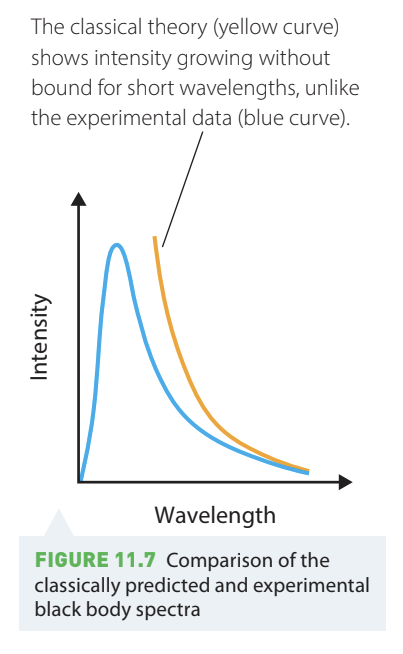
The figure shows the mismatch between classical theory (predicting ever-increasing intensity at short wavelengths) and experimental data (showing intensity decreasing at short wavelengths). This discrepancy was called the ultraviolet catastrophe – a catastrophe only for the theory that predicted it, not for reality!
A completely new theory was needed.
Planck's quanta of energy
In 1900, German physicist Max Planck used what he called "lucky guesswork" to derive a formula matching the experimentally observed spectrum. Planck proposed that atoms could only oscillate with discrete energies, given by:
where:
- is an integer ()
- is the frequency of oscillation
- is a constant (Planck's constant)
Planck's constant: J s eV s
These two values are related by the electronic charge, . The value in J s divided by gives the value in eV s.
Important
Important note on units: and must have consistent units. If is in joules, use in J s. If is in eV, use in eV s. Always write numbers with units to avoid confusion.
This was revolutionary. It meant energy is quantised – it can only take discrete values given by the equation above, not any value in a continuous range.
From this, Planck deduced that oscillators could only emit and absorb electromagnetic radiation in packets of specific energy sizes. He called these packets quanta (singular: quantum).
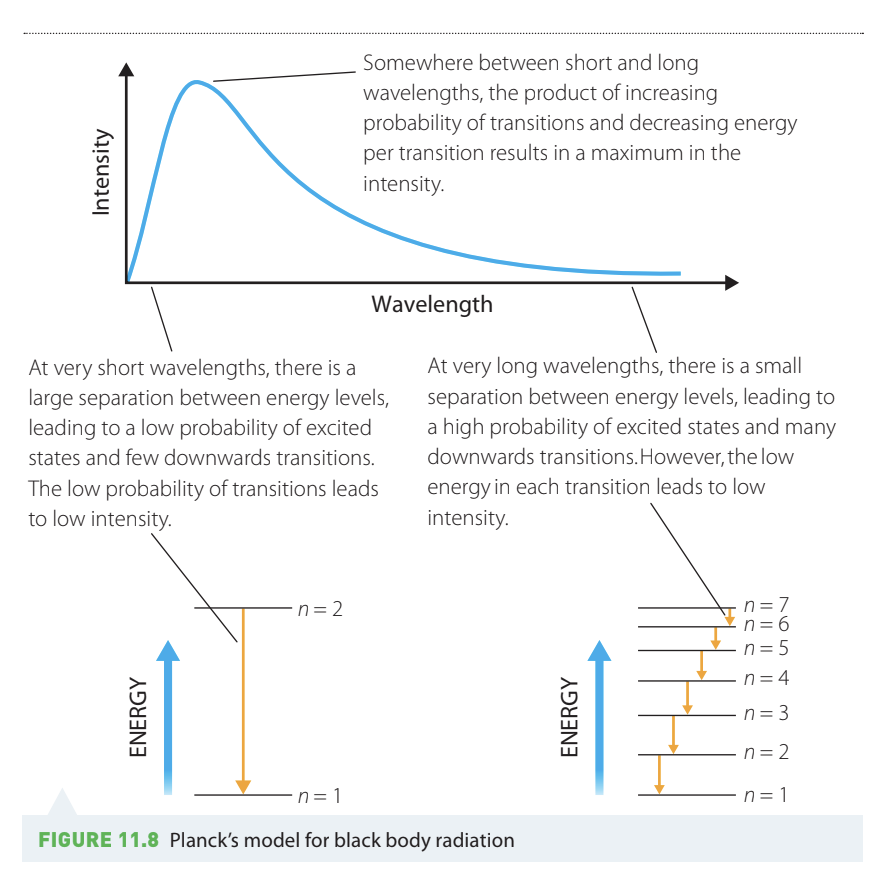
The amount of energy emitted equals the energy lost when an oscillator transitions to a lower energy state. For example, if an oscillator transitions from to , the energy lost is:
Note
One quantum of light has energy:
How Planck's model explains the spectrum
Planck combined quantisation with two ideas from statistical mechanics:
- Probability decreases with energy: The probability of an oscillator having a particular energy decreases as energy increases. Therefore, atoms are less likely to be in higher energy states (excited states). This means radiation intensity at high frequencies (short wavelengths) is small.
- Probability decreases with relative energy gap: The probability of an energy change decreases with the relative gap between energy levels. The relative gap is larger at lower energies (long wavelengths), so intensity is again low at these wavelengths.
At intermediate wavelengths, these two effects balance, creating the observed peak.
Note
At very short wavelengths: Large separation between energy levels leads to low probability of excited states and few downward transitions. Low probability means low intensity.
At very long wavelengths: Small separation between energy levels leads to high probability of excited states and many downward transitions. However, low energy per transition means low intensity.
At intermediate wavelengths: The product of increasing transition probability and decreasing energy per transition results in maximum intensity.
Example
Worked Example: Calculating frequency and energy from wavelength
Problem: A quantum of energy has wavelength m.
- (a) What is the frequency?
- (b) What is the energy?
| Answers | Logic |
|---|---|
| m | Identify the relevant data |
| (a) | Use the dispersion relation for light to relate frequency to wavelength |
| Rearrange for frequency | |
| Substitute values with correct units | |
| Hz | Calculate the final value |
| (b) | Relate energy to frequency |
| Substitute values with correct units | |
| J | State the final answer with appropriate significant figures |
Practice problems:
- Find an expression for as:
- (a) a function of
- (b) a function of
- What happens to when:
- (a) increases?
- (b) increases?
The significance of Planck's work
Energy quantisation was such a revolutionary departure from classical physics that Planck himself was reluctant to accept it. Although Planck had discovered a mathematical way of explaining the black body spectrum shape, he was concerned there was no physical model for how energy could exist in discrete packets.
Note
Planck proposed that oscillators were quantised – they gained or lost energy in discrete amounts. He did not propose that light itself was quantised. It was Albert Einstein who later gave physical meaning to Planck's quantum hypothesis.
This was the beginning of quantum physics – a completely new way of understanding nature that underpins modern technology.
Application: Earth as a black body
We can think of Earth as a black body. It absorbs radiation from its surroundings (mainly the Sun) and emits radiation itself. If energy in equals energy out, Earth's temperature remains stable.
At our distance from the Sun, the power per unit area arriving from the Sun is approximately W m. This is called the solar constant, .
If Earth's radius is , the area Earth presents to the Sun is . Therefore, Earth intercepts a total power of watts.
Earth's surface area is . To radiate this energy away without heating up, Earth needs to radiate:
from each square metre of surface.
However, Earth is not a perfect black body. About one-third of incoming energy is reflected back into space, so Earth needs to radiate approximately W m.
Black body radiation calculations show that to radiate W m, Earth would need to be at approximately K, or about C.
Earth is warmer than this because it has a blanket – the atmosphere. The effectiveness of this blanket depends on its composition. Carbon dioxide allows visible light through but blocks infrared radiation, trapping heat. This is beneficial – it prevents Earth from freezing. However, humans have added significant carbon dioxide (and other gases) to the atmosphere, making Earth's blanket too effective. Consequently, Earth is warming up.
Important
Understanding black body radiation is central to understanding climate change – probably the biggest issue of our time.
Summary
Key Points to Remember:
-
All objects emit electromagnetic radiation based on their temperature, forming a continuous spectrum with intensity low at both the shortest and longest wavelengths.
-
Wien's law relates the peak wavelength to temperature: , where m K. This allows us to determine temperatures of distant objects like stars.
-
Classical physics failed to explain the black body spectrum, predicting infinite intensity at short wavelengths (the ultraviolet catastrophe), which doesn't occur in reality.
-
Planck's revolutionary idea: Energy is quantised in discrete packets called quanta, with energies given by . One quantum of light has energy , where J s is Planck's constant.
-
Black body radiation is crucial for understanding climate change, as Earth's energy balance depends on absorbed solar radiation and emitted thermal radiation, affected by atmospheric composition.