Dispersion of Light (HSC SSCE Physics): Revision Notes
📚Revision Notes
Dispersion of Light
What is chromatic dispersion?
When white light passes through a transparent material like glass or water, it separates into its component colours. This separation happens because different colours of light bend (refract) by different amounts as they pass through the material. This effect is called chromatic dispersion.
The key principle is that red light refracts the least, whilst violet light refracts the most. We can express this mathematically as:
This relationship tells us that the refractive index for red light is lower than for blue light in the same material. Each colour of the visible spectrum has a slightly different refractive index, which causes the separation we observe.
Note
The difference in refractive indices between colours is typically small (usually just a few percent), but this small difference is enough to create the spectacular colour separation we can observe with a prism or in rainbows.
Understanding wavelength and refraction
The reason different colours refract by different amounts relates to their wavelengths. Shorter wavelengths (like violet and blue light) are refracted more strongly than longer wavelengths (like red and orange light). This wavelength-dependent refraction is what creates the beautiful spectrum of colours we can observe.
Important
Remember: Shorter wavelength = stronger refraction. This is why violet light always bends more than red light when passing through transparent materials.
Dispersion through a prism
One of the clearest demonstrations of chromatic dispersion occurs when white light passes through a glass prism. The separation of colours happens through a two-stage process:
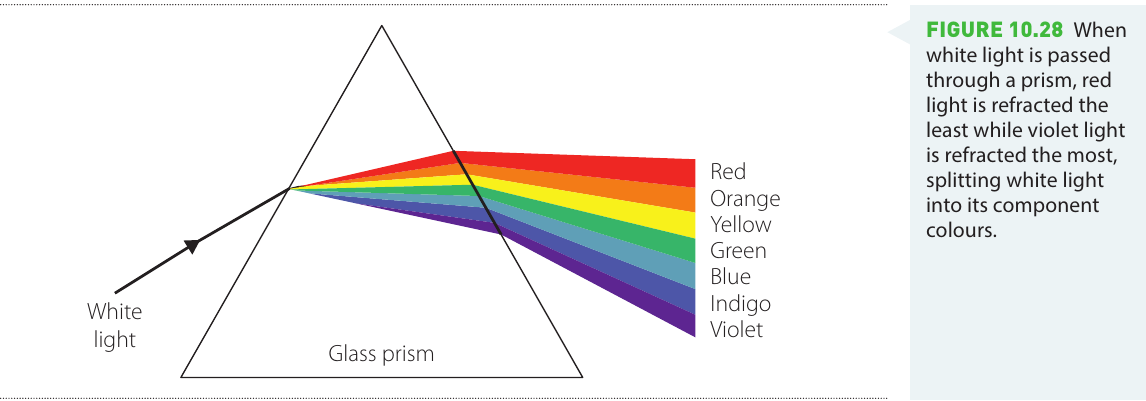
- First refraction: When white light enters the prism, it slows down and bends towards the normal. Because different colours bend by different amounts, they start to separate at this point.
- Second refraction: When the light exits the prism back into air, it speeds up and bends away from the normal. Importantly, both refractions bend the light in the same general direction.
This double refraction amplifies the separation between colours, making the effect much more visible than it would be with a single refraction. The emerging light shows the familiar spectrum of colours: red, orange, yellow, green, blue, indigo, and violet (remembered by the mnemonic ROYGBIV).
Note
Why double refraction matters:
The prism is particularly effective at showing dispersion because both refractions work together. If you had just one refraction (like light entering a rectangular glass block and traveling perpendicular to the opposite face), the colours would separate but remain very close together, making them hard to distinguish. The prism's angled surfaces ensure both refractions bend light in the same direction, doubling the separation effect.
Red light, which refracts the least, emerges at the smallest angle from the original direction. Violet light, which refracts the most, emerges at the largest angle. This creates the characteristic fan of colours we associate with prism dispersion.
Rainbow formation
Rainbows are one of nature's most spectacular demonstrations of chromatic dispersion. They form when sunlight interacts with millions of water droplets suspended in the atmosphere.
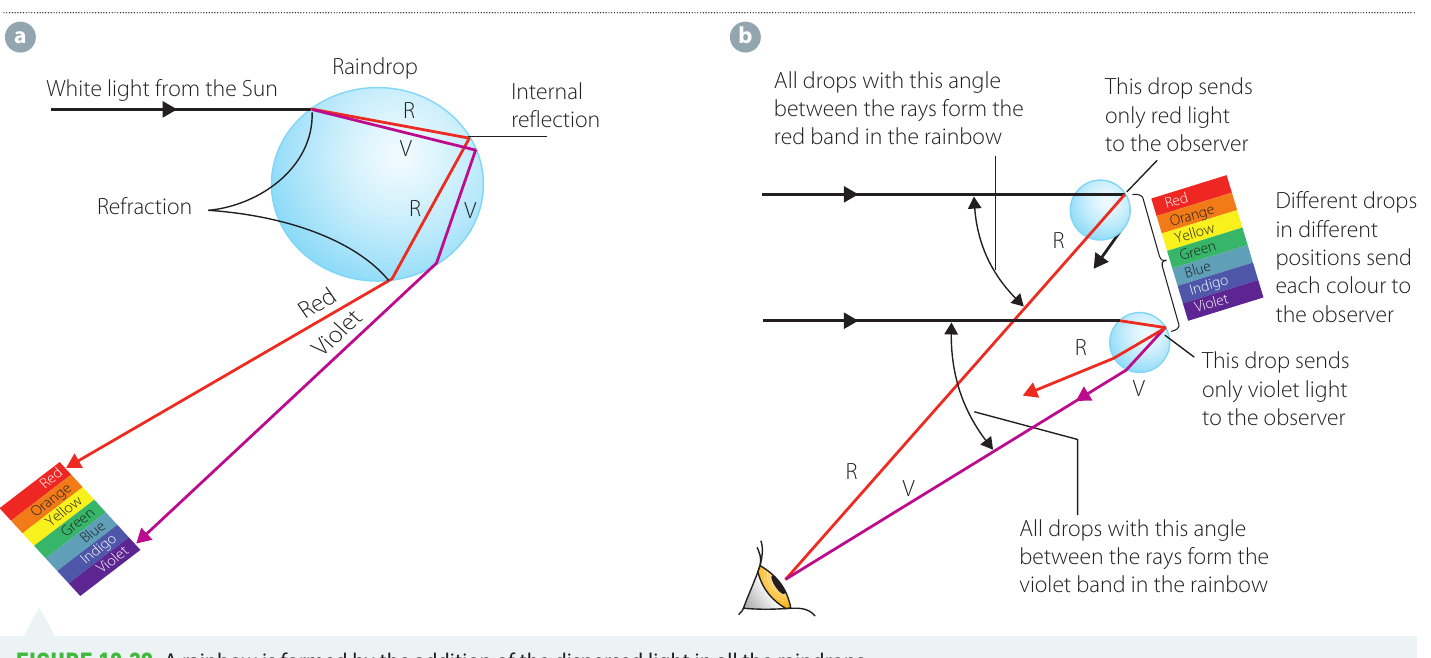
The formation of a rainbow involves three optical processes within each raindrop:
- Refraction on entry: White sunlight enters the raindrop and disperses into its component colours. Just like in a prism, different colours bend by different amounts.
- Internal reflection: The separated colours reach the back surface of the raindrop and reflect internally. This bounces the light back towards the front of the drop.
- Refraction on exit: As the light exits the raindrop, it refracts again, further separating the colours.
Important
The key to understanding rainbows:
A particular raindrop will only send one specific colour to your eye, depending on its position relative to you and the sun. Raindrops at slightly different positions send different colours to your eye. When you look at millions of raindrops simultaneously, each drop at a particular angle sends its corresponding colour, building up the complete rainbow arc you observe.
This explains why different observers see the rainbow in slightly different positions - each person receives light from a different set of raindrops. It also explains why you can never reach the end of a rainbow!
Refractive indices for different colours
The extent of dispersion depends on the material through which light passes. Different types of glass can be manufactured to have different optical properties, which affects both how much they refract light and how much they disperse different colours.
The table below shows the refractive indices for different colours in two common types of glass:
| Colour | Crown Glass | Flint Glass |
|---|---|---|
| Red | ||
| Yellow | ||
| Blue | ||
| Violet |
Note
Key Observations from the Data:
-
Within each glass type: The refractive index increases from red to violet. This confirms that violet light refracts more than red light.
-
Between glass types: Flint glass has consistently higher refractive indices than crown glass for all colours. This means flint glass bends light more strongly.
-
Dispersion amount: The difference between red and violet refractive indices is larger for flint glass () than for crown glass (). This means flint glass produces greater dispersion and more vivid colour separation.
These differences in optical properties are important in applications such as lens design and decorative glass manufacturing. Flint glass, with its greater dispersion, is used in applications where colour separation or sparkle is desired.
Investigation 10.5: Demonstrating dispersion of light
Example
Practical Investigation: Observing Light Dispersion
Aim
To demonstrate and explain the dispersion of light using a prism.
Materials
- Ray box
- Glass or perspex triangular prism
- Paper, ruler, pencil and protractor
- Optional: camera (or other recording device)
Risk assessment
| What are the risks in doing this investigation? | How can you manage these risks to stay safe? |
|---|---|
| The globe in the ray box can get very hot and cause burns. | Take care handling the ray box to ensure you do not touch the globe. |
You should also consider other risks such as working with sharp-edged prisms and ensuring electrical equipment is used safely away from water.
Method
-
Set up the apparatus on a flat surface on a piece of paper so that a single ray of light is incident on the prism (similar to the arrangement shown in the prism diagram).
-
Trace the outline of the prism and mark the path of the incident white light ray onto the paper beneath the prism.
-
Carefully trace the paths of the exiting coloured light rays, being as accurate as possible. Label each colour as you identify it.
-
Once complete, remove the paper. Using a protractor, measure the angle between the violet and red light rays that are leaving the prism. This angle represents the total angular dispersion.
Results
You should photograph your investigation setup and the completed ray diagram, or ensure your traced diagram is retained with your notes. The diagram should clearly show:
- The prism outline
- The incident white light ray
- The separated coloured rays (labelled)
- The measured angle between red and violet rays
Analysis of results
Compare the change in direction of the red ray relative to the original white light ray. Measure the angle between them. Then repeat this measurement for the violet ray. Calculate the difference between these two angles - this is your angular dispersion.
You should observe that the violet ray has deviated more from the original direction than the red ray, confirming that violet light refracts more strongly than red light.
Discussion
-
Why dispersion is not usually observed: When light refracts through a single flat surface (like a window), dispersion still occurs, but the separated colours are so close together that our eyes cannot distinguish them. The colours remain overlapped and appear white. The prism is effective because it refracts light twice in the same direction, amplifying the small angular differences between colours.
-
Conditions necessary for dispersion: For visible dispersion to occur, you need:
- White light (containing multiple colours)
- A transparent refracting medium
- Preferably multiple refractions in the same general direction
- Sufficient path length for colours to separate enough to be distinguished
-
Beyond the visible spectrum: When white light disperses, wavelengths beyond the visible spectrum also refract. Beyond the red end, you might detect infrared radiation using an appropriate detector. Beyond the violet end, ultraviolet radiation would be present. These invisible parts of the electromagnetic spectrum follow the same refraction principles as visible light.
Conclusion
Your conclusion should address the aim by explaining how the investigation demonstrated dispersion. You should state that white light separated into its component colours when passed through the prism, with violet light refracting more than red light. The measured angular separation between colours provides quantitative evidence for chromatic dispersion. The double refraction of the prism amplified the dispersion effect, making it easily observable.
Summary
Key Points to Remember:
-
Chromatic dispersion occurs when different colours in white light refract by different amounts as they pass through a material.
-
Shorter wavelengths (violet, blue) refract more strongly than longer wavelengths (red, orange). This can be expressed as .
-
A prism creates visible dispersion because light refracts twice - once entering and once leaving - with both refractions bending light in the same direction.
-
Rainbows form through dispersion within raindrops, involving refraction on entry, internal reflection, and refraction on exit. Different raindrops send different colours to an observer's eye.
-
The amount of dispersion varies between materials. Flint glass shows greater dispersion than crown glass because it has larger differences in refractive index between different colours.