Sound Waves (HSC SSCE Physics): Revision Notes
📚Revision Notes
Beats and the Doppler Effect
Introduction
The wave nature of sound creates some fascinating phenomena that we experience in everyday life. Two important effects that arise from the properties of sound waves are beats and the Doppler effect. Both of these rely on fundamental wave principles and have practical applications in music, transportation, and many other areas.
Note
Both beats and the Doppler effect demonstrate how wave properties create observable phenomena in our daily lives. Understanding these effects not only explains common experiences but also provides practical tools for musicians, engineers, and scientists.
The superposition of sound producing beats
What are beats?
When two sound sources produce tones at slightly different frequencies at the same time, something interesting happens. The sound waves from both sources overlap and combine through a process called superposition. As the waves superpose, they alternately reinforce each other (constructive interference) and cancel each other out (destructive interference). This creates a pulsing or throbbing effect in the sound intensity that we hear.
This pulsing phenomenon is called beats, and the rate at which the sound grows and shrinks is called the beat frequency.
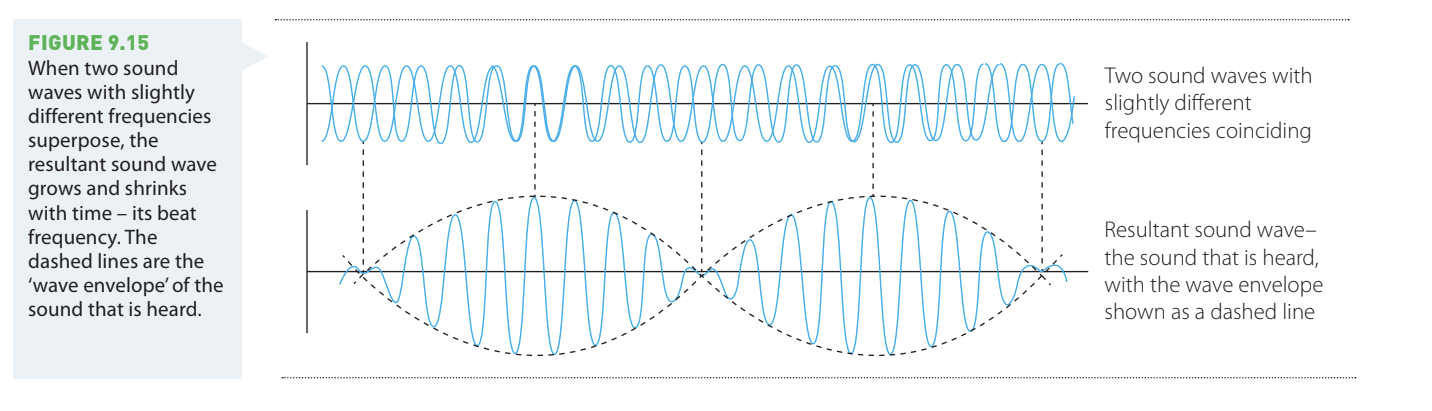
The diagram shows two sound waves with slightly different frequencies (shown in cyan at the top). When these waves combine, the resultant wave (shown below) has an amplitude that rises and falls periodically. The dashed envelope curve shows how the overall sound intensity varies with time, creating the characteristic "beating" pattern.
Understanding beat frequency
The beat frequency is remarkably simple to calculate. It equals the difference between the two source frequencies:
where and are the frequencies of the two sound sources.
Note
The absolute value symbols ensure the beat frequency is always positive, regardless of which frequency is larger. This makes sense because the pulsing effect is the same whether or .
Real-world applications
Beats are extremely useful in practical situations:
- Musical instrument tuning: Experienced musicians and piano tuners use beats to tune their instruments precisely. When two strings are slightly out of tune, beats can be heard. As the tuner adjusts one string closer to the correct pitch, the beat frequency decreases. When the beating stops completely, the strings are perfectly in tune.
- Aircraft and boats: Beats can sometimes be heard from aircraft or boats with two engines running at slightly different speeds. While many people might not consciously notice this effect, it becomes quite obvious once you know what to listen for.
Important
The 20 Hz Rule
Beats are only audible when the frequency difference is less than approximately . Beyond this threshold, the human ear cannot perceive the amplitude variations as beats and instead hears two separate, distinct tones. This limit is related to the temporal resolution of human hearing.
Worked example: calculating beat frequency
Example
Worked Example: Calculating Beat Frequency
Problem: A musical instrument is played with a frequency of . Another instrument is played at the same time with a frequency of . What beat frequency is heard?
Solution:
| Step | Working |
|---|---|
| Identify the data | ; |
| Write the formula | |
| Substitute values | |
| Calculate |
Answer: The beat frequency heard is , meaning the sound intensity will pulse twice per second.
Investigation: observing beats in sound
This practical investigation allows you to observe and measure beats directly.
Aim: To observe beats in sound
Materials:
- 2 signal generators with speakers (or phone apps with external speakers)
Safety considerations:
| Risk | Management Strategy |
|---|---|
| Electrical equipment near water | Keep all devices plugged into 240 V mains power well away from water |
| Other hazards | Assess and document any additional risks in your laboratory setting |
Important
Safety First
Always ensure electrical equipment is kept away from water sources. Complete a proper risk assessment for your specific laboratory environment before beginning this investigation.
Method:
- Set each signal generator to a frequency of . Listen carefully to the resulting sound produced.
- Now set the first signal generator to while keeping the second at . Listen and observe the sound created.
- Change the frequency of the first signal generator to . Listen and observe again.
- Set the signal generators' frequencies to different values a few Hz apart. Listen and observe the beating effect.
- Measure the beat frequency by counting or tapping every peak in sound intensity over a period of seconds, then divide by . This averaging technique reduces measurement error.
- Change the signal generators' frequencies so they are more than apart and listen carefully.
Results: Record your observations for each frequency setting used.
Analysis questions:
- How did the beat frequency relate to the difference between the two source frequencies?
- Expected finding: The beat frequency should equal the absolute difference between the two source frequencies.
- Describe what was heard as the difference between the two source frequencies increased to beyond .
- Expected finding: When the frequency difference exceeds approximately , beats are no longer heard. Instead, the ear perceives two separate tones. This is because is roughly the limit of the human ear's ability to perceive amplitude variations.
Discussion points:
- Using a diagram, explain the cause of the beats you observed. Consider how constructive and destructive interference create the pulsing pattern.
- Explain why beat frequencies are not heard when the difference between source frequencies exceeds . This relates to the temporal resolution of human hearing.
The Doppler effect
What is the Doppler effect?
Have you ever noticed how the pitch of an ambulance siren seems to drop suddenly as it passes you? This is the Doppler effect in action. The Doppler effect is the change in observed frequency of a sound when there is relative motion between the sound source and the observer.
The physics behind the effect
The Doppler effect occurs because relative motion changes the time between successive sound wave compressions reaching the observer.
When the source approaches the observer:
- The source "chases" the sound waves it emits
- Successive compressions reach the observer sooner than if there were no motion
- The wavelength of the sound decreases
- The observed frequency increases (higher pitch)
When the source moves away from the observer:
- It takes longer for successive compressions to reach the observer
- The wavelength increases
- The observed frequency decreases (lower pitch)
Note
Understanding the Wavelength-Frequency Relationship
Since the relationship between wave velocity, frequency, and wavelength is , and the speed of sound in air remains constant, a decrease in wavelength must result in an increase in frequency, and vice versa. This is the fundamental principle behind the Doppler effect.
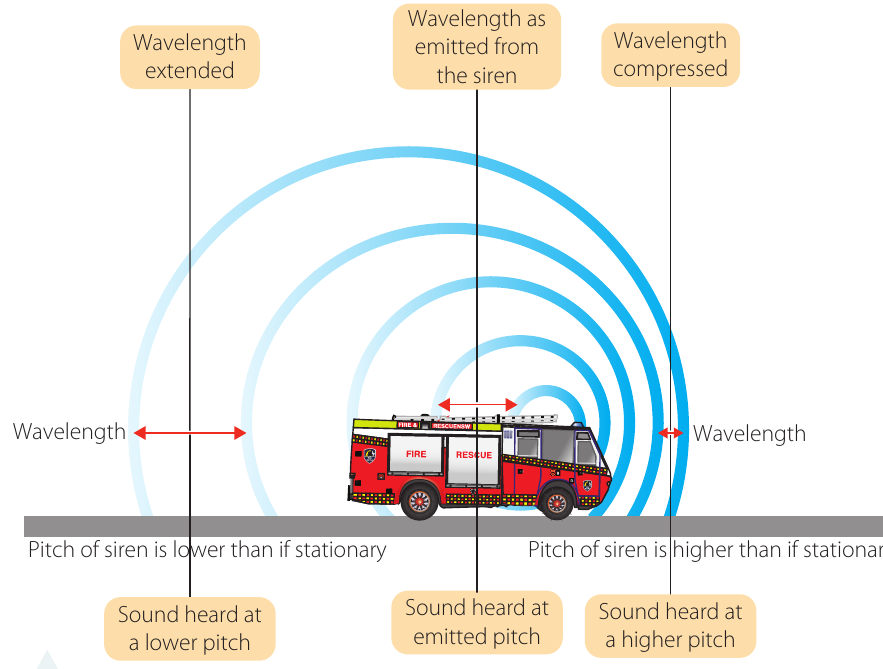
This diagram shows how a moving siren creates the Doppler effect. On the right side (where the siren is moving towards the observer), the wavelengths are compressed and closer together, resulting in a higher pitch. On the left side (where the siren is moving away), the wavelengths are extended and farther apart, resulting in a lower pitch. The wavelength as emitted from the siren itself is shown in the centre.
Real-world examples
The Doppler effect can be observed in many everyday situations:
- Emergency vehicle sirens: The classic example of an ambulance or fire truck approaching and passing you
- Racing motorcycles: The distinctive change in engine note as they pass spectators
- Aircraft flyovers: Particularly noticeable with low-altitude, high-speed aircraft
The mathematics of the Doppler effect
The change in observed frequency depends on the velocities of both the source and the observer. There are several different scenarios to consider:
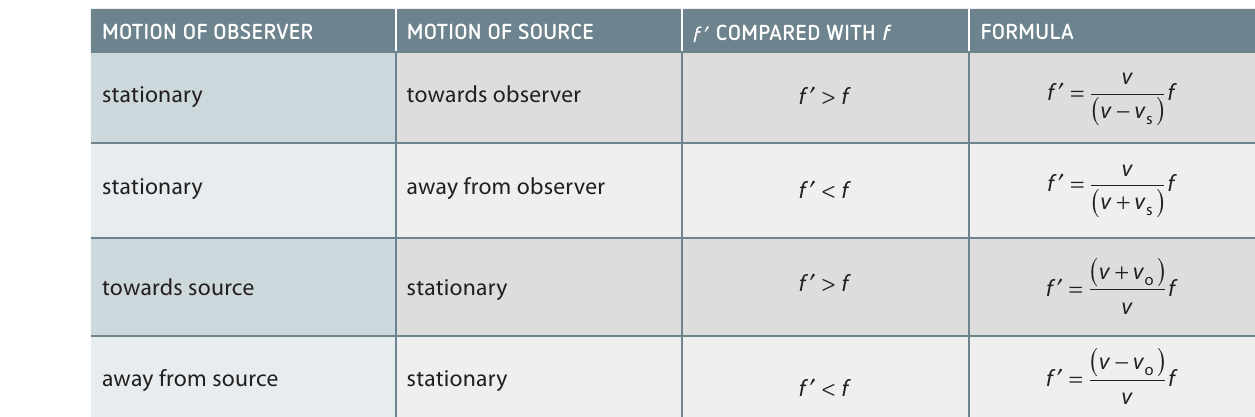
The table above summarises the four main cases and their formulas. The key principle is:
- When the distance between source and observer is decreasing, (frequency increases, higher pitch)
- When the distance is increasing, (frequency decreases, lower pitch)
General Doppler formula
When both the source and observer may be moving, we can use a general formula:
where:
- is the observed frequency
- is the source frequency
- is the speed of sound in air ( at room temperature)
- is the velocity of the observer
- is the velocity of the source
Important
Critical Sign Convention
Pay careful attention to the signs of velocities in the Doppler formula:
- Use positive velocity when moving towards each other
- Use negative velocity when moving away from each other
- For the numerator (observer): add if moving towards source, subtract if moving away
- For the denominator (source): subtract if moving towards observer, add if moving away
A common mistake is to confuse these signs, which will give an incorrect result. Remember: the formula structure reflects the physical reality that approaching motion compresses wavelengths while receding motion extends them.
Worked example: ambulance and car approaching
Example
Worked Example: Moving Source and Moving Observer
Problem: The siren from an approaching ambulance has a frequency of . The ambulance is travelling at . A car is moving towards the approaching ambulance at . What is the frequency of the sound heard by an occupant of the car?
Solution:
| Step | Working |
|---|---|
| Identify the data | ; ; ; |
| Write the formula | |
| Substitute values | |
| Calculate |
Answer: The occupant of the car hears a frequency of , which is noticeably higher than the actual siren frequency of . This makes sense because both vehicles are moving towards each other, creating a double Doppler effect.
Sonic booms and supersonic motion
An interesting and extreme consequence of the Doppler effect occurs when a source moves faster than the speed of sound. In this case:
- The source overtakes the sound waves it is emitting
- No sound is heard by an observer until after the source passes
- The source creates a shock wave called a sonic boom
Note
Breaking the Sound Barrier
When the source speed equals or exceeds the speed of sound, you can see from the Doppler formula that approaches zero, causing to approach infinity theoretically. In reality, this creates a shock wave as the source breaks through the sound barrier. This shock wave produces the distinctive loud "boom" heard when supersonic aircraft fly overhead.
Remember!
Summary
Key Concepts to Remember:
-
Beats occur when two sound waves with slightly different frequencies superpose, creating alternating constructive and destructive interference that produces a pulsing effect in sound intensity.
-
The beat frequency equals the absolute difference between the two component frequencies: . Beats are only audible when this difference is less than approximately .
-
The Doppler effect is the change in observed frequency when there is relative motion between a sound source and an observer. Motion towards each other increases observed frequency (higher pitch), while motion apart decreases it (lower pitch).
-
The general Doppler formula is , where careful attention must be paid to the signs of velocities depending on direction of motion.
-
Practical applications: Musicians use beats to tune instruments by listening for the beat frequency to disappear, indicating perfect tuning. The Doppler effect explains why emergency vehicle sirens change pitch as they pass by.