Relationship Between Distance and Intensity (HSC SSCE Physics): Revision Notes
📚Revision Notes
Relationship Between Distance and Intensity
What is sound intensity?
When a source produces sound waves, the energy spreads out into the surrounding air, covering an increasingly larger area. As this happens, the intensity of the sound decreases.
Intensity is the amount of sound energy passing through a unit area in one second. To understand this:
- Energy is measured in joules ()
- Unit area means one square metre ()
- Time is one second
This gives us the unit joules per second () per square metre. Since one joule per second equals one watt (), we express intensity in watts per square metre ().
Note
The unit (watts per square metre) tells us how much sound power passes through each square metre of area every second. This standardized unit allows us to compare sound intensities in different situations.
The inverse square law
Sound intensity follows a pattern called the inverse square law. This describes how intensity changes as you move away from a sound source.
For this relationship to work accurately, we assume:
- The sound source is a point source (very small)
- There are no nearby objects to reflect or absorb the sound
Important
The inverse square law only applies accurately when:
- The sound source is very small (a point source)
- There are no reflections from nearby surfaces
- There is no significant absorption by the surrounding medium
In real-world situations, these conditions are approximations, but the law still provides useful predictions.
The inverse square law states that intensity is inversely proportional to the square of the distance from the source:
where:
- is the intensity of sound
- is the distance from the sound source
- means "is proportional to"
What does this mean in practice?
If you double your distance from a sound source, the intensity becomes one-quarter of what it was. If you triple the distance, the intensity becomes one-ninth. The sound spreads out over a larger area, so the intensity at any point decreases rapidly.
Note
Think of it like this: when sound travels twice as far, it spreads over an area four times as large (since area increases with the square of distance). The same amount of energy spread over four times the area means one-quarter the intensity at any point.
Using the inverse square law for calculations
When comparing intensities at two different distances, we can use this mathematical relationship:
where:
- is the intensity at distance
- is the intensity at distance
This formula is very useful for solving problems about how sound intensity changes with distance.
Measuring intensity in decibels
Sound intensity is commonly measured using the decibel (dB) scale. This is a logarithmic scale, which means each step represents a multiplication rather than simple addition.
Why use a logarithmic scale? Because the range of sound intensities we can hear is enormous - from the faintest whisper to a jet engine represents a difference of over a trillion times!
Note
A logarithmic scale compresses this huge range into a manageable set of numbers. Instead of dealing with values from to watts per square metre, we use the decibel scale from 0 to 120 dB.
The threshold of hearing
The quietest sound humans can typically hear is called the threshold of hearing. This has been assigned:
This is defined as .
How the decibel scale works
The decibel scale increases logarithmically:
- has 10 times the intensity of , or
- has 10 times the intensity of , or
- Each increase of represents a tenfold increase in intensity
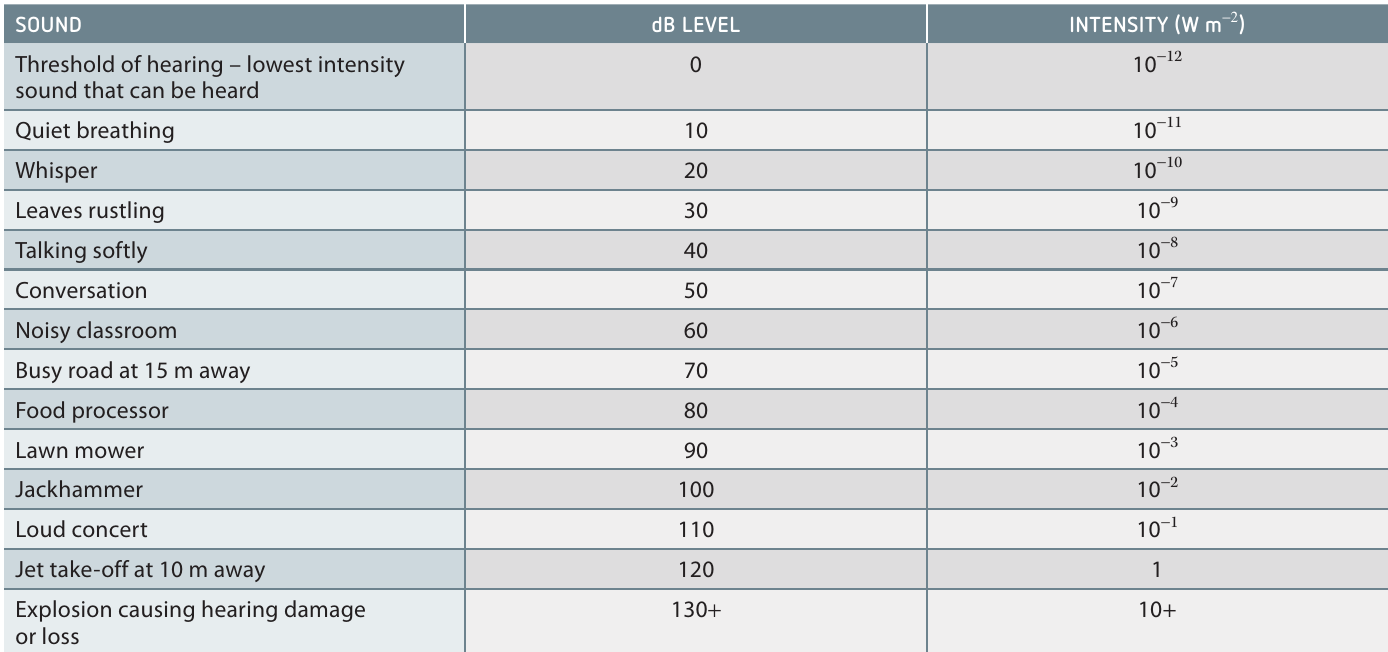
Here's a table showing common sounds and their intensities:
Note
From this table, you can see that a loud concert () has an intensity (100 billion) times greater than the threshold of hearing! This demonstrates why the logarithmic scale is so useful for representing such vast ranges.
Converting decibels to watts per square metre
Since most sound level meters and smartphone apps display readings in decibels, you often need to convert to for calculations. Use this formula:
where:
- is the sound intensity in
- is the sound level in decibels
Important
When converting from decibels to watts per square metre, remember that this formula involves a logarithmic relationship. A small change in decibels represents a much larger change in actual intensity!
Investigation: Relationship between distance and intensity of sound
Aim
To investigate the relationship between the intensity of sound and the distance from the source.
Before conducting the investigation, write a hypothesis about how you predict distance from a sound source will affect the measured intensity.
Materials
- Constant sound source (e.g. signal generator with speaker, or electric bell)
- Decibel meter (or suitable smartphone app)
- Measuring tape
Method
1. Select a suitable quiet area outdoors, preferably away from walls and other buildings that might reflect sound. This helps ensure you're only measuring the direct sound from your source.
2. With the constant sound playing, measure the decibel reading at 10 different distances from the source.
3. Record your results in the table below.
Important
Safety Considerations:
- Ensure the sound source is not at a dangerously high volume
- Be aware of your surroundings when conducting outdoor measurements
- Protect your hearing by maintaining a safe distance from loud sound sources
Record your measurements in the first two columns of this table:

Analysis of results
1. Calculate the values for the third, fourth and fifth columns:
- For the third column (sound intensity), convert your decibel readings using:
- For the fourth column, square each distance value ()
- For the fifth column, calculate the inverse of distance squared ()
2. Plot a graph of intensity ( in ) on the y-axis versus inverse distance squared () on the x-axis.
3. Alternatively, you can use spreadsheet software:
- Copy the fifth column (inverse distance squared) and third column (intensity) into the spreadsheet
- Important: The fifth column must be to the left of the third column, or your axes will be swapped
- Highlight both columns and insert a scatter graph
- Add appropriate labels and a title
4. Draw a line of best fit through your plotted data points. This line should pass as close to all data points as possible.
Note
If the inverse square law holds true, your graph of intensity versus should produce a straight line passing through the origin. This linear relationship confirms that .
Discussion questions
Consider these questions when analysing your results:
1. Does your data support the inverse square law for sound? A straight line through the origin would confirm this relationship.
2. What other factors might have affected your measurements? Think about:
- Background noise
- Wind
- Reflections from nearby surfaces
- Accuracy of the decibel meter
3. How could you improve this investigation to get more reliable results?
Conclusion
Write a conclusion that:
- Refers to your original hypothesis
- Summarises what your data shows about the relationship between distance and intensity
- Links your findings to the inverse square law
- Notes any limitations or uncertainties in your results
Example
Worked Example: Using the inverse square law
Let's look at how to solve problems involving the relationship between distance and intensity.
Problem: The intensity of a sound wave is at a distance of from the source. What will the intensity be at a distance of ?
Solution:
Given information:
- (intensity at first distance)
- (first distance)
- (second distance)
- (what we're finding)
Step 1: Start with the inverse square law formula:
Step 2: Rearrange to solve for :
Step 3: Substitute the known values with their units:
Step 4: Calculate the answer:
Important notes:
- Always include units in your calculations
- Express your final answer with the correct number of significant figures (2 significant figures in this case, based on the given data)
- The intensity decreased significantly because the distance increased by more than 4 times
Summary
Key Concepts:
-
Intensity of sound () measures the amount of sound energy passing through a unit area per second, with units of
-
Intensity is inversely proportional to the square of the distance from a point source, following the inverse square law:
-
For calculations involving two positions, use:
-
The decibel (dB) scale is logarithmic, with the threshold of hearing defined as or
-
To convert from decibels to watts per square metre:
Summary
Remember!
-
Sound spreads out: As sound waves travel away from their source, they spread over an increasingly larger area, causing intensity to decrease.
-
The inverse square law: When you double your distance from a sound source, the intensity becomes one-quarter of its original value. Triple the distance, and intensity drops to one-ninth.
-
Decibels are logarithmic: An increase of means the sound is 10 times more intense. An increase of means it's 100 times more intense!
-
Real-world applications: This is why standing next to a lawn mower requires hearing protection, but being across the street from one doesn't - the inverse square law means intensity drops rapidly with distance.
-
Always include units: When solving problems, carry units through your calculations to help catch errors and ensure your final answer is in the correct form.