Thermodynamics (HSC SSCE Physics): Revision Notes
📚Revision Notes
Energy Transfer Models
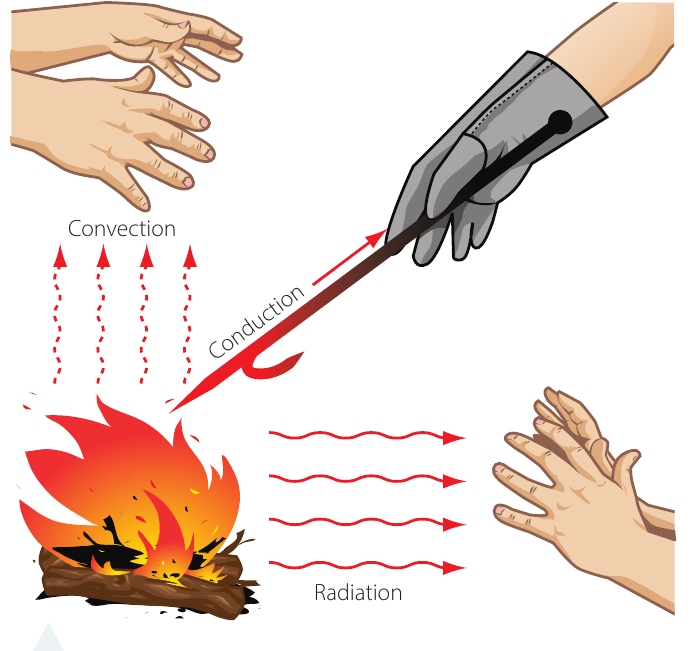
Heat energy naturally flows from regions of high temperature to regions of low temperature. This transfer occurs through three distinct mechanisms: conduction, convection, and radiation. The kinetic particle model provides a useful framework for understanding how heat moves through materials, particularly in conduction and convection.
Conduction
What is conduction?
Conduction is the process by which heat energy transfers through a substance via particle collisions. Importantly, there is no overall movement of the particles themselves - they vibrate in place rather than moving from one location to another.
When one end of a material (such as a metal rod) is heated, the particles in that region gain energy and vibrate more vigorously. These energetic particles collide with neighbouring lower-energy particles, transferring kinetic energy through the chain of collisions. Eventually, the average kinetic energy of all particles becomes equal throughout the substance, a state called thermal equilibrium.
Thermal conductivity
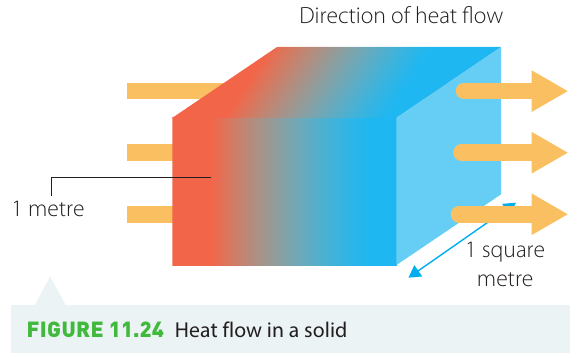
Different materials conduct heat at different rates. Thermal conductivity () is a measure of how effectively a material transfers heat energy. Specifically, it quantifies how much energy (in joules) flows per second through a cross-sectional area of , over a distance of , for each degree of temperature difference between the two ends.
The unit of thermal conductivity is (watts per metre per kelvin).
Note
Generally:
- Solids conduct heat better than liquids or gases
- Metals are excellent heat conductors
- Non-metals are typically poor heat conductors (good insulators)
The thermal conductivity equation
When calculating heat flow through a material, we need to consider several factors:
- Energy change: (in joules)
- Rate of energy transfer: (energy per second, in watts)
- Cross-sectional area: (in square metres)
- Temperature difference: (in kelvin or degrees Celsius)
- Distance through the material: (in metres)
- Thermal conductivity of the material: (in )
These variables combine to give us the thermal conductivity equation:
Rearranging to find the total energy transferred:
Important
Since heat flows from hot to cold, the temperature difference () will always be negative when calculated as final minus initial temperature. The negative sign indicates the direction of energy flow (outward from the heat source).
Why metals conduct heat so well
Metals are particularly effective heat conductors because of their atomic structure. In metallic bonding, valence electrons are not tightly bound to individual atoms. Instead, they exist as delocalised electrons - free to move throughout the metal lattice.
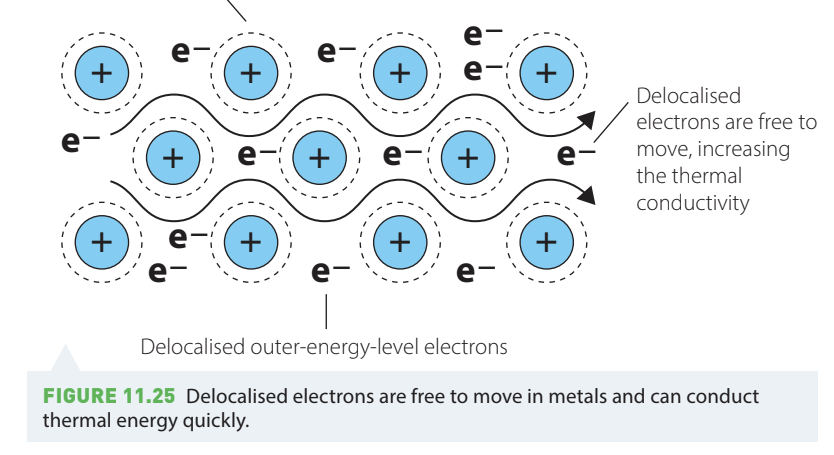
These mobile electrons can rapidly transfer kinetic energy to other electrons and atoms throughout the metal. This is much faster than energy transfer through vibrations alone, which is the primary mechanism in non-metallic materials.
Thermal conductivity values for common metals
| Substance (at 20°C) | Thermal conductivity (W m⁻¹ K⁻¹) |
|---|---|
| Admiralty brass | 111 |
| Aluminium, pure | 204 |
| Copper, pure | 386 |
| Gold | 315 |
| Lead | 35 |
| Tungsten | 170 |
| Zirconium | 23 |
Note
Notice how copper has the highest thermal conductivity in this table, making it ideal for applications like heat sinks and cooking utensils.
Insulators and heat retention
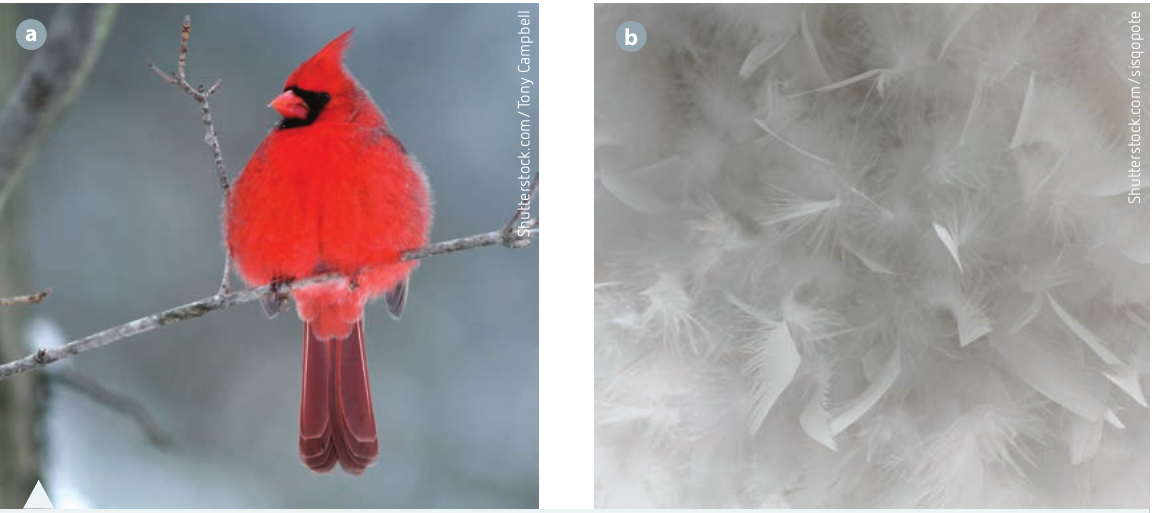
Almost all non-metallic materials, including gases, are thermal insulators. Unlike metals, non-metals lack free delocalised electrons. In solids, particles are relatively fixed in position, whilst in gases they are widely spaced. Both situations result in slower heat transfer.
Animals exploit this principle to retain body heat. Birds fluff their feathers and cats puff up their fur when cold, trapping layers of air. Since air is an excellent insulator, this reduces heat loss from their bodies.
Worked example: heat transfer through aluminium
Example
Worked Example: Heat Transfer Through Aluminium
Question: Given that the thermal conductivity of aluminium is , how much energy is transferred through a distance of in a block of aluminium of square cross-section with one side at and the other at , in seconds?
Solution:
First, identify the known values:
- (or )
The appropriate formula is:
Rearranging to find :
Substituting the values:
The negative sign indicates energy transferred out from the hot end to the cold end.
Final answer: 1910 kJ or 1.91 × 10⁶ J
(We report the magnitude only, since the question asks "how much energy is transferred")
Investigation 11.5: Determining thermal conductivity of an unknown metal
Aim: To identify an unknown metal by determining its thermal conductivity
Materials required:
- Hot plate (to maintain constant temperature)
- 250 mL beaker and 150 mL beaker
- Ice cubes and water
- Measuring cylinder
- 2 thermometers
- Styrofoam sleeve for insulation
- Styrofoam cup
- Dissecting probe
- Timer/stopwatch
- Putty or other sealant
- Unknown metal rod (approximately 15 cm long)
- 2 retort stands with boss heads and clamps
- Safety glasses and protective gloves
Safety considerations:
| Risk | Safety management |
|---|---|
| Hot water can cause burns and scalds | Do not exceed the experimental temperature. Wear safety glasses and protective gloves. If spilt on skin, wash with plenty of cold water for 5 minutes. Apply ice pack. |
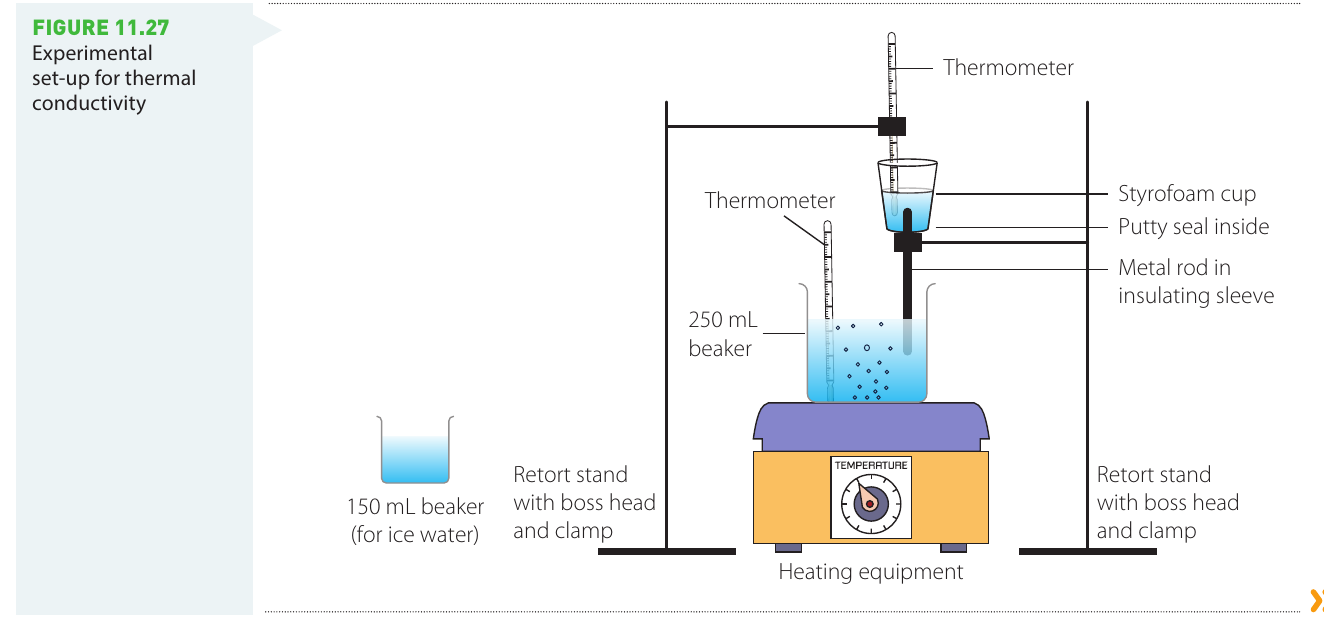
Method:
- Set up the equipment as shown in the diagram:
- Prepare ice water: Place 100 mL of water in the 150 mL beaker, add ice cubes, and monitor until the temperature reaches 0°C
- Prepare hot water bath: Place 200 mL of water in the 250 mL beaker on the hot plate. Heat until the temperature reaches 60°C
- Place the insulating sleeve around the middle of the metal rod, leaving about 2 cm exposed at each end
- Make a small hole in the base of the styrofoam cup with the dissecting probe
- Insert the metal rod from below so that 2 cm penetrates into the cup. Seal with putty inside
- Clamp the styrofoam cup with rod inserted high on the retort stand
- Clamp the thermometer to measure the temperature inside the styrofoam cup
- Measure 100 mL of ice water (no ice cubes) into the styrofoam cup. Check for leaks.
- Lower the rod/cup assembly so that the bottom 2 cm of the rod is in the hot water bath.
- Start the timer.
- Record the elapsed time and the temperature of the water in the styrofoam cup at the beginning, and then every minute for 5 minutes.
- Repeat for reliability.
Results: Record your results in a table and display the data as a graph.
Analysis:
- Determine the amount of energy transferred to the water in the styrofoam cup using: (Remember that applies to the water in the styrofoam cup only)
- Measure the length and diameter of the rod. Calculate its cross-sectional area from the diameter.
- Determine the thermal conductivity () of the metal using the formula (Rearrange to make the subject first)
- Compare your calculated value with published thermal conductivity values to identify the metal.
Discussion questions:
- Did your graph yield a straight line? What does this indicate?
- Were the results of your second trial consistent with your first trial?
- How would you assess the overall reliability of your investigation?
- What improvements could enhance reliability?
- How valid was the investigation? Did it meet the stated aim?
Convection
What is convection?
Convection is the transfer of heat energy through the bulk movement of particles in a fluid. Unlike conduction, where particles vibrate in place, convection involves actual flow of the fluid itself from warmer to cooler regions, creating convection currents.
When a fluid is heated, it expands and becomes less dense. This makes it more buoyant, causing it to rise. Cooler, denser fluid sinks to replace it, creating a continuous circulation pattern. This is why we often say "heat rises" - though technically, it's the hot fluid that rises.
Note
Convection occurs only in fluids (liquids and gases) because their particles are weakly connected and can move freely. Convection is more effective in gases than liquids because gas particles are even less tightly connected.
In nature, birds soar gracefully on convection currents in the atmosphere, also called thermals. These are caused by temperature differences between air masses.
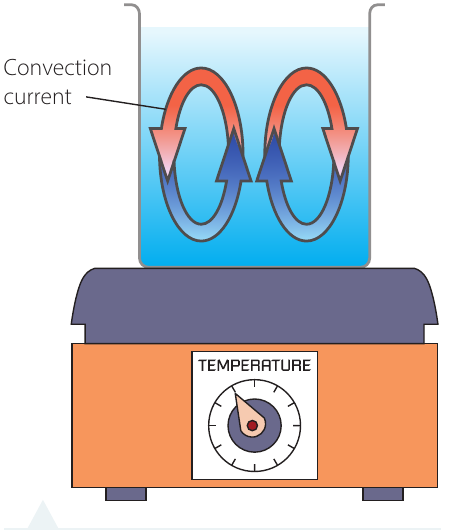
Convection cells
A convection cell forms where warm and cold fluid masses meet and interact. Examples include:
- Atmospheric weather patterns
- Ocean currents
- Hydronic heating systems in homes
In a convection cell, warm, less dense fluid flows upward whilst denser, cooler fluid sinks downward. This creates a continuous circulation pattern that efficiently transfers heat energy throughout the fluid.
Investigation 11.6: Bottled convection currents
Aim: To explore convection in liquids
Materials required:
- 4 empty identical transparent bottles with a mouth at least 8 cm across
- Warm and cold water
- Food colouring (yellow and blue)
- An old playing card (or card of similar dimensions and strength)
- Digital camera (optional)
Safety considerations:
| Risk | Safety management |
|---|---|
| Water on the floor can cause slipping | Perform the experiment in a sink or large tray to avoid spills. Clean up any spills immediately. |
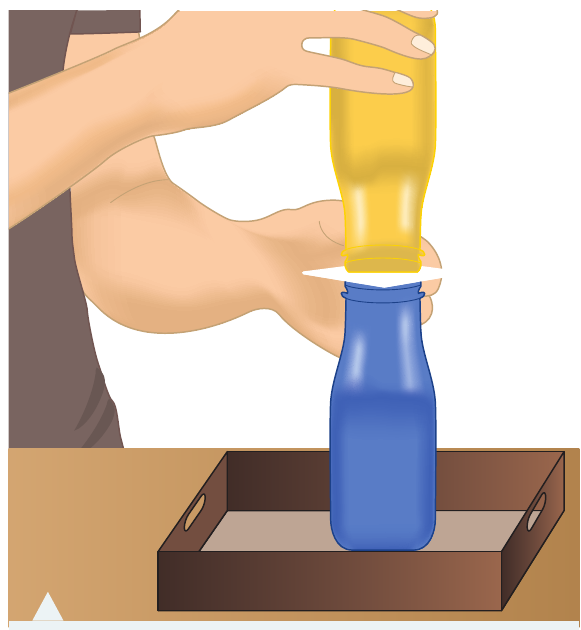
Method:
- Fill four bottles with water - two with warm tap water and two with cold water.
- Add yellow food colouring to the bottles of warm water, and blue food colouring to the bottles of cold water.
- Place the playing card over the mouth of one warm water bottle.
- Over a sink or large tray, turn the bottle upside down and rest it on top of a cold water bottle. Make sure they are exactly aligned mouth to mouth with the card separating the two liquids.
- Bring the two liquids into direct contact by carefully sliding the card out.
- Observe what happens to the coloured liquids.
- Repeat steps 3-6, but this time place the cold water on top of the warm water.
Analysis:
- For each situation, describe any changes to the cold water and warm water.
- Support your descriptions with annotated diagrams, photos or video clips.
- Use the kinetic particle model to explain what you observed.
Discussion: Which of the two experiments could be used as a model to explain:
- Ocean currents?
- The formation of thunder clouds?
Radiation
What is radiation?
Radiation is fundamentally different from conduction and convection because it does not require a medium to transfer energy. Unlike the other two methods, radiation does not involve particles of matter moving or colliding.
All objects (except those at absolute zero, 0 K) emit electromagnetic radiation. This occurs because moving charged particles (electrons or ions) within the object generate electromagnetic waves.
The relationship between temperature and radiation
The temperature of an object determines the characteristics of the radiation it emits:
- Hotter objects: Particles move faster, generating radiation with higher frequency and shorter wavelength
- Cooler objects: Particles move slower, generating radiation with lower frequency and longer wavelength
This relationship can be visualized using Planck curves, which show the intensity of radiation at each wavelength for objects at different temperatures. These curves are related to the Maxwell-Boltzmann distribution of particle energies.
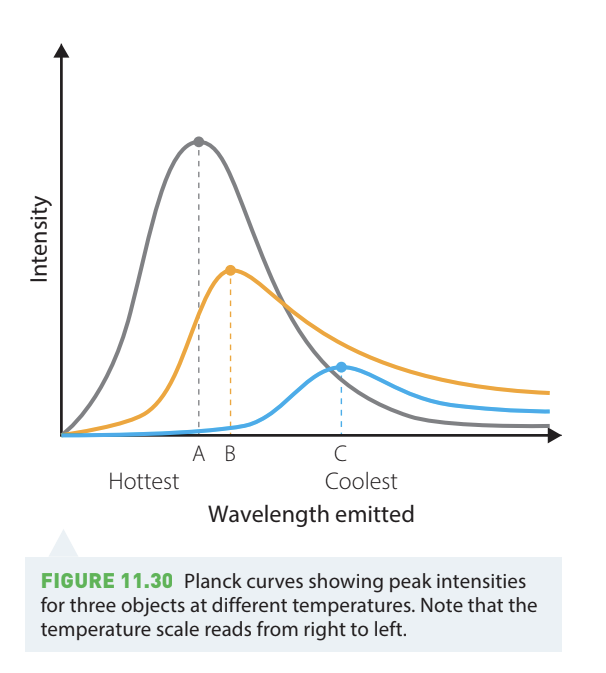
Note
The diagram shows how the peak intensity shifts to shorter wavelengths (left) as temperature increases, following Wien's displacement law.
Examples of thermal radiation
Different objects emit different types of electromagnetic radiation based on their temperature:
- Gas clouds in space (close to 0 K): Emit radio waves
- Warm bodies (including humans): Emit mostly infrared radiation
- Hot objects (800°C): Glow dull red
- Stars (3000-30,000 K): Emit visible light and ultraviolet radiation
- Very hot stars like Spica (22,000 K): Emit primarily ultraviolet light
Scientists use Planck curves to measure temperatures in furnaces and distant stars by analyzing the spectrum of radiation they emit.
The electromagnetic spectrum
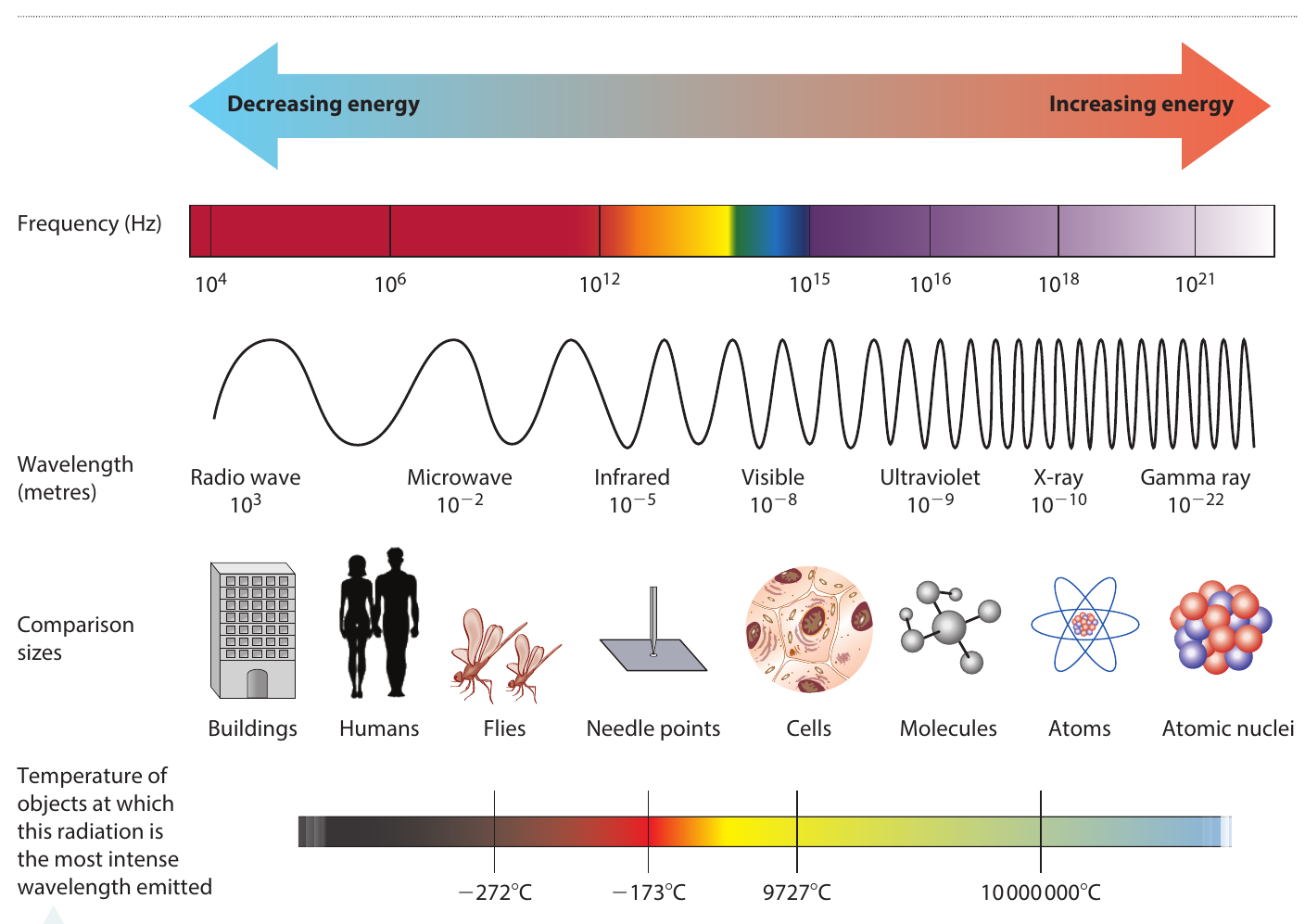
The electromagnetic spectrum encompasses all types of electromagnetic radiation, arranged by wavelength and frequency:
- Radio waves: Longest wavelength ( m), lowest frequency ( Hz)
- Microwaves: Wavelength m, frequency Hz
- Infrared: Wavelength m, frequency Hz
- Visible light: Wavelength m, frequency Hz
- Ultraviolet: Wavelength m, frequency Hz
- X-rays: Wavelength m, frequency Hz
- Gamma rays: Shortest wavelength ( m), highest frequency ( Hz)
Note
The temperature scale shows which type of radiation is most intensely emitted at different temperatures, ranging from -272°C to 10,000,000°C.
Investigation 11.7: Radiative heating with microwaves
Aim: To investigate the heating properties of microwaves
Materials required:
- Microwave oven (2.45 GHz)
- Oven mitts
- Baking paper
- 2 solid blocks of chocolate (length > 13 cm)
- Ruler
- Digital camera
Safety considerations:
| Risk | Safety management |
|---|---|
| Hot molten chocolate can burn | Only handle the molten chocolate with oven mitts. Do not eat it. |
Method:
- Remove the rotating tray from inside the microwave unit.
- Cover the 'floor' of the microwave with baking paper, avoiding the rotating spindle.
- Place one block of chocolate on baking paper, parallel to the microwave door.
- Cook for 30 seconds (assuming 1 kW microwave unit).
- Remove paper with chocolate on it.
- Repeat steps 2-5, this time with the chocolate block perpendicular to the door.
Results:
- Measure the distances between the hot spots and record in a table.
- Take a digital image of your chocolate blocks.
Discussion: Explain the existence of, and distance between, the hot spots.
Note
The hot spots reveal the standing wave pattern of microwaves inside the oven. The distance between hot spots equals half the wavelength of the microwave radiation.
Remember!
Summary
Key Points to Remember:
-
Three methods of heat transfer: Heat can be transferred by conduction, convection, or radiation. Each method works differently and is suited to different situations.
-
Conduction formula: The rate of heat flow through a material is given by , where is thermal conductivity, is cross-sectional area, is temperature difference, and is distance.
-
Metals conduct, non-metals insulate: Metals have delocalised electrons that rapidly transfer energy, making them excellent conductors. Non-metals lack these free electrons and are typically good insulators.
-
Convection requires fluids: Convection involves bulk movement of particles and only occurs in liquids and gases. It creates convection currents and convection cells where warm and cold fluid masses meet.
-
Radiation needs no medium: Unlike conduction and convection, radiation transfers energy through electromagnetic waves and does not require matter. All objects above absolute zero emit radiation, with hotter objects emitting higher-frequency, shorter-wavelength radiation.