Conservation of Energy (HSC SSCE Physics): Revision Notes
📚Revision Notes
Conservation of Energy
Understanding energy systems
In thermodynamics, we need to understand two important types of systems:
Closed system: A closed system is one where matter cannot enter or leave the system, but energy can be transferred into or out of the system through work or heat processes. Think of a sealed bottle of hot water - the water molecules stay inside, but thermal energy can escape through the bottle walls.
Isolated system: An isolated system is one where neither energy nor matter can enter or leave. In reality, perfectly isolated systems don't exist (except perhaps the universe itself), but we can model systems as isolated when energy losses are negligible, such as in well-insulated calorimeter experiments.
Note
The key difference between these systems lies in what can cross their boundaries:
- Closed systems: Energy can cross the boundary, but matter cannot
- Isolated systems: Neither energy nor matter can cross the boundary
Understanding these distinctions is essential for applying conservation principles correctly in thermodynamic problems.
The conservation of energy principle
Within an isolated system, the total amount of energy always remains constant. Although energy can be converted from one form to another, and can be transferred from place to place, the total energy within the isolated system never changes.
Energy transfer occurs when energy flows from one object or substance to another. For example, heat flowing from hot water to a cooler container.
Energy transformation occurs when energy changes from one form to another. When you switch on a torch, the battery's stored chemical energy transforms into electrical energy, which then transforms into both light energy and thermal energy. The battery converts chemical energy to electrical energy, while the globe or LED converts electrical energy into light and heat.
First law of thermodynamics
Important
The first law of thermodynamics (also called the law of conservation of energy) states that in an isolated system, energy can neither be created nor destroyed. Energy can be transferred from one object to another, or transformed from one type to another, but the total energy of an isolated system remains constant.
This fundamental principle underlies all energy calculations and helps us understand why perpetual motion machines are impossible.
State changes
Pure substances undergo state changes at specific temperatures. A pure solid begins to change state to a liquid at its melting point. A pure liquid begins to change state to a gas at its boiling point.
Types of state changes
There are six main types of state changes:
- Melting: Solid → Liquid (requires energy input)
- Vaporization: Liquid → Gas (requires energy input)
- Condensation: Gas → Liquid (releases energy)
- Solidification (Freezing): Liquid → Solid (releases energy)
- Sublimation: Solid → Gas directly (requires energy input)
- Deposition: Gas → Solid directly (releases energy)
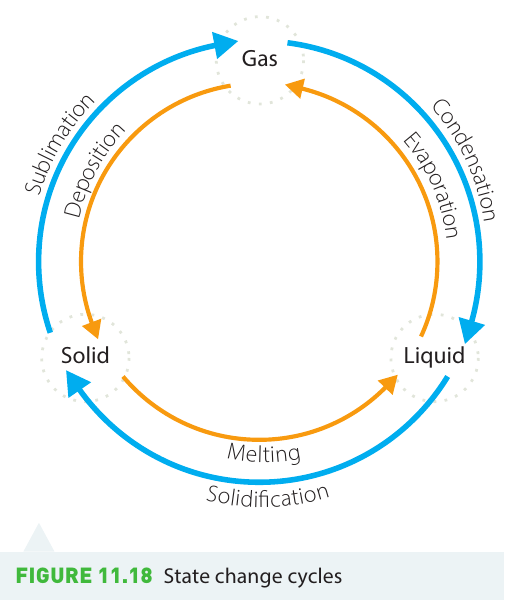
Note
Understanding sublimation and deposition:
Sublimation occurs when a solid turns directly into a gas when heated without sufficient external pressure (like dry ice). The reverse process, deposition, can also occur when gases form solids directly.
Notice that processes moving "upward" (solid→liquid→gas) require energy input, while processes moving "downward" (gas→liquid→solid) release energy to the surroundings.
Evaporation vs vaporization
These two processes are often confused, but they are distinctly different:
Evaporation occurs below the boiling point at the surface of a liquid. Particles with relatively high kinetic energy that are less tightly bound at the surface can escape into the vapour phase. Some particles may lose energy and return to the liquid.
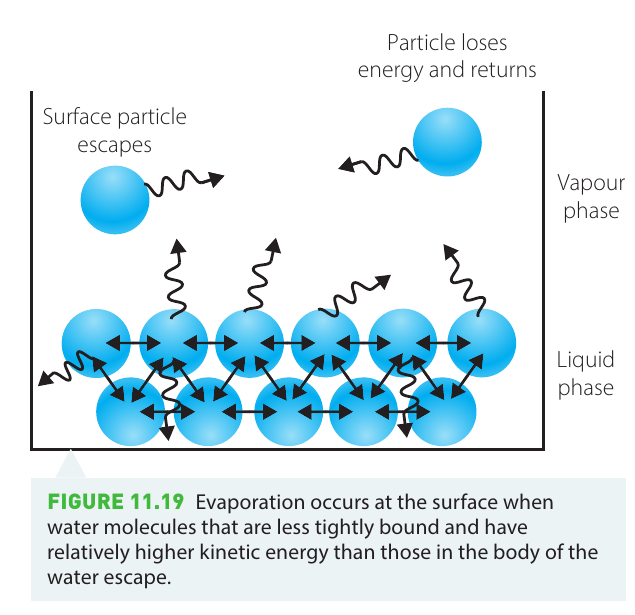
Vaporization occurs when a liquid changes to gas at the boiling point. Bubbles form below the surface and throughout the liquid. Importantly, no temperature change occurs during vaporization, even though energy is being continuously added.
Important
Key distinction:
- Evaporation: Occurs at the surface only, below boiling point, particles with high kinetic energy escape
- Vaporization: Occurs throughout the liquid at boiling point, bubbles form, temperature remains constant
Remember: Surface vs Bubbles - Evaporation happens at the Surface; vaporization produces Bubbles.
Latent heat
When a substance undergoes a state change, energy must be added or removed, but the temperature remains constant during the change. This energy is called latent heat (from the Latin word meaning "hidden").
Specific latent heat of fusion
The specific latent heat of fusion of a substance is the energy required to change the state of of the substance from its solid state to its liquid state without any change in temperature.
For water, the specific latent heat of fusion is .
In the solid state, water particles are held tightly together in a rigid structure. To separate them enough to form a liquid requires a large amount of energy. This energy is supplied from an external source and increases the average separation between particles, not their kinetic energy. Therefore, the internal energy increases, but since there's no increase in average kinetic energy, the temperature remains constant and a thermometer cannot detect this energy change.
Specific latent heat of vaporization
The specific latent heat of vaporization of a substance is the heat required to change the state of of the substance from its liquid state to its gaseous state.
For water, the specific latent heat of vaporization is .
This value is much larger than the latent heat of fusion because it requires significantly more energy to completely separate the particles from each other to form a gas.
Note
Why is latent heat "hidden"?
The term "latent" means hidden in Latin. This heat is "hidden" because you cannot measure it with a thermometer - the temperature doesn't change during a state change even though energy is being continuously added or removed. The energy goes into changing the particle separation (internal energy) rather than particle motion (kinetic energy).
Why latent heat matters
Both melting and vaporization are reversible processes. When steam at condenses to liquid water at , it releases the latent heat of vaporization to its surroundings. This is why steam burns are far more severe than burns from the same mass of liquid water at - the steam releases additional energy as it condenses on your skin.
Application: Cloud formation
Condensation and latent heat release play a crucial role in cloud formation. When a pocket of moist air rises into cooler regions (because it's less dense than the surrounding dry air), the water vapour condenses to form clouds. During condensation, the latent heat of vaporization is released into the surrounding air, warming it. This warmer air becomes even less dense and continues rising. Eventually, the rising air reaches the boundary of the troposphere (the weather zone's "ceiling"), and cloud formation continues horizontally rather than vertically. This creates the distinctive anvil-shaped clouds often seen at the tops of thunderclouds, particularly in tropical regions.
Calculating energy changes during state changes
Deriving the formula
Through experimental investigation, scientists have found a direct proportionality between the energy required for a state change and the mass of substance changing state:
To convert this proportionality to an equation, we introduce a constant, (the latent heat):
Rearranging this equation to find the latent heat:
where:
- is the energy transferred (in joules, J)
- is the mass (in kilograms, kg)
- is the specific latent heat (in joules per kilogram, )
Investigating latent heat
A student investigated the relationship between mass and energy during the melting of ice. Different masses of ice at were dried to remove any liquid water, then heated at a steady rate of until the ice had just melted. The time was recorded for each mass. The investigation was designed to minimize external heat gains or losses.
| Mass of water produced (kg) | Time (s) | Energy (kJ) |
|---|---|---|
| 0.10 | 33 | 33 |
| 0.22 | 71 | 71 |
| 0.39 | 88 | 88 |
| 0.51 | 175 | 175 |
| 0.64 | 217 | 217 |
| 0.90 | 300 | 300 |
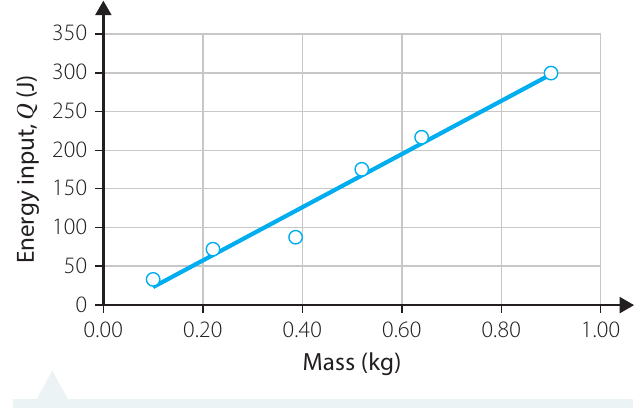
The graph clearly shows a direct proportional relationship between energy input and mass. From the graph, the gradient equals , which represents the latent heat of fusion in units of . This matches the known value of for water.
Example
Worked Example: Melting ice
Problem: Given that the latent heat of fusion of water is , how much energy is required to melt of ice at to of water at ?
Solution:
Step 1: Identify the given data and convert units if necessary
Given data: ;
Step 2: Select the appropriate formula
Using the formula:
Step 3: Substitute the values
Substituting values:
Step 4: Calculate the result
Calculating:
Expressing in scientific notation:
Answer: Therefore, of energy is required to melt of ice at .
Investigation: Latent heat of fusion of solids
This investigation can be adapted to measure the latent heat of fusion for various solids including ice and other substances that melt at similar temperatures.
Basic principle
When crushed ice at is added to water at a known temperature, the ice melts and the water cools. By measuring the temperature change of the water and knowing the masses involved, you can calculate the latent heat of fusion of ice.
Experimental design considerations
Aim: To determine the latent heat of fusion of ice by calorimetry.
Materials needed:
- Calorimeter (or well-insulated container)
- Thermometer
- Crushed ice at (dried to remove surface water)
- Water at room temperature
- Balance for measuring mass
Important
Safety considerations:
When conducting this investigation, consider potential hazards such as:
- Spillage of water
- Glass thermometers breaking
- Handling ice (may cause cold burns with prolonged contact)
Manage these risks by working carefully, using appropriate containers, and handling materials with care.
Analysis approach
The energy lost by the warm water equals the energy gained by the ice:
Energy lost by water = Energy to melt ice + Energy to warm melted ice to final temperature
Using:
This can be written as:
By measuring masses and temperatures, you can solve for , the latent heat of fusion.
Note
Experimental tips for accurate results:
- Ensure the ice is dry before adding it to the water (surface water will affect mass measurements)
- Use crushed ice rather than large chunks for faster melting and better mixing
- Stir the water gently during the experiment to ensure even temperature distribution
- Minimize heat exchange with the surroundings by using a well-insulated calorimeter
- Record the initial temperature of the water as close to the moment of adding ice as possible
Summary
Key Points to Remember:
-
Energy is conserved: In an isolated system, energy cannot be created or destroyed, only transferred or transformed.
-
State changes require energy: Melting, vaporization, and sublimation require energy input. Condensation, solidification, and deposition release energy.
-
Latent heat is "hidden": During state changes, temperature remains constant even though energy is being added or removed. This energy changes particle separation (internal energy) rather than particle motion (kinetic energy).
-
Use the formula : To calculate energy changes during state changes, where is the specific latent heat.
-
Water's latent heats are large: Water has a specific latent heat of fusion of and a specific latent heat of vaporization of - much larger values that reflect the strong intermolecular forces in water.
-
Remember the mnemonic: "Latent = Hidden" - The heat is "hidden" because you can't measure it with a thermometer (no temperature change).