Heat, Work, and Energy (HSC SSCE Physics): Revision Notes
📚Revision Notes
Heat, Work, and Energy
What is thermodynamics?
Thermodynamics is a branch of physics that examines how heat, work, and energy affect physical systems. This field emerged during the 19th century when scientists and engineers were developing steam engines and trying to understand their operation. The study focuses on observable, measurable effects at scales large enough for us to detect and quantify.
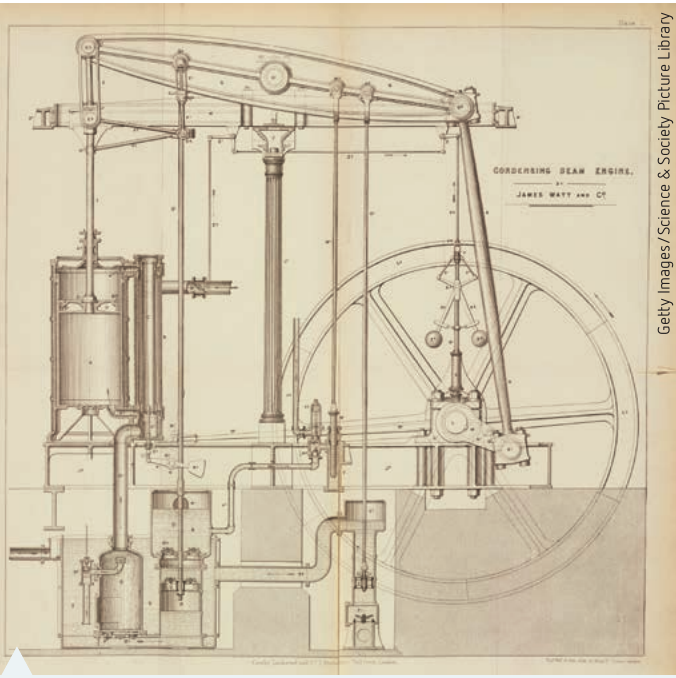
Note
Thermodynamics is governed by three fundamental laws, which are somewhat confusingly numbered as the zeroth, first, and second laws. These laws help explain how systems interact through heat, energy, and work.
The zeroth law defines and explains thermal equilibrium - the state where objects at the same temperature no longer exchange heat. The first law (the law of conservation of energy) and the second law help us understand how systems reach equilibrium and why certain processes occur naturally while others do not.
Understanding heat, work, and energy
Energy is a central concept throughout physics, appearing in many theories and models. We use the law of conservation of energy to explain observations and make predictions in countless situations. Energy exists in many different forms.
What is heat?
Heat is energy that is currently being transferred from one location to another due to a temperature difference. This is a crucial distinction: heat is not a form of stored energy, but rather energy in the process of moving. When we say we "heat" something, we mean we are adding heat energy to it - for example, when heating food on a stove.
What is work?
Work is energy being transferred due to the action of a force. Like heat, work is not stored in an object or system - it describes energy in transit.
Important
Both heat and work are processes of energy transfer, not forms of energy that can be contained. This distinction is fundamental to understanding thermodynamics.
Historical development: from caloric to energy
The scientific community took considerable time to accept that heat was a form of energy. In the 17th century, Antoine Lavoisier (1743-1794) developed the caloric theory, which proposed that caloric was a weightless fluid that flowed from hotter to colder objects through microscopic holes in materials. This theory remained influential for many years.
Sir Benjamin Thompson (Count Rumford, 1753-1814) conducted numerous experiments examining the relationship between heat and mechanical work. His research led him to conclude that heat and mechanical work were different manifestations of the same phenomenon: energy. French physicist Sadi Carnot (1796-1832) expanded these ideas, particularly in relation to engine operation.
Joule's groundbreaking experiments
James Prescott Joule (1818-1889) performed exceptionally precise experiments that definitively established the relationship between mechanical energy and heat. In his careful work, he used a known quantity of mechanical energy to raise the temperature of a measured amount of water. His data conclusively demonstrated that heat and mechanical energy are quantitatively equivalent - they can be converted between one another in predictable, measurable amounts.
Joule's evidence was instrumental in establishing the law of conservation of energy (also known as the first law of thermodynamics), which became the foundation for all subsequent studies of heat. The importance of his work is commemorated in the SI unit for energy: the joule (). Joule also collaborated with Lord Kelvin (William Thomson) to develop the absolute temperature scale and discovered the relationship between electrical current flowing through a resistance and heat generation, now known as Joule's law.
Note
Interestingly, caloric theory and energy theory coexisted for an extended period before energy became the preferred concept. Even today, echoes of caloric theory persist in how we describe heat "flowing" from hotter to colder objects, even though heat is not actually a substance.
Measuring temperature: objective versus subjective
A thermometer provides an objective, quantitative measurement of temperature using a standardized scale. In contrast, your hands give you a subjective, qualitative indication of temperature. This subjective sensation comes from heat-detecting nerves in your skin that respond to the rate at which energy (heat) is transferred to or from your skin. Since the rate of heat transfer depends on temperature difference, your nervous system interprets this sensation as temperature - but it can be misleading, as the following investigation demonstrates.
Investigation 11.1: Sensing hot and cold
Aim: To explore how we sense hot and cold
Materials:
- Three large bowls of water at different temperatures:
- Cold water (refrigerated but not frozen)
- Warm water (equal mixture of hot and cold water)
- Hot water (as hot as your hands can comfortably stand)
- Thermometer
Risk assessment:
| What are the risks in doing this investigation? | How can you manage these risks to stay safe? |
|---|---|
| Water that is too hot can burn. | Limit the temperature to . |
Consider what other risks might be associated with this investigation and how you can manage them to stay safe.
Method:
- Record the temperature of each bowl of water using the thermometer.
- Place your left hand in the cold water and your right hand in the hot water for 2 minutes.
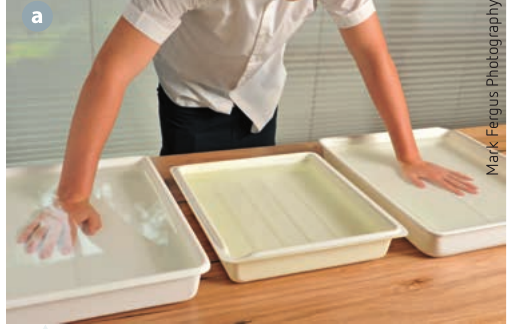
- After 2 minutes, place both hands simultaneously in the warm water mixture.
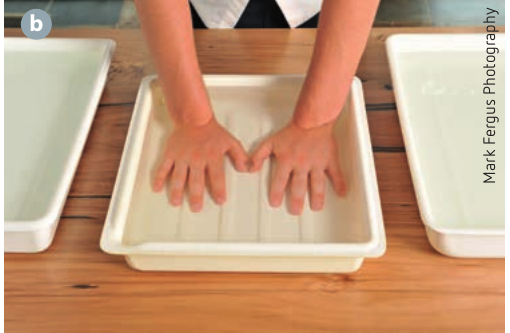
Results:
Record descriptions of the sensation of hotness or coldness in each hand:
- At the start, when you first place your hands in the hot and cold water
- After you have placed both hands in the warm water mixture
Discussion:
Identify two or more advantages and disadvantages of subjective measurements (using your hands) versus objective measurements (using a thermometer) of temperature.
Conclusion:
Write a conclusion based on the aim of this investigation, referring to your data and analysis.
Note
You should find that the same water (the warm water) feels different to each hand, demonstrating that our subjective sensation of temperature can be unreliable. The thermometer, however, gives a consistent reading regardless of which hand performed the measurement.
The kinetic particle model
According to the kinetic particle model, all matter consists of small particles that are in constant motion. This model describes particle interactions at a very small scale. Thermodynamics and kinetic theory complement each other - some principles are more easily understood using one approach rather than the other. We use the kinetic particle model to explain the states of matter and transitions between states.
Note
The kinetic particle model is based on several key assumptions:
-
All matter is composed of small particles in constant motion. These particles possess kinetic energy.
-
Collisions between particles are perfectly elastic, meaning the total kinetic energy before and after any collision remains the same. Energy is transferred between particles but not lost.
-
Potential energy is stored in the forces (like springs) that connect particles. The amount of potential energy depends on the distance between particles - greater separation means more potential energy.
States of matter
Matter can exist in four different states: solid, liquid, gas, and plasma. For our purposes, we will focus on the first three states, as plasmas (which are so hot that electrons separate from atomic nuclei) are not relevant to this discussion.
Solid state
Solids have fixed shapes and fixed volumes, and they are mostly incompressible. In a solid, particles (atoms or molecules) are attached to each other by intermolecular forces (bonds) that behave somewhat like springs. Each bond has an ideal length, but it can be stretched or compressed. The solid material possesses potential energy because of these bonds - this is what people mean when they refer to "chemical energy" in food or fuels.
The particles in a solid also have kinetic energy. Even though a solid appears stationary, its atoms are constantly vibrating. While there is no translational motion (atoms don't move from place to place), each atom is moving. Imagine a large assembly of students sitting in their chairs - the group as a whole stays in place, but each student fidgets and leans from side to side to talk to their neighbours.
Liquid state
In liquids, particles are only loosely bound together. Liquids have fixed volumes but take the shape of their containers, and they are more or less incompressible. There is still potential energy associated with interactions between particles, but less than in a solid. However, liquid particles typically have much more kinetic energy than solid particles, allowing them greater freedom of movement.
Gas state
In gases, the bonds between molecules or atoms have broken, and particles are free to move independently. Gases have no fixed shape or volume and are compressible. There is no longer potential energy associated with bonds between particles (although there is still energy associated with bonds within individual molecules).
We model gas particles as being in constant, random motion. When they interact, they do so through collisions that are elastic - kinetic energy is conserved during collisions. Energy transfers from one particle to another but is not converted into potential energy. This model is called the kinetic particle model or ideal gas model. The pressure that a gas exerts is caused by constant collisions between gas particles and the walls of their container.
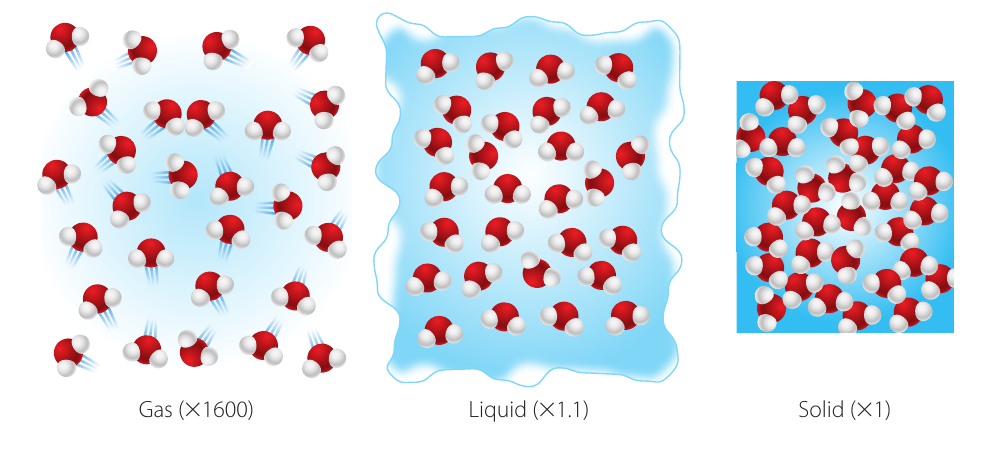
Diffusion
Diffusion explains how smells reach us from distant sources. According to the kinetic particle model, particles move invisibly from their source through a "sea" of randomly moving air particles that are relatively far apart from each other. Diffusion occurs very rapidly in gases (which is why you can quickly smell perfume sprayed across a room), more slowly in liquids, and can even occur between solids under pressure, though very slowly.
Forms of energy
Energy exists in many forms, including heat, light, mechanical, gravitational, electrical, magnetic, sound, chemical, and even mass itself. Regardless of the specific form, energy is fundamentally the same thing. The "form" is often named by the energy's origin or mode of transfer (such as nuclear or solar energy).
All forms of energy can be transformed from one form to another and transferred from one place to another. For example, when you turn on an electrical bar heater, electrical energy transforms into radiant heat and light energy.
Note
The SI unit for measuring energy is the joule (). One joule is approximately equivalent to the energy required to lift a apple from the ground to a height of .
The two fundamental categories of energy are:
- Kinetic energy: energy associated with movement
- Potential energy: stored energy that is ready to be used
All energy sources can ultimately be classified into these two fundamental forms.
Kinetic energy
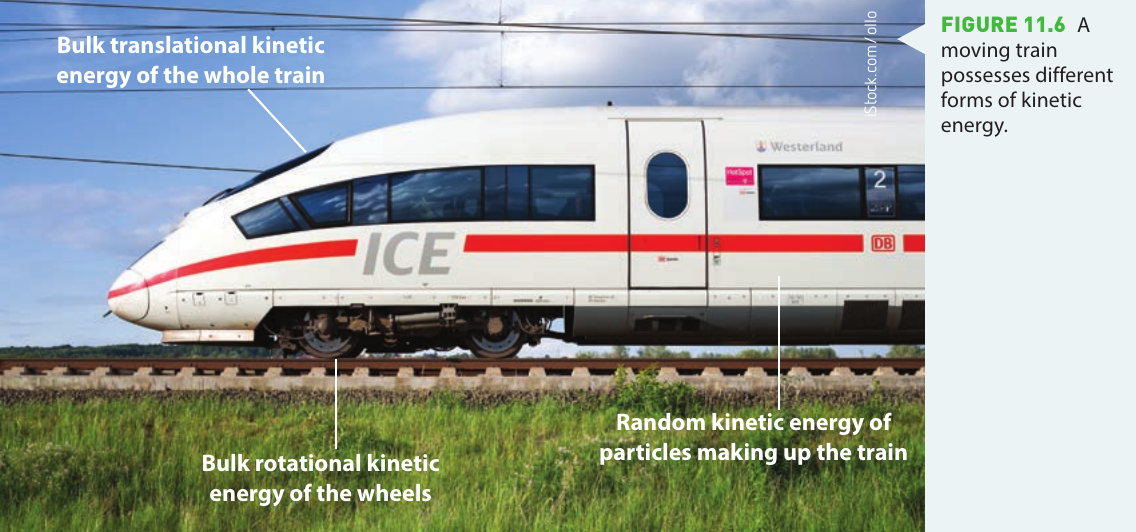
Kinetic energy is the energy a body possesses due to its motion. There are several different types of kinetic energy. Consider a moving train as an example:
Example
The Three Types of Kinetic Energy in a Moving Train:
-
Bulk translational kinetic energy: The energy associated with the straight-line motion of the entire train as it moves along the track
-
Bulk rotational kinetic energy: The energy associated with the rotating wheels and spinning engine parts
-
Random kinetic energy: The energy associated with the disorganised vibrations of atoms and molecules in the solid materials that make up the train
All three types of kinetic energy exist simultaneously in the moving train. The organised motion (translational and rotational) can be observed and measured at the macroscopic scale, while the random motion occurs at the microscopic particle level.
Potential energy
When you stretch an elastic band, you do work on it and store energy within it. The elastic band now has the potential to do work - it has stored the energy you added. When the elastic band is released, it transforms this stored energy into kinetic energy, and work is performed.
As stretching occurs, atoms change their positions relative to each other, and potential energy increases. This extra potential energy can be recovered as work when the elastic band returns to its original shape. The stored potential energy is associated with the changed positions of atoms and the stretched bonds between them.
Even when not stretched, an elastic band contains potential energy stored in the way particles are connected to each other. This inherent potential energy keeps the material solid and gives it structure, but it is not available to do additional work beyond maintaining the material's integrity.
Internal energy
Internal energy is the sum of the kinetic energy and the potential energy of all the particles in a substance. This is a crucial concept in thermodynamics.
Heating and temperature rise
When a solid body is heated, its temperature increases. The particles gain kinetic energy and, on average, vibrate faster. As particles vibrate more vigorously, they move further apart, which means the "springs" (bonds) between them also store more energy. Both kinetic and potential energy increase during normal heating.
Phase changes
At the melting point of a solid (the temperature at which it becomes a liquid), a phase change occurs.
Important
During a phase change, something interesting happens: the kinetic energy of particles does not change until the phase change is completed. However, intermolecular bonds are being broken, and particles become further separated.
This means that at a phase change, energy input is used to increase the distance between particles (increasing potential energy), not to increase their kinetic energy. This is why the temperature remains constant during melting or boiling, even though heat energy is continuously being added.
Temperature and particle motion
Temperature explained
Consider heating a cup of water versus a saucepan of water. The cup comes to a boil () much faster than the saucepan. Although the final temperature is the same for both, the larger mass of water in the saucepan requires more total heat energy to reach that temperature.
However, once both reach , all particles in the cup have (on average) the same kinetic energy as particles in the saucepan. This leads to an important conclusion: temperature is a measure of the average random kinetic energy of the particles making up a substance.
Energy distribution in materials
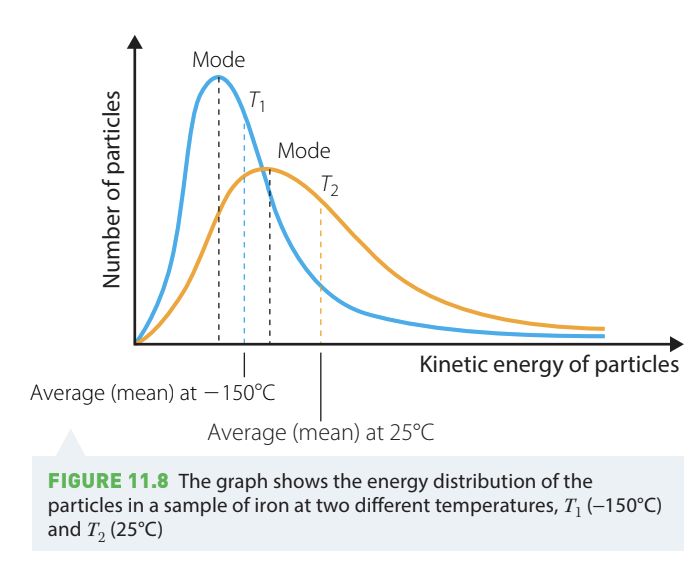
When you heat a material, the average kinetic energy of its particles increases. However, not all particles have the same kinetic energy at any given moment. The following graph shows the distribution of kinetic energies among particles:
Note
This distribution of energies is called a Maxwell-Boltzmann distribution. Several important features are visible:
- The peak of the curve represents the most common kinetic energy among particles (the mode)
- The average (mean) is to the right of the peak because the distribution is not symmetrical
- At higher temperatures, the distribution becomes broader and shifts to higher energies
- Even at lower temperatures, some particles have very high kinetic energies
This same distribution pattern applies to solids, liquids, and gases. The distribution explains why evaporation occurs even from cold liquids - a few particles always have enough energy to escape from the liquid surface, even when the average energy is low.
Absolute zero
According to the particle model, it should theoretically be possible for all particles in a substance to be completely still. This theoretical condition is called absolute zero. It would be measured as:
- on the Kelvin scale
- on the Celsius scale
The Kelvin and Celsius scales use identical increments, but the Kelvin scale starts at absolute zero, while the Celsius scale uses the freezing/melting point of water at standard atmospheric pressure as its zero point.
When a material is heated and heat energy is added, the proportion of particles vibrating faster increases. The average kinetic energy of particles rises, and therefore the temperature increases.
Summary
Key Points to Remember:
-
Heat is energy being transferred from one place to another due to a temperature difference, not a form of stored energy.
-
Work is energy being transferred due to the action of a force, also not stored in objects or systems.
-
James Joule's careful experiments established the law of conservation of energy by proving that heat and mechanical energy are quantitatively equivalent.
-
Temperature measures the average kinetic energy of particles in a substance, not the total energy.
-
Internal energy is the sum of kinetic energy and potential energy of all particles in a substance.
-
During normal heating, particles gain both kinetic energy (vibrate faster) and potential energy (move further apart).
-
During phase changes, heat energy increases the distance between particles (potential energy) without changing their kinetic energy, which is why temperature remains constant during melting or boiling.
-
At any given temperature, particles have a range of kinetic energies described by the Maxwell-Boltzmann distribution - some move slower than average and some faster.
-
Objects can have organised (bulk) kinetic energy independent of their internal energy - a moving train has both bulk motion and internal particle motion.