Specific Heat Capacity (HSC SSCE Physics): Revision Notes
📚Revision Notes
Specific Heat Capacity
What is specific heat capacity?
Different materials require different amounts of energy to change their temperature. Understanding this concept is crucial for many practical applications, from designing kettles to understanding climate patterns.
When you boil water in a electric kettle, it transfers of energy every second for quite a long time. Water requires a large amount of energy to increase its temperature. If you heated the same mass of cooking oil at the same starting temperature, it would take about half the time to reach in the same kettle.
Heat capacity is the ratio of the amount of heat required for a given change in temperature. This is a physical property of the material and is related to its structure. However, heat capacity depends on how much of the substance you have.
A more useful quantity is specific heat capacity (or just specific heat). This is the amount of energy required to raise the temperature of of a substance by , without a change of phase.
Note
Water has a high specific heat capacity. Cooking oil has a much lower specific heat capacity. This means oil heats up and cools down almost twice as quickly as water.
Investigating specific heat
Scientists determine specific heat capacity through careful experimentation. Let's examine how a student investigated this property.
A student heated of an unknown liquid X by adding heat energy at a steady rate of for . The temperature was measured at regular intervals during the heating process.
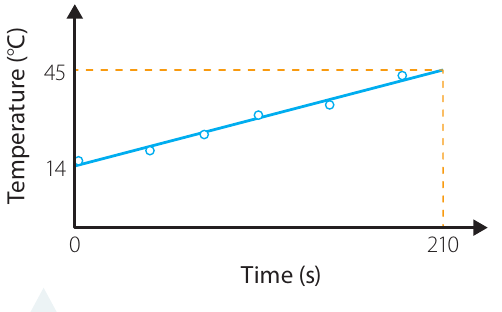
The graph shows that the temperature of a body increases in direct proportion to the amount of heat energy put into the liquid:
The experiment was then repeated using only of the unknown liquid, with all other conditions kept the same.
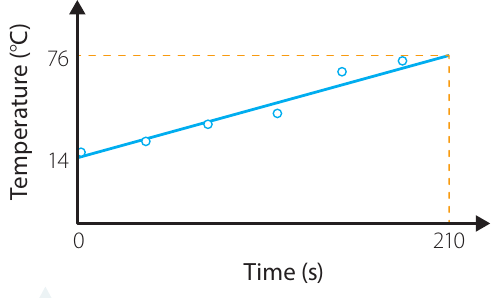
Note
The second graph shows that for the same energy input, half the mass increases its temperature by twice as much. Therefore, the change in temperature of the body is inversely proportional to the mass of the body :
The specific heat capacity formula
Putting these two findings together gives us the relationship:
There is always a constant, , that makes a proportionality an equality, so by rearranging we get:
Important
Key Formula Components:
Where:
- is the specific heat capacity of the substance being heated
- is the quantity of energy supplied (in joules)
- is the mass of the body being heated (in kilograms)
- is the change in temperature (in kelvin or degrees Celsius)
The units of specific heat capacity can be found by substituting the units into the formula:
That is, joules per kilogram per kelvin. Since , in practice we can use degrees Celsius instead of kelvin.
The relationship is then expressed in its simplest algebraic form:
Note
This is an excellent example of how careful experimentation provides useful data to find meaningful relationships (formulae). These relationships can then be used to predict what will happen under different conditions.
Specific heat capacity of water
Water plays an integral part in evolution and the sustaining of life. It has the highest specific heat capacity of the most commonly-occurring substances: .
Compared with the same mass of most other substances, water:
- Heats up more slowly
- Cools down more slowly
- Stores more internal energy
Many cooling and heating systems (from hot water bottles and hydronic heaters to water-cooled engines) utilise water's high specific heat capacity.
Note
Large bodies of water such as oceans, seas and lakes absorb large amounts of energy with only small temperature changes. For the same amount of energy input, landmasses have much greater temperature changes than water. This means temperatures inland are much hotter than on islands and in coastal regions.
During the warmer months, when the sea temperature is less than the average air temperature, the sea acts as a heat sink – it stores energy. During the colder months, when sea temperature is warmer than the average air temperature, the sea releases the stored energy. This release of energy moderates the temperature of regions close to large bodies of water.
Specific heat capacities of different materials
Just as landmasses have specific heat capacities different to water, so do most other substances, including metals.
| Substance | Specific heat capacity (J kg⁻¹ K⁻¹) |
|---|---|
| Water | 4200 |
| Ethylene glycol (antifreeze) | 2400 |
| Cooking oil | 2800 |
| Ice | 2100 |
| Steam | 2000 |
| Air | 1000 |
| Aluminium | 900 |
| Soil | 800 |
| Crown glass | 670 |
| Iron | 450 |
| Copper | 380 |
| Lead | 130 |
Note
Notice that metals generally have much lower specific heat capacities than water. This means they heat up and cool down much more quickly.
Experiments have demonstrated that a small metal block will take about minutes to come to thermal equilibrium with boiling water. Once it has reached this temperature, it can be placed in a known mass of water (specific heat capacity ) at a different temperature. Left for long enough in a calorimeter, the two will reach thermal equilibrium. From this and the mass of the metal block, the specific heat capacity of the metal can be calculated.
Worked examples
Example
Worked Example 1: Heating Water
Question: of pure water at is heated to .
- Sketch a heating curve for the water from to . Show on the graph the section relevant to this question.
- How much energy is needed to achieve this temperature change?
Solution:
-
The heating curve:
-
Calculate the energy required:
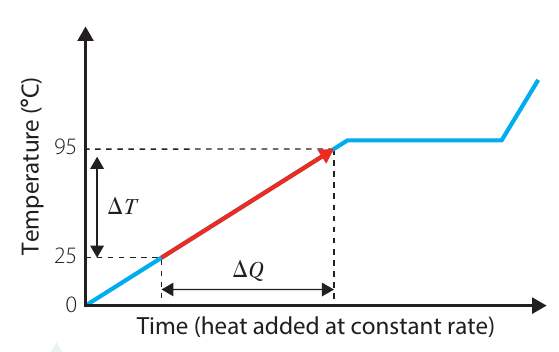
Given data:
- (since of water has a mass of )
- (from the table)
Formula:
Substitution:
Answer: (to 2 significant figures)
Example
Worked Example 2: Mixing Hot and Cold Water
Question: A nurse prepares a bath that needs to be at for a patient. First, the nurse adds of water at from the cold tap. Next, the nurse will need to add water at from the hot tap so the bath is at the correct temperature.
- What four assumptions must be made before starting to solve this problem?
- How much water did the nurse need to add from the hot tap to achieve the required temperature of ?
Solution:
-
Assumptions:
- No energy is lost to the surroundings such as the taps, the air and the bath
- The mixing process does not add energy to the water
- The water is pure
- of water has a mass of
-
Calculate the mass of hot water needed:
Given data:
Formula:
The heat lost by the hot water equals the heat gained by the cold water:
Since both are water, cancels out:
Substitution:
Answer: of hot water was added.
Investigation: Specific heat capacity of metals
This investigation allows you to determine the specific heat capacity of different metals experimentally.
Aim
To find the specific heat capacity of one or more metals.
Materials
- Calorimeter
- Thermometer or calibrated temperature probe
- Heating equipment
- beaker
- Glass stirring rod
- Electronic scales
- Different metal cubes with dimensions about
- Strong cotton thread
- Paper towel
- Protective gloves
- Safety glasses
Risk assessment
Important
Safety Precautions:
| Risk | How to manage |
|---|---|
| Hot metal blocks can cause burns | Double check that the cotton thread is properly tied. Avoid touching the metal when transferring the block |
| Heating equipment can cause burns | Avoid touching the equipment. Wait for the equipment to cool before you put it away |
| Hot water can cause burns and scalds | Wear safety glasses and protective gloves. Lower the block gently into the water. Avoid splashing the water. If spilt on skin, wash it with plenty of cold water for 5 minutes. Apply ice pack |
Method
- Set up the equipment as shown in the diagram below.
- Place of water into the beaker. Heat the water until it is boiling.
- Determine the mass of the cube and securely tie the cotton thread around it.
- Gently lower the metal cube into the boiling water and leave until it is at ( minutes).
- Meanwhile, measure and record the mass of the calorimeter.
- Add approximately of cold tap water to the calorimeter, and measure and record the mass of the calorimeter and water.
- Suspend the thermometer (or temperature probe) in the cold water.
- Gently stir the water with the stirring rod and wait for the temperature of water and thermometer (or temperature probe) to come to equilibrium. Record this temperature.
- Carefully lift the hot metal cube out of the boiling water, quickly dry it, then lower it gently into the calorimeter water. Stir the water gently and frequently.
- Record the temperature of the mixture of the metal block and the water when it reaches its maximum.
- Repeat the experiment with a second trial.
- If directed by your teacher, repeat the experiment with a different metal.
Results
Record your results in a table. Include an estimate of the uncertainty in each measurement.
Analysis of results
- Use the data to find the specific heat capacity of the metal for both trials.
- Use the data to determine the measurement value and the estimate of the uncertainty.
- Look up the accepted value of the specific heat capacity of the metal, including the uncertainty associated with this value. Decide whether the range of your measurement value overlaps the range of the accepted value.
Discussion
- Why were you instructed to dry the metal cube before placing it in the cold water?
- Why is it desirable to start with the water temperature below room temperature and have a final temperature above room temperature?
- Why were you asked to do two trials? Does this improve accuracy or precision?
- Did your best estimate of the specific heat capacity of the metal differ from the accepted value? Explain.
- Is it meaningful to calculate the percentage error in this experiment? Explain.
Note
When analyzing your results, consider sources of experimental error such as heat loss to the surroundings, measurement uncertainties, and the assumption that all heat transfer occurs between the metal and water only.
Conclusion
With reference to the data obtained and its analysis, write a conclusion based on the aim of this investigation.
Remember!
Summary
Key Points to Remember:
- Specific heat capacity () is the amount of energy required to raise the temperature of of a substance by , without a change of phase.
- The formula for heat energy transfer is: , where is mass, is specific heat capacity, and is the temperature change.
- Water has the highest specific heat capacity of commonly-occurring substances: .
- The sea acts as a heat sink during warmer months and releases stored energy during colder months, moderating coastal temperatures.
- Different materials have different specific heat capacities, with metals generally having much lower values than water, meaning they heat up and cool down more quickly.