Thermal Equilibrium (HSC SSCE Physics): Revision Notes
📚Revision Notes
Thermal Equilibrium
Understanding the zeroth law of thermodynamics
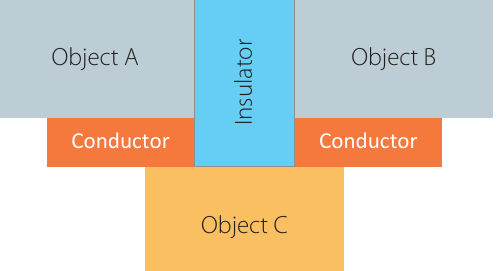
The zeroth law of thermodynamics provides a fundamental principle for understanding how temperature works. This law states that when two separate systems are each at thermal equilibrium with a third system, they must also be in thermal equilibrium with each other.
Example
Understanding the Zeroth Law: The A-B-C Relationship
Think of it this way: if you have three objects - let's call them A, B, and C:
- Object A is at the same temperature as object C
- Object B is also at the same temperature as object C
- Therefore, objects A and B must be at the same temperature as each other
If you were to bring objects A and B into contact, no heat would flow between them because they're already at thermal equilibrium.
Note
This law might seem obvious, but it's actually quite important. It provides the theoretical foundation for temperature measurement and tells us that temperature is a fundamental property that different systems can share.
How thermal equilibrium works
When you mix substances at different temperatures, something interesting happens. The heat energy lost by the hotter substance exactly equals the heat energy gained by the cooler substance. This is a consequence of energy conservation.
Example
Practical Demonstration: Hot Stone in Cold Water
Imagine placing a hot stone into a container of cold water:
Step 1: Heat energy begins transferring from the hot stone to the cold water and its container.
Step 2: As this happens, the stone becomes cooler whilst the water and container become warmer.
Step 3: This energy transfer continues until all three components - the stone, water, and container - reach the same temperature.
Result: When they reach this point, we say they are in thermal equilibrium.
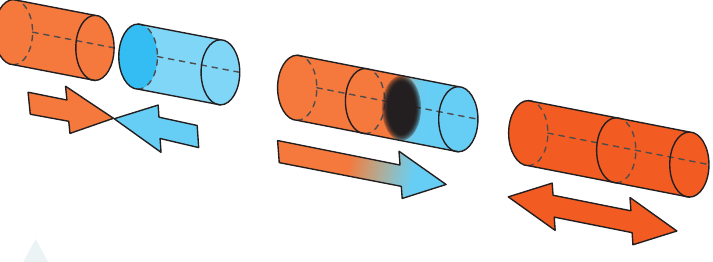
What happens at thermal equilibrium? Particle collisions continue to occur between the water molecules and the stone's particles, but the situation has changed. The amount of heat flowing from the water into the stone now exactly balances the amount of heat leaving the stone and entering the water. There is no longer a net transfer of energy from one object to another - the energy exchange has become balanced.
Important
Exam tip: When answering questions about thermal equilibrium, remember that particles don't stop moving or colliding - energy transfer just becomes balanced in both directions.
Heating and cooling curves
Understanding how substances heat up and cool down is crucial for many practical applications. When you heat a pure substance, its temperature increases in direct proportion to the energy you add, but only under certain specific conditions.
Note
For this direct proportionality to hold true, three conditions must be met:
- The substance must not change phase (no melting, boiling, or freezing)
- The mass must remain constant
- The energy input rate must be constant
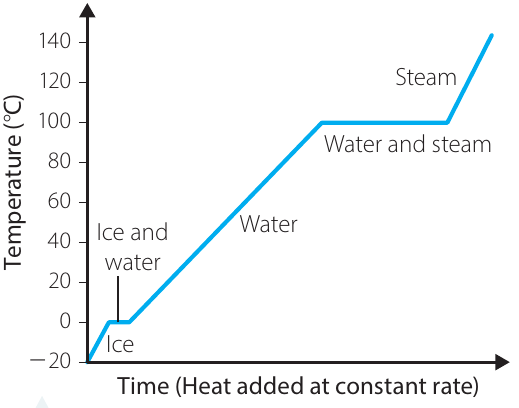
The heating curve for water demonstrates these principles beautifully. Starting from the bottom left, you can see ice heating up towards its melting point at . Notice how the curve becomes completely flat when the ice reaches - this is the fascinating part. During melting, even though you're continuously adding energy, the temperature doesn't change at all.
Why doesn't the temperature increase during melting? The energy you're adding isn't increasing the kinetic energy of the particles (which would raise the temperature). Instead, it's breaking the bonds between particles, changing their potential energy. This is why we see a flat plateau on the graph.
Once all the ice has melted, the water continues heating until it reaches . At this boiling point, the curve flattens out again for the same reason - the energy goes into breaking bonds between water molecules to turn liquid water into steam, rather than increasing temperature. Only after all the water has turned to steam does the temperature begin rising again.
Important
Learning aid: Remember "FLAT = Phase change" - whenever you see a flat section on a heating curve, a phase change is occurring.
Measuring temperature
The zeroth law of thermodynamics isn't just theoretical - it has important practical applications, particularly in temperature measurement. Many materials have properties that change with temperature, and we can use these changes to measure temperature accurately.
Creating a mercury thermometer
Consider a column of mercury sealed in glass. When no heat flows in or out of the column, its height remains steady. We can calibrate this column by bringing it into thermal equilibrium with systems at known temperatures.
Example
Calibrating a Mercury Thermometer
Step 1: Establish the lower fixed point Place the mercury column in contact with water at its freezing/melting point () and mark the height of the mercury.
Step 2: Establish the upper fixed point Bring the column into thermal equilibrium with water at its boiling point () and mark this new height.
Step 3: Create the scale By dividing the distance between these two marks into 100 equal divisions, you've created a Celsius thermometer.
Key principle: This calibration process relies entirely on the zeroth law - we know that when no heat flows between the mercury and the water, they must be at the same temperature.
Types of thermometers
Different thermometers exploit different temperature-dependent properties. Here's an overview of common thermometer types and how they work:
| Type of thermometer | Property utilised |
|---|---|
| Mercury in glass | Uses different coefficients of expansion between mercury and glass |
| Thermocouple | Uses different temperature-dependent electrical properties of different metals that are brought into contact |
| Thermostat | Uses variation in electrical resistivity of a material with temperature |
| Thermal paint | Uses colour change with temperature |
| Bimetallic strip | Uses variation in coefficients of expansion between two different metals to detect temperature changes |
| Infrared | Uses the electromagnetic radiation radiated from a surface to measure temperature on the absolute temperature scale |
| Digital | Uses the variation in resistivity of a material with temperature - the greater the resistance, the lower the current |
Note
Each type of thermometer has advantages and disadvantages depending on the temperature range, accuracy required, and application.
Investigation: Bimetallic strips and thermometers
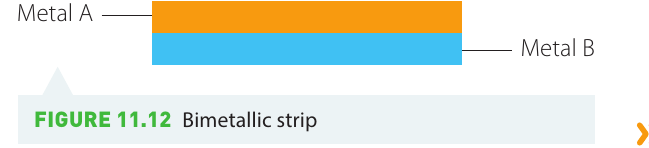
Understanding how different metals expand at different rates when heated is crucial for many applications. A bimetallic strip consists of two different metals welded together, and these strips form the basis of many temperature-sensing devices.
Aim
To build a working bimetallic strip thermometer
Materials (suggested)
- Metals to be investigated
- Water baths (, and )
- Metal clamps and tongs
- Thermometer
- Protective mats
- Protective gloves
- Calibrated background
- Access to oven and/or freezer
Risk assessment
Understanding and managing risks is essential for safe practical work. Here are the main hazards and how to control them:
| What are the risks in doing this investigation? | How can you manage these risks to stay safe? |
|---|---|
| Hot and cold metals, ovens and freezers all pose a burns risk. | Be extremely careful when manipulating the bimetallic bar, oven and freezer when in operation. Hot metal looks exactly the same as cold metal. Wear protective gloves. |
| Hot water can cause burns and scalds. | Be extremely careful. Wear safety glasses, lab coat and protective gloves. If spilt on skin, wash with plenty of cold water for 5 minutes. Apply ice pack. |
Important
Safety note: Hot metal looks identical to cold metal - you cannot tell the difference by looking. Always assume metal that has been heated is still hot until you've verified otherwise.
Method
You will need to write your own procedure in point form for carrying out this investigation. Your method should explain how you will:
- Investigate how the bimetallic strip behaves when heated
- Use this information to design your thermometer
- Calibrate your thermometer to give quantitative temperature readings
- Test your thermometer in the oven
Note
Ask your teacher to check your method before you begin.
Results
Your measurements will be quantitative and objective. Consider carefully how you will display your results - will a table or graph be most appropriate? Make sure you record:
- Temperature readings from the reference thermometer
- Corresponding readings from your bimetallic strip thermometer
- Any observations about how the strip behaves at different temperatures
Discussion
Analyse your results carefully. Your discussion should address these important questions:
- How could you improve the temperature range of your thermometer?
- How could you improve the accuracy of your scale?
- Is your scale linear? Explain your answer.
- Would your thermometer be as good as a glass-mercury bulb thermometer to measure daily temperature differences? Explain your reasons.
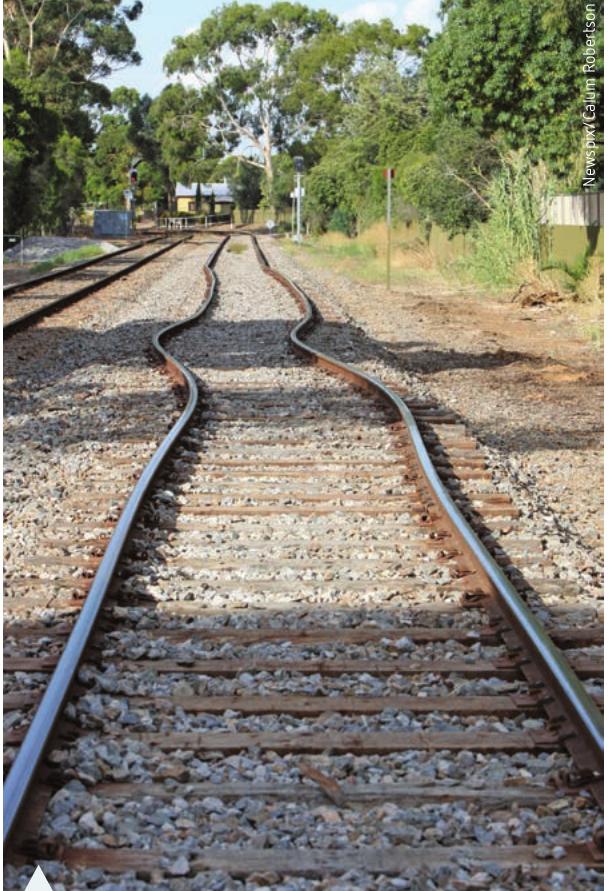
Note
This photograph shows railway tracks that have buckled during a heat wave. The connection to your investigation is that railway tracks, like your bimetallic strip, expand when heated. If the tracks cannot expand freely (because they're fixed at both ends), they buckle upwards instead. This is thermal expansion in action - the same principle your thermometer relies upon.
Conclusion
Write a conclusion that refers back to the aim of the investigation. Your conclusion should be based on the data you collected and analysed, and should state whether you successfully built a working bimetallic strip thermometer and what you learned about thermal expansion in the process.
Remember!
Summary
Key Points to Remember:
-
The zeroth law of thermodynamics states that if two systems are each in thermal equilibrium with a third system, they must be in thermal equilibrium with each other.
-
Thermal equilibrium occurs when objects reach the same temperature and there is no net transfer of energy between them. Energy exchange continues but becomes balanced in both directions.
-
During phase changes, temperature remains constant even as energy is added because the energy breaks bonds between particles rather than increasing their kinetic energy.
-
Different thermometers use different temperature-dependent properties such as thermal expansion, electrical resistance, or colour change to measure temperature.
-
Bimetallic strips work because different metals have different coefficients of expansion - they expand by different amounts when heated to the same temperature.