Wave Behaviour (HSC SSCE Physics): Revision Notes
📚Revision Notes
Wave Superposition
What is superposition?
When waves of similar type (both transverse or both longitudinal) travel through the same medium, they can pass through each other. During this interaction, something remarkable happens: the displacement values from each wave combine mathematically at every point where they overlap. After passing through each other, the waves continue travelling with their initial characteristics completely unchanged. This phenomenon is called superposition.
Note
The mathematical combination of wave displacements follows a simple rule: at each point in space, add the displacement from wave 1 to the displacement from wave 2. This algebraic addition creates the resultant wave pattern we observe.
The mathematical combination typically creates a complex pattern. At any given point, the interaction may produce either constructive interference (resulting in larger amplitude) or destructive interference (resulting in reduced amplitude), depending on how the two waves align.
Constructive interference
Constructive interference occurs when two waves align perfectly so that their crests coincide with each other and their troughs also coincide. When this happens, the waves reinforce each other.
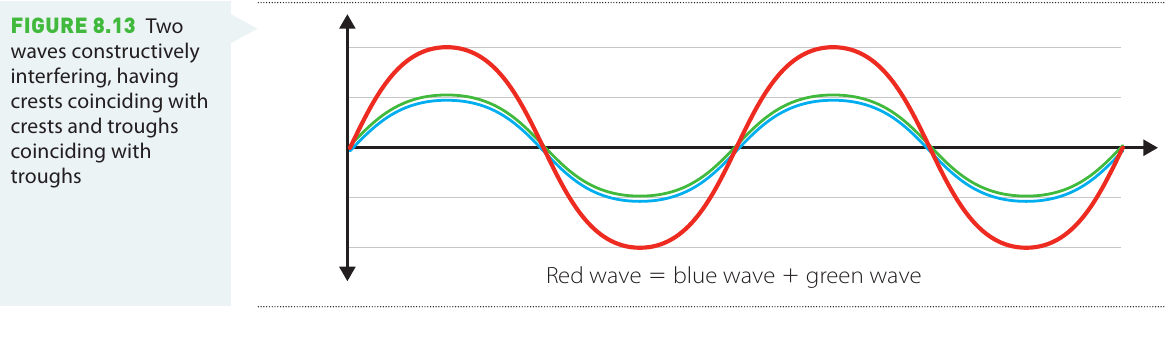
When two identical waves meet with this perfect alignment, they create a resultant wave with twice the amplitude of either original wave. The wave appears to grow larger because the displacements from both waves add together positively.
Example
Worked Example: Calculating Resultant Amplitude
If two waves each have an amplitude of , and they meet in phase (crests aligned with crests), the resultant wave will have an amplitude of .
This happens because: displacement₁ + displacement₂ =
Destructive interference
Destructive interference occurs when two waves meet with opposite alignment—a crest from one wave coinciding with a trough from the other wave. In this situation, the waves' displacements work against each other.
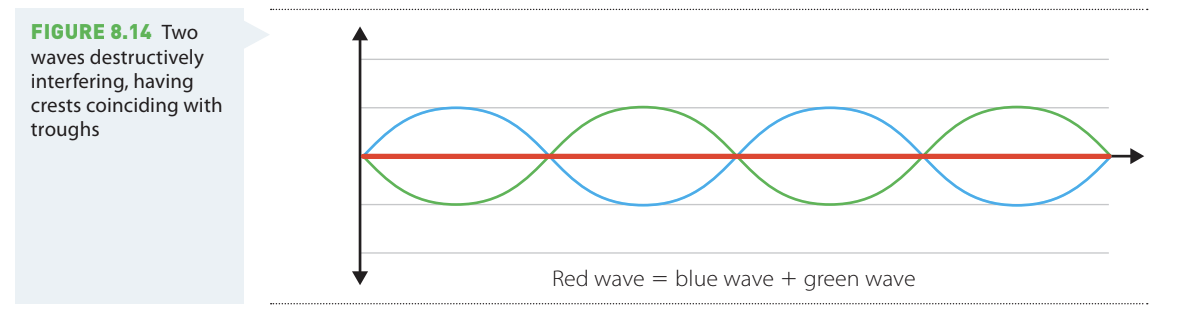
When two identical waves arrive at the same location completely out of phase (crest meeting trough), their displacements cancel completely. The result is zero displacement—the waves effectively disappear at that point! This complete cancellation demonstrates the remarkable nature of wave superposition.
Example
Worked Example: Complete Cancellation
If one wave has displacement (crest) and another has displacement (trough) at the same point, the resultant displacement is:
The waves completely cancel each other out at this location.
Important
Don't confuse destructive interference with waves disappearing permanently! The waves continue travelling and emerge unchanged after passing through each other. The cancellation only occurs at specific points where the waves are out of phase.
Waves with different wavelengths
When two waves with different wavelengths overlap, the pattern becomes more interesting. The resultant wave shows alternating regions where constructive and destructive interference occur.
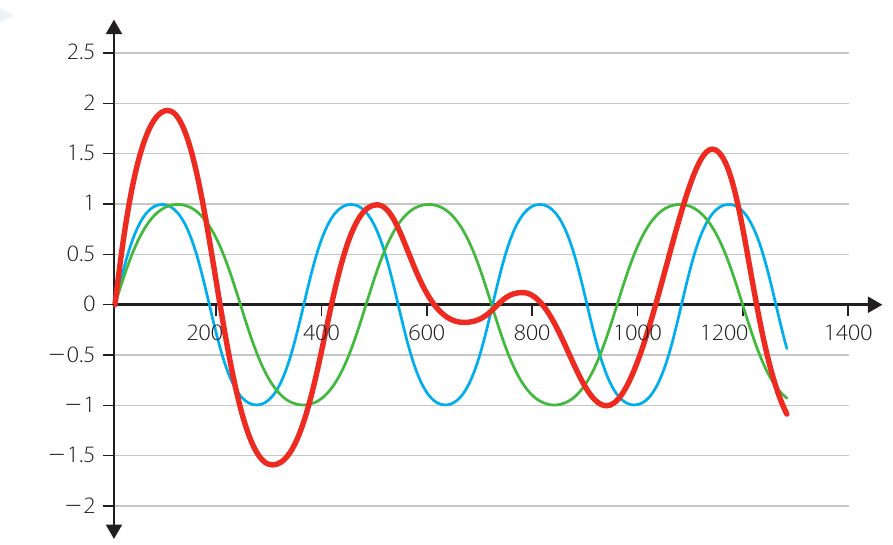
In the diagram above, you can see three waves:
- The blue wave (higher frequency, shorter wavelength)
- The green wave (lower frequency, longer wavelength)
- The red wave (the resultant of adding the blue and green waves)
Note
Notice how the red wave has regions where its amplitude is large (where the blue and green waves reinforce each other) and regions where its amplitude is small (where the blue and green waves partially cancel each other). This creates a characteristic "beating" pattern in the resultant wave.
Real-world application: acoustics and the Sydney Opera House
The principle of superposition is crucial in acoustics—the study of sound behaviour. Acoustic engineers use their understanding of wave superposition to design buildings with excellent sound qualities for concerts, speeches, and theatrical performances.
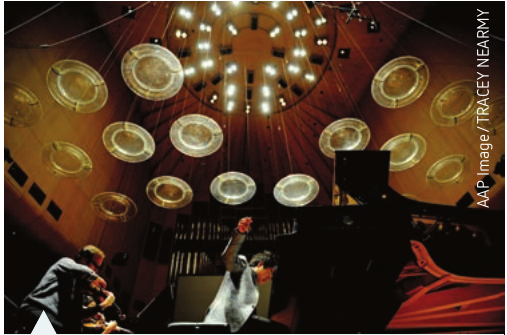
The Sydney Opera House Concert Hall provides a fascinating case study. When the Concert Hall first opened in the 1970s, the acoustics were poor—the orchestra sounded muffled and lacked clarity. The problem was destructive interference: sound waves reflected off various surfaces were arriving out of phase with each other, causing cancellation that reduced the sound quality.
Note
Engineering Solution: Reflective Rings
The solution was to install the circular reflective rings visible above the stage. These rings reflect sound waves back towards the audience in a controlled way, reducing destructive interference and improving the overall sound quality. Today, acoustic engineers use computer simulations based on superposition principles to prevent such problems during the design phase.
Investigation 8.4: Destructive and constructive interference in the classroom
Aim: To experience how destructive and constructive interference can occur with sound in a classroom
Materials:
- Two signal generators (smartphones using tone generator apps with suitable speakers work well)
- Optional: smartphone app that measures sound level intensity
Method:
- Position the two speakers at least apart at the front of the room. Set both to play the same sine wave sound at exactly the same frequency (approximately works well).
- Start at a position equidistant from both speakers. Move slowly sideways across the room, listening carefully for changes in the sound loudness.
- Measure the distance you need to move between two positions where constructive interference occurs (where the sound is loudest). A sound level intensity app can help identify these positions precisely.
Results:
Record your observations about how the loudness varies as you move. Create a scale map of the classroom showing where you observed constructive and destructive interference along your path.
Analysis of results:
Example
Calculating the Wavelength
Calculate the wavelength of the sound waves using:
where and
Compare this calculated wavelength with the distance between positions of constructive interference. You should find they are related—the distance between loud spots corresponds to changes in path difference equal to one wavelength.
Note
Why does this happen?
As you move sideways, you change the path difference between the sound from each speaker reaching your ears. At some positions, the waves arrive in phase (constructive interference—loud). At other positions, they arrive out of phase (destructive interference—quiet). The pattern repeats as you move, creating alternating loud and quiet regions.
Investigation 8.5: The principle of superposition
Aim: To demonstrate the principle of superposition using electronic equipment
Materials:
- Cathode ray oscilloscope (CRO) with two inputs
- Two microphones
- Signal generators or sound sources (musical instruments like guitars also work)
- Device to record video (camera, phone, laptop or tablet)
Safety considerations:
| Risk | Management |
|---|---|
| Electrical equipment near water | Keep all devices plugged into mains power well away from water |
Method:
- Connect both microphones to separate inputs on the CRO. Set up two sound sources (signal generators or musical instruments) producing sounds at slightly different frequencies.
- Adjust the CRO's vertical scale so that each microphone's signal has approximately the same size when displayed separately.
- Change the CRO display mode to 'add'. This makes the oscilloscope add the signals from both microphones to display one combined waveform.
- Observe what happens both on the screen and with your ears. You should see and hear alternating periods of constructive and destructive interference.
Results:
Record your observations by taking video of the changing CRO display or by capturing snapshots at different times. Notice how the waveform changes shape and amplitude over time.
Note
What's happening?
When two sound sources have slightly different frequencies, they drift in and out of phase with each other. Sometimes they align (constructive interference—the amplitude on the screen increases and the sound gets louder). Other times they oppose each other (destructive interference—the amplitude decreases and the sound gets quieter). This creates a periodic variation called "beats" which is explored further in studies of sound waves.
Investigation 8.6: Constructing a resultant wave using the principle of superposition
Aim: To apply the principle of superposition to produce a resultant waveform from two component waves
Materials:
- Grid paper (preferably grids)
- Pencil
- Ruler
Method:
- Draw a graph of wave A starting at the origin with wavelength and amplitude .
- On the same axes, draw wave B starting at the origin with and .
- At each vertical grid line, measure the displacement of wave A and wave B from the horizontal axis. Add these two values together and plot the sum.
- Connect your plotted points with a smooth curved dashed line. This is the resultant wave (A + B).
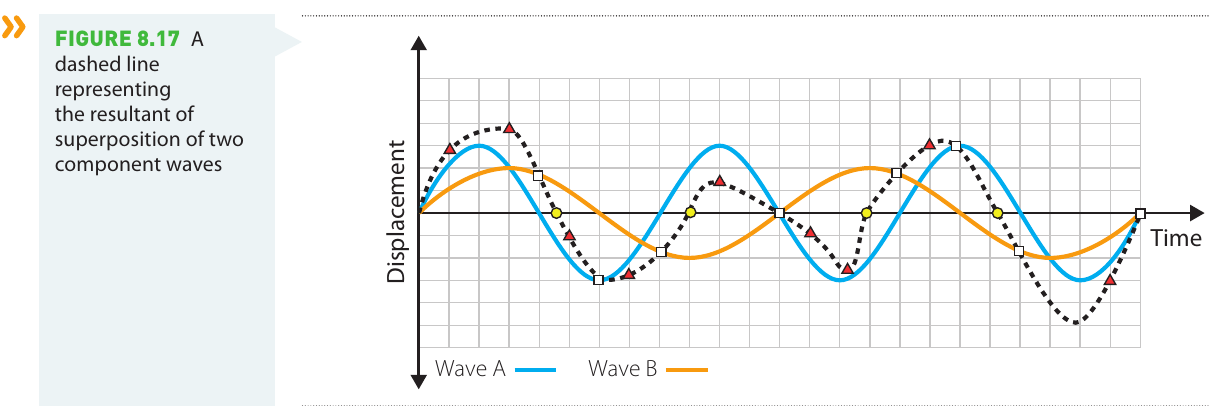
Results:
The curved dashed line represents the resultant wave formed by superposition of waves A and B.
Analysis of results:
- Measure the amplitude of the resultant wave A + B. Notice that it varies along the wave—it's not constant like the original waves.
- Identify and label regions where:
- Constructive interference occurred (where the resultant amplitude is largest)
- Destructive interference occurred (where the resultant amplitude is smallest)
Important
Key Observation:
The resultant wave has a complex shape different from either original wave. In regions where wave A and wave B were in phase, they reinforced each other (constructive interference), creating larger amplitudes. Where they were out of phase, they partially cancelled each other (destructive interference), creating smaller amplitudes. The overall shape represents the mathematical sum of the two component waves at every point.
Musical instruments and characteristic sound
Every musical instrument produces a unique sound, even when playing the same note as another instrument. For example, a saxophone playing middle C sounds noticeably different from a clarinet playing middle C, despite both instruments using a vibrating reed to generate sound.
This distinctive quality, called timbre, results from superposition. Each instrument doesn't produce just one pure frequency. Instead, it generates multiple sound waves at different frequencies simultaneously. These component waves superpose to create the complex resultant wave that we hear. The unique combination of frequencies and their relative amplitudes gives each instrument its characteristic sound.
Note
The overall waveform you see on an oscilloscope when an instrument plays is the result of many superpositions of different component frequencies. This complex pattern is unique to each instrument type, making them recognisable even when playing the same musical note.
Key Takeaways
Summary
Key Points to Remember:
-
Superposition occurs when waves pass through each other and their displacements combine mathematically at each point, after which they continue unchanged.
-
Constructive interference happens when wave crests align with crests and troughs align with troughs, creating a resultant wave with increased amplitude.
-
Destructive interference occurs when crests align with troughs, reducing or completely cancelling the amplitude.
-
Waves with different wavelengths create complex patterns with alternating regions of constructive and destructive interference.
-
The principle of superposition is essential in acoustic engineering and explains why different musical instruments have unique sounds even when playing the same note.