Reflection of Waves (HSC SSCE Physics): Revision Notes
📚Revision Notes
Reflection of Waves
Introduction to wave reflection
Wave reflection occurs frequently in our daily lives. When you look in a mirror, you see a reflected image. Water waves bounce back when they hit a pool wall. Sound waves create echoes when they reflect off solid surfaces like cliffs or walls. Understanding how waves reflect helps us develop useful technologies, from radar systems used in navigation to the microwave ovens in our kitchens.
Note
Wave reflection is not just a theoretical concept - it's the fundamental principle behind many everyday technologies and natural phenomena we encounter constantly. From the simple act of seeing yourself in a mirror to the complex functioning of satellite communications, reflection plays a crucial role in our modern world.
Understanding rays and wavefronts
Before studying reflection, we need to understand how waves can be represented. A ray is a single line that shows the direction in which a series of waves travels. Rays are always drawn perpendicular (at right angles) to the wavefronts. This simplified representation makes it easier to study how waves behave when they reflect.
Note
Using rays to represent waves is a simplification that makes complex wave behavior much easier to visualize and analyze. While waves actually spread out in all directions, rays help us focus on the specific direction of wave travel and make calculations more manageable.
The law of reflection
When a wave strikes a surface and bounces back, it follows a predictable pattern described by the law of reflection.
Key terminology
To understand reflection, you need to know these important terms:
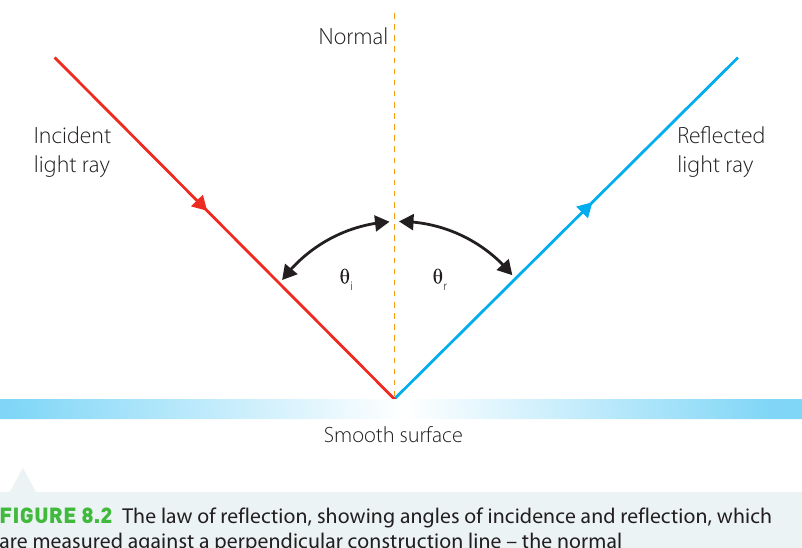
- Normal: A construction line drawn perpendicular to the reflecting surface at the point where the wave strikes
- Incident ray: The incoming wave approaching the surface
- Reflected ray: The wave bouncing away from the surface after reflection
- Angle of incidence (): The angle between the incident ray and the normal
- Angle of reflection (): The angle between the reflected ray and the normal
Important
All angles in reflection are measured from the ray to the normal, NOT to the reflecting surface itself. This is a common source of errors in calculations and diagrams.
Statement of the law
The law of reflection states that the angle of incidence equals the angle of reflection:
This relationship remains true regardless of the angle at which the wave strikes the surface. The law also works in reverse - if you reverse the direction of the wave, it will follow the same path backwards.
Properties preserved during reflection
When a wave reflects, certain properties remain unchanged:
- The speed of the wave stays the same
- The wave's shape is preserved (though curved mirrors may distort images)
- The wave's characteristics don't change (blue light reflects as blue light, sounds echo back unchanged)
Note
Understanding which properties remain unchanged during reflection is crucial. While the direction of travel changes, the fundamental characteristics of the wave - its speed, frequency, and wavelength - all remain constant. Only the direction of propagation is affected.
Reflection from different surfaces
Different shaped surfaces reflect waves in different ways. The three main types are plane (flat), concave (curved inward), and convex (curved outward) surfaces.
Reflection from plane surfaces
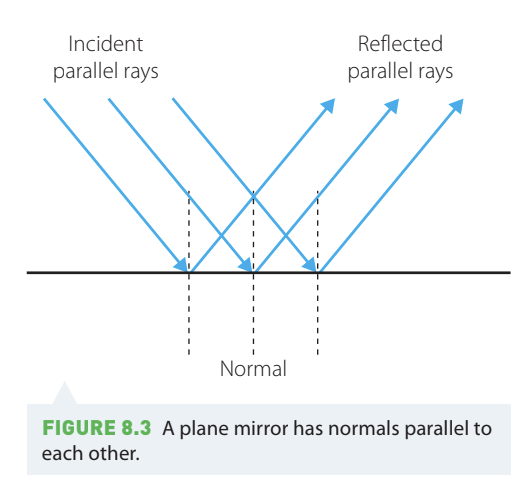
A plane surface is a flat, smooth surface like a typical bathroom mirror. When waves reflect from a plane surface, the image appears undistorted because all the normals along the surface are parallel to each other. This means that parallel incident rays reflect as parallel rays, maintaining the original shape and proportions of the image.
Note
Applications of plane mirrors include:
- Bathroom and bedroom mirrors
- Mirrors in shops and retail spaces
- Any situation requiring an accurate, undistorted reflection
The key advantage of plane mirrors is that they preserve the true size and proportions of objects, making them ideal for applications where accurate representation is important.
Reflection from concave surfaces
A concave surface curves inward, like the inside of a bowl. Concave reflectors have a special property - they can focus waves to a single point called the focal point.
The focal point
The focal point has two important characteristics:
- When parallel rays strike a concave surface, they all reflect and converge (meet) at the focal point
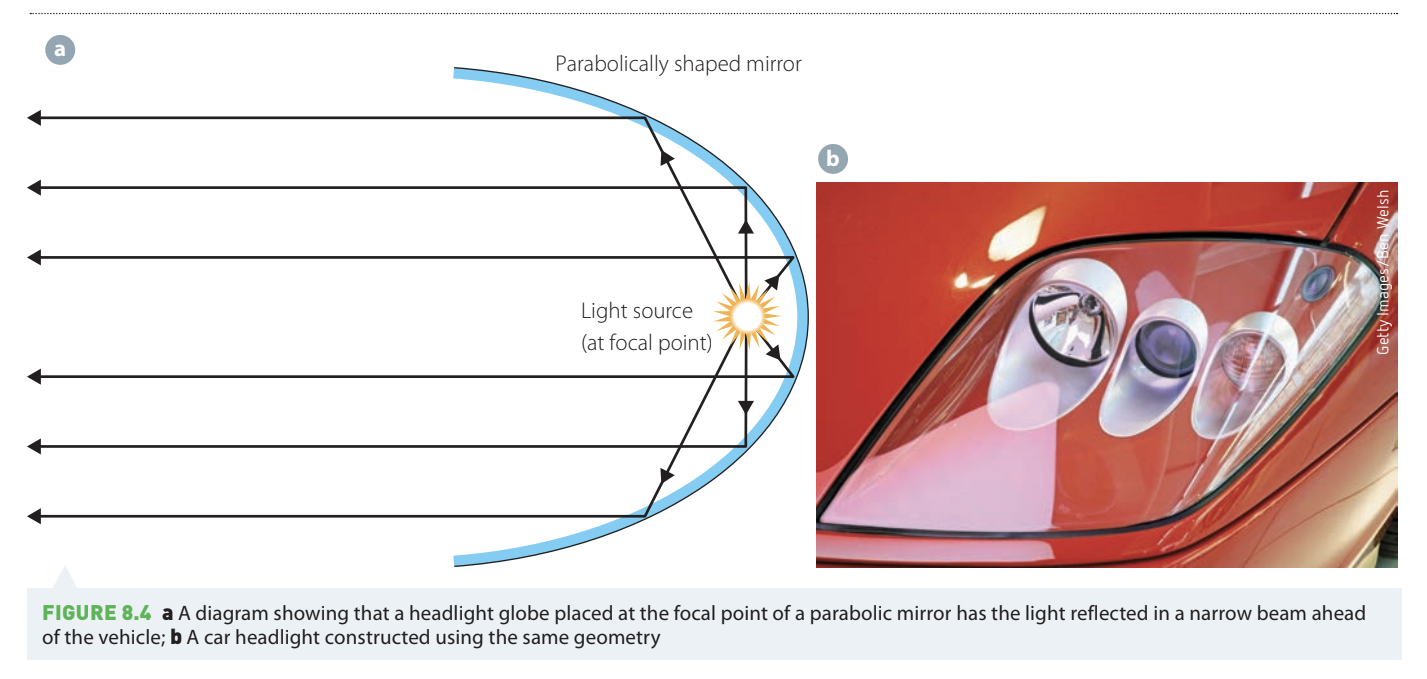
- When a light source is placed at the focal point, the reflected rays emerge as parallel beams
For the best focusing effect, concave reflectors should have a parabolic shape rather than a circular curve. Parabolic curves have a single, well-defined focal point, whereas circular curves do not.
Example
Practical Application: Car Headlights
The light bulb is positioned at the focal point of a parabolic reflector. Light rays from the bulb reflect off the parabolic surface and emerge as parallel beams, creating a concentrated beam of light that illuminates the road ahead effectively.
This demonstrates the second characteristic of the focal point: when a source is placed at the focal point, the reflected rays emerge as parallel beams. This is why car headlights produce such effective, far-reaching beams of light.
Example
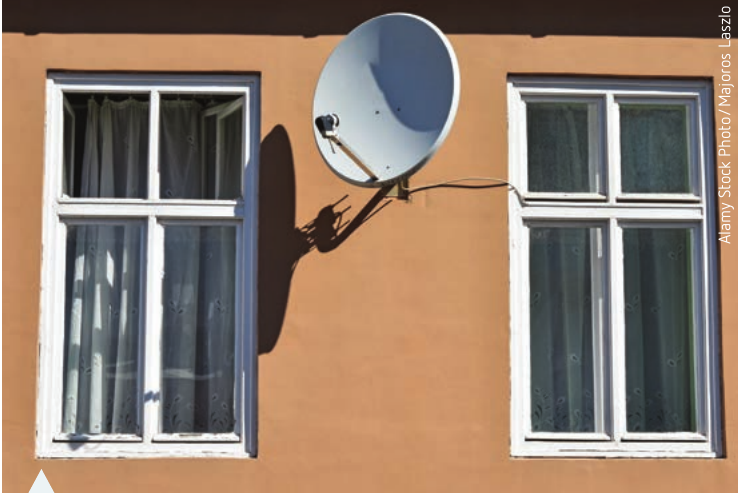
Practical Application: Satellite Dishes
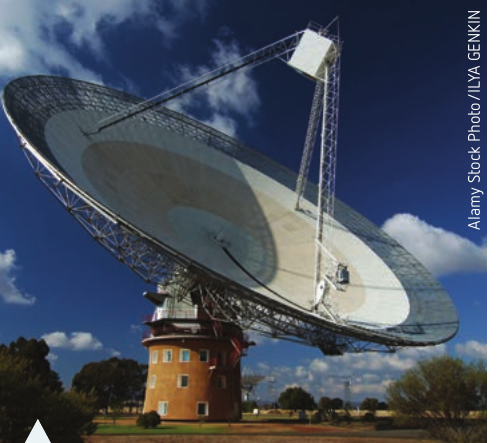
These work in the opposite way to headlights. Weak microwave signals from satellites arrive as nearly parallel rays. The parabolic dish reflects all these rays toward the focal point, where the receiving antenna is located.
This design allows the dish to collect signals over its entire large surface area and concentrate them at one point, making it possible to detect very weak signals. This demonstrates the first characteristic of the focal point: parallel incoming rays converge at the focal point.
Reflection from convex surfaces
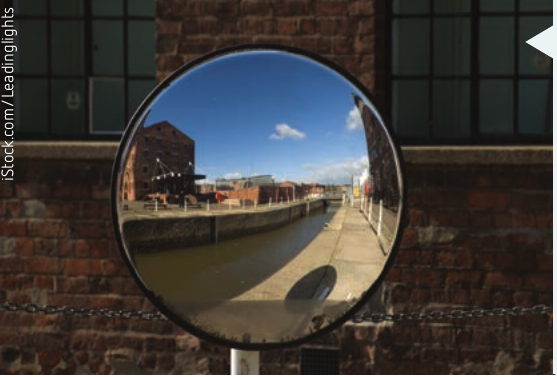
A convex surface curves outward, like the outside of a ball. Convex reflectors cause parallel rays to diverge (spread out) after reflection. This creates a wider field of view but makes objects appear smaller and farther away than they actually are.
Note
Applications of convex mirrors:
- Vehicle side mirrors: Allow drivers to see a wider area, helping to eliminate blind spots
- Shop security mirrors: Enable shopkeepers to monitor multiple areas of their store simultaneously
- Traffic mirrors: Placed at intersections or driveways with limited visibility to give drivers a wider view of approaching traffic
The trade-off with convex mirrors is that while they provide a wider field of view, they distort distances - objects appear farther away than they actually are. This is why vehicle side mirrors often carry the warning "Objects in mirror are closer than they appear."
Investigations
Investigation 8.1: Applications of reflection
Aim: To investigate the application of different shapes used to reflect waves
Materials:
- Paper
- Pen
- Pencil
- Ruler
- Protractor
Method:
- On paper, trace two curves: one parabolic shape and one circular arc. Each curve should be approximately half a page in size. (You can find a suitable parabolic curve online and trace it by placing paper on your screen)
- Using a protractor, construct six normals to each curve's surface at different locations along the curve
- Draw incident rays that are parallel to each other, with one ray for each normal. Each incident ray should strike the curve at a point where you have drawn a normal
- Apply the law of reflection to draw the reflected ray for each incident ray. Remember to measure both angles from the ray to the normal, not to the surface
- Compare the two diagrams, noting how the reflected rays behave differently for the parabolic shape versus the circular arc
Important
When drawing reflected rays, always ensure that at each point. Use your protractor carefully to measure angles from the normal, not from the surface. This precision is essential for observing the difference between parabolic and circular reflection.
Results: Record your observations about how the reflected rays behave in each case.
Discussion questions:
- What differences did you observe between reflection from the parabola and reflection from the circular arc?
- Which curved shape is better suited for reflecting waves in practical applications? Why?
- Why are parabolic shapes preferred in devices like satellite dishes and car headlights?
Conclusion: Write a conclusion explaining which shape is more effective for focusing reflected waves and why.
Investigation 8.2: Reflection of light from a variety of surfaces
Aim: To investigate the reflection of light from plane, concave and convex surfaces
Materials:
- Ray box kits
- Power packs
- Protractor
- Pencil, ruler and paper
Important
Safety considerations:
| What are the risks in doing this investigation? | How can you manage these risks to stay safe? |
|---|---|
| Power packs use a 240 V mains power supply | Keep devices plugged into 240 V mains power well away from water |
| The laboratory may be darkened | Place trip hazards such as bags away carefully to prevent accidents |
Method:
- Set up a ray box to produce three or more parallel rays of light from its end
- Trace the incident rays on paper for each of the following mirror surfaces:To do this, place the apparatus on paper and use a ruler and pencil to trace the rays. Draw arrows showing the direction of light travel
- Plane mirror
- Concave mirror
- Convex mirror
- At each point where an incident ray strikes the mirror, construct a normal to the mirror's surface
- Using a protractor, measure the angle of incidence () and the corresponding angle of reflection () for each point. Verify that the law of reflection () has been obeyed
Note
For best results, work in a darkened room where the light rays are most visible. Keep your pencil sharp for accurate tracing, and use a ruler to ensure your normals are truly perpendicular to the mirror surface at each point.
Results: Keep or photograph your diagrams for your files.
Analysis of results: Suggest ways to improve the accuracy of this investigation.
Discussion questions:
- In which cases were the reflected rays:
- parallel?
- diverging (spreading out)?
- converging (coming together)?
- How does the way parallel rays reflect from each surface relate to the practical applications of these mirror shapes?
Conclusion: Write a conclusion based on your observations, explaining how different mirror shapes affect the behaviour of reflected light.
Exam tips
Important
Key Points for Success:
- Always measure angles from the ray to the normal, never from the ray to the surface
- Remember that applies to ALL types of reflecting surfaces
- For parabolic reflectors, remember the dual function of the focal point (focusing incoming rays and creating parallel outgoing rays)
- Convex mirrors provide a wider field of view but distort distance perception
- When drawing reflection diagrams, always include the normal as a dashed perpendicular line
Remember!
Summary
Key Points to Remember:
-
The law of reflection: The angle of incidence equals the angle of reflection () for all reflecting surfaces
-
Plane mirrors reflect without distortion because their normals are all parallel, causing parallel rays to reflect as parallel rays
-
Concave parabolic reflectors focus parallel incoming rays to a focal point, or convert rays from a source at the focal point into parallel outgoing rays - used in satellite dishes and car headlights
-
Convex mirrors spread out reflected rays to provide a wider field of view - used in vehicle side mirrors and security applications
-
Wave properties (speed, frequency, wavelength) remain unchanged during reflection - only the direction changes