Electromagnetic Waves (HSC SSCE Physics): Revision Notes
📚Revision Notes
Electromagnetic Waves
What are electromagnetic waves?
Electromagnetic waves are a unique type of wave that can travel through empty space. Unlike mechanical waves such as sound, electromagnetic waves do not need a medium to propagate. We can picture electromagnetic radiation as two fields—one electric and one magnetic—that vibrate together at right angles to each other while moving through space.
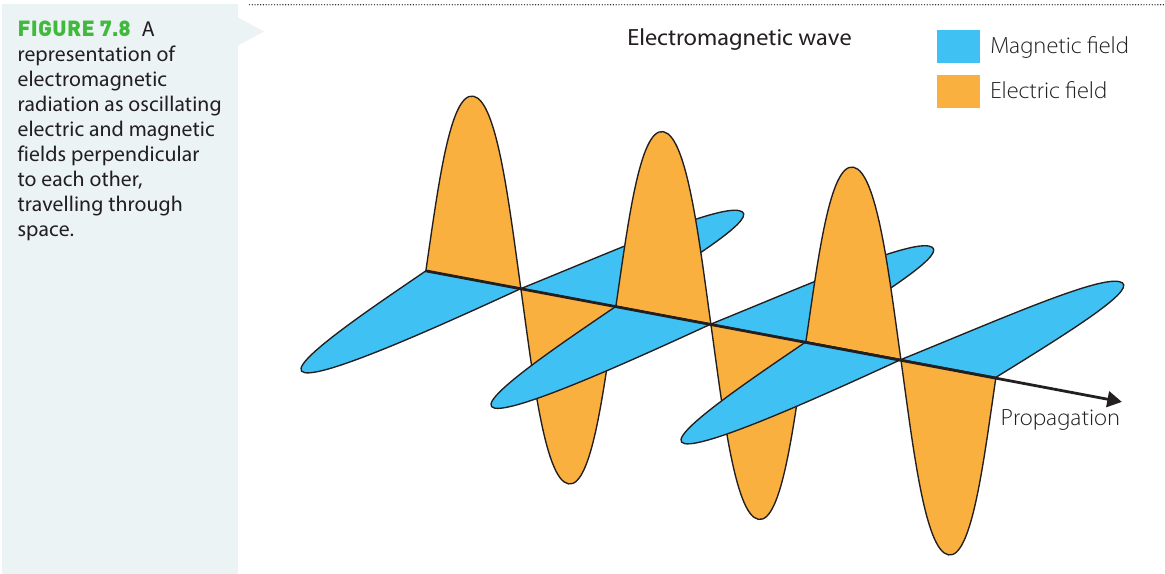
The two fields are perpendicular to both each other and to the direction of travel. As the electric field oscillates, it creates a changing magnetic field. This changing magnetic field, in turn, generates an electric field. This continuous interaction allows the fields to sustain themselves and propagate forward without requiring any material medium.
Note
This self-propagating nature is what makes electromagnetic waves so special—they can travel through the vacuum of space without needing any matter to carry them forward.
Historical development
Early discoveries
The connection between electricity and magnetism was first identified by Hans Christian Ørsted in 1820. His discovery was subsequently investigated further by Michael Faraday and Humphry Davy, who explored how these two phenomena were related.
Maxwell's breakthrough
In the 1860s, James Clerk Maxwell developed mathematical equations that described electromagnetic radiation. His work showed that:
- A changing magnetic field induces an electric field perpendicular to it
- A changing electric field induces a magnetic field perpendicular to it
- These oscillations can self-propagate through space
Important
When Maxwell solved his equations to find the speed at which these waves would travel, he discovered something remarkable. The speed was the same regardless of the wave's frequency, and it matched the known speed of light. This led Maxwell to hypothesise that light itself was an electromagnetic wave, and that other similar waves with different frequencies might exist.
This prediction proved correct with the later discovery of X-rays, radio waves, infrared radiation, and ultraviolet radiation.
The speed of light
Maxwell's equations revealed that the speed of light in a vacuum is , which is approximately . For most calculations, this is rounded to .
This speed turned out to be of fundamental importance. Albert Einstein's special theory of relativity identified it as the theoretical universal speed limit—nothing can travel faster than the speed of light in a vacuum.
The aether debate and Einstein's resolution
Maxwell's result showed that the speed of light was invariant (constant), suggesting that electromagnetic waves could travel through space without requiring a medium. This idea sparked intense debate among physicists. Many scientists believed there must be some medium—called the 'aether'—through which these waves propagated, and numerous experiments were conducted to try to detect it.
However, the existence of such a medium would have significant implications. It would mean the aether itself became the universal frame of reference, which contradicted fundamental principles. Einstein realised that the constant speed of electromagnetic wave propagation meant there was no aether. To reconcile Maxwell's theories with observations, Einstein developed his 'thought experiments', which showed that both time and space as experienced by observers would vary depending on their location and motion. This revolutionary thinking led to the special theory of relativity in 1905, which ushered in the modern physics we understand today.
The electromagnetic spectrum
The electromagnetic spectrum encompasses all types of electromagnetic radiation, distinguished by their wavelengths and frequencies. The spectrum includes an enormous range of wavelengths, from kilometres for long radio waves down to picometres () for gamma rays.
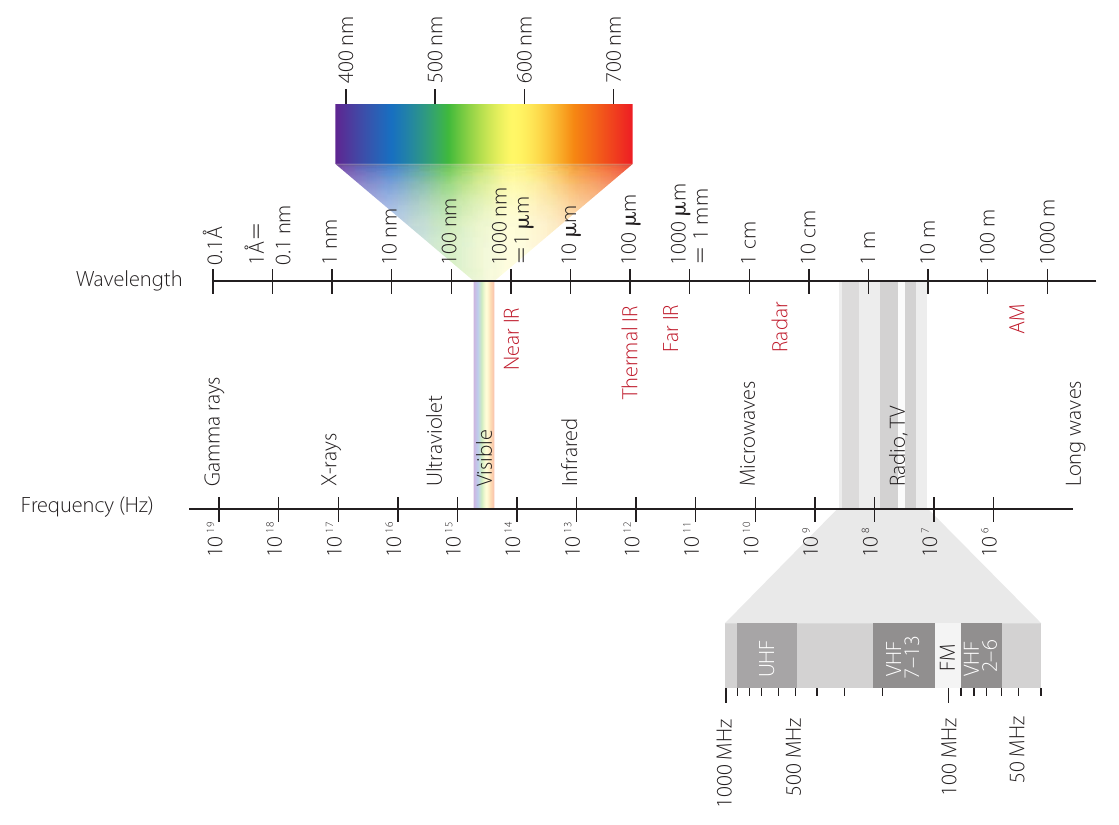
The electromagnetic spectrum includes, in order of increasing wavelength:
- Gamma rays: Shortest wavelength (around Ångströms or ), highest frequency
- X-rays: Wavelengths from about to
- Ultraviolet: Wavelengths from about to
- Visible light: Wavelengths from approximately (violet) to (red)
- Infrared: Divided into near, thermal, and far infrared, with wavelengths from about to
- Microwaves: Including radar frequencies, wavelengths from about to
- Radio waves: Including TV, FM, VHF, UHF, and AM radio, wavelengths from about to kilometres
- Long waves: Longest wavelengths in the spectrum
Note
Memory Aid: To remember the order of increasing wavelength, try this mnemonic: "Good X-rays Usually Visible, Including Microwaves, Radio" (Gamma, X-ray, Ultraviolet, Visible, Infrared, Microwaves, Radio).
All these different types of electromagnetic radiation are fundamentally the same phenomenon—oscillating electric and magnetic fields—but with different wavelengths and frequencies. Crucially, they all travel at the speed of light when in a vacuum.
Properties of electromagnetic waves
No medium required
Unlike mechanical waves, electromagnetic waves can travel through a vacuum. The radiation reaching us from the Sun, distant stars, and pulsars travels through the emptiness of space at the speed of light. This is possible because the waves do not require matter to propagate—they consist of oscillating electric and magnetic fields, not vibrating particles.
Travelling through materials
While electromagnetic waves can travel through a vacuum, they can also pass through certain materials:
- Light can travel through the atmosphere, water, glass, and diamond
- Light cannot pass through rocks, wood, or metals
- Earth's atmosphere effectively absorbs or blocks most electromagnetic radiation, with the main exceptions being visible light, radio waves, and microwaves
Invisible oscillations
With electromagnetic waves, there is no physical vibration of matter. Instead, it is invisible electric and magnetic fields (which do not involve matter) that oscillate in space, transferring energy as the oscillating fields propagate forward.
Investigation 7.4: Differences between mechanical and electromagnetic waves
Aim
To observe differences between mechanical and electromagnetic waves.
Hypothesis
If the medium is removed, a mechanical wave will not pass but electromagnetic waves will.
Materials
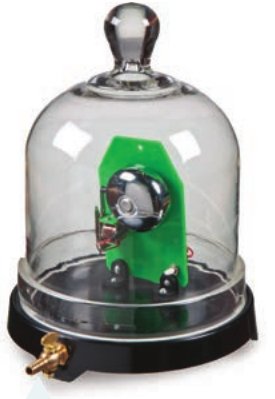
- Well-greased air-tight bell jar with air outlet
- Strong vacuum pump
- Battery-powered bell
Risk assessment
| What are the risks in doing this investigation? | How can you manage these risks to stay safe? |
|---|---|
| The vacuum pump is very heavy and may cause injury if dropped. | Place the vacuum pump well away from the edge of the bench. |
| A strong vacuum can cause a glass container to implode and shatter, spreading shards of glass. | Only use a purpose-built vacuum jar and wear safety glasses. |
You should also consider any other risks associated with your investigation and how you can manage them safely.
Method
- Place the battery-powered bell inside the bell jar, turn it on, and seal the jar
- Connect the vacuum pump
- Observe the sound of the bell
- Start the vacuum pump and continue to observe the sound of the bell
- Once the vacuum has been attained, observe the sound from the bell and observe the bell itself
Results
Record your observations in a suitable format. You should note both what you hear and what you see throughout the experiment.
Discussion
The experiment demonstrates a fundamental difference between mechanical and electromagnetic waves. When the vacuum is created inside the bell jar:
- The sound from the bell becomes much quieter or disappears completely (mechanical wave requiring a medium)
- The light from the bell (if it has a light) remains unchanged (electromagnetic wave not requiring a medium)
Important
Sound is a mechanical wave that requires a medium (air, in this case) to travel. When the air is removed from the bell jar, the sound waves cannot propagate from the bell to the jar walls and then to your ears. Any sound you still hear travels through the physical support structure of the bell inside the jar.
Light, however, is part of the electromagnetic spectrum and can travel through a vacuum. When the air is removed, the light from the bell passes through the vacuum inside the jar without any change, demonstrating that electromagnetic waves do not need a medium.
Conclusion
The investigation supports the hypothesis. When the medium (air) is removed from the bell jar, the mechanical wave (sound) cannot propagate effectively, but the electromagnetic wave (light) continues to travel through the vacuum without change. This demonstrates the fundamental difference between these two types of waves.
Key differences from mechanical waves
Note
Understanding the Distinctions:
It is important to understand the distinctions between electromagnetic and mechanical waves:
Electromagnetic waves:
- Consist of oscillating electric and magnetic fields perpendicular to each other
- Do not require a medium for propagation
- Can travel through a vacuum
- All travel at the speed of light () in a vacuum
- Include radio waves, microwaves, infrared, visible light, ultraviolet, X-rays, and gamma rays
Mechanical waves:
- Require a physical medium to propagate
- Cannot travel through a vacuum
- Involve the vibration of particles in the medium
- Examples include sound waves and water waves
Calculating with electromagnetic waves
When working with electromagnetic waves, you can use the relationship between speed, distance, and time:
Example
Worked Example: Light Travel from Sun to Earth
Question: How long does it take light to travel from the Sun to Earth?
Given information:
- Distance from Sun to Earth: million kilometres =
- Speed of light:
Step 1: Identify the formula
Step 2: Substitute the values
Step 3: Calculate
Step 4: Convert to minutes
Answer: Light takes approximately 8 minutes and 20 seconds to travel from the Sun to Earth.
Exam tip: When calculating how long it takes light to travel from the Sun to Earth, remember to convert the distance to metres if it's given in kilometres.
Remember!
Summary
Key Points to Remember:
- Electromagnetic waves consist of electric and magnetic fields oscillating perpendicular to each other, allowing them to self-propagate through space
- Unlike mechanical waves, electromagnetic waves do not require a medium and can travel through a vacuum
- All electromagnetic waves travel at the speed of light in a vacuum:
- The electromagnetic spectrum includes (in order of increasing wavelength): gamma rays, X-rays, ultraviolet, visible light, infrared, microwaves, and radio waves
- The bell jar vacuum experiment demonstrates that mechanical waves (sound) require a medium, while electromagnetic waves (light) do not