Transverse and Longitudinal Waves (HSC SSCE Physics): Revision Notes
📚Revision Notes
Transverse and Longitudinal Waves
Introduction
Waves can be classified into different types based on how the particles in the medium move as the wave passes through. The two most commonly observed types of waves are transverse waves and longitudinal waves. Understanding the difference between these wave types is essential for studying wave behaviour and properties.
Note
The key to understanding wave classification lies in observing the direction of particle motion relative to the direction of energy transfer. This fundamental distinction affects how waves interact with different types of materials and determines what media they can travel through.
Transverse waves
What are transverse waves?
In a transverse wave, particles within the material oscillate perpendicular to the direction in which the wave is travelling. This means if the wave is moving horizontally, the particles move up and down (or side to side) as the wave passes through.
As a transverse wave travels through a medium, it creates a pattern of crests (high points) and troughs (low points) that move through the material. The particles themselves do not travel with the wave; they simply oscillate about their rest position.
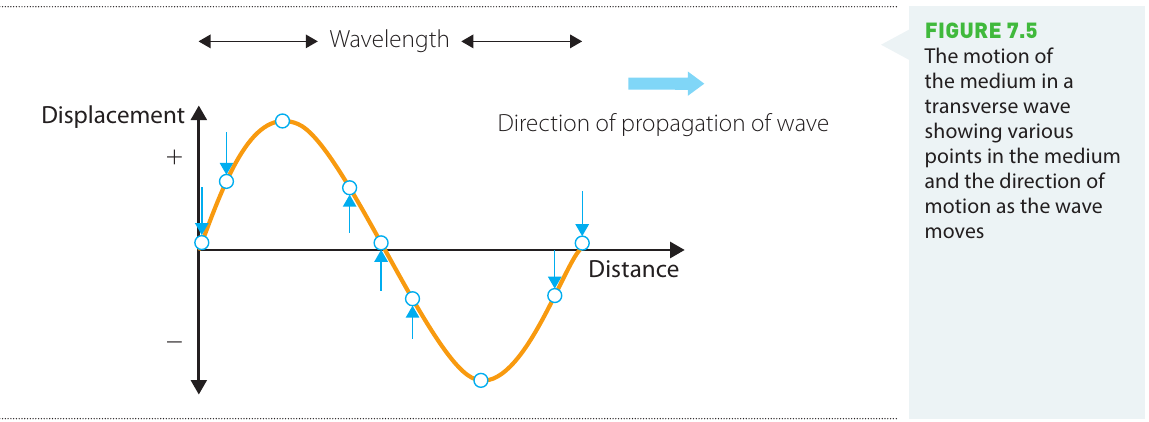
Particle motion in transverse waves
The motion of particles in a transverse wave follows a specific pattern:
- At a crest or trough: Particles are momentarily stationary (not moving) and are about to reverse direction back towards their rest position
- Between crests and troughs: Particles are moving perpendicular to the direction the wave is travelling
- Complete cycle: Each particle completes one full up-and-down oscillation as one wavelength passes
Note
It's important to remember that individual particles in the medium do not travel with the wave. They only oscillate about their rest position while the wave energy passes through. Think of spectators doing "the wave" in a stadium - each person only stands up and sits down, but the wave travels around the stadium.
The wavelength () is the distance between two consecutive crests or two consecutive troughs. The displacement refers to how far a particle is from its rest position at any given moment.
Reflection of transverse waves
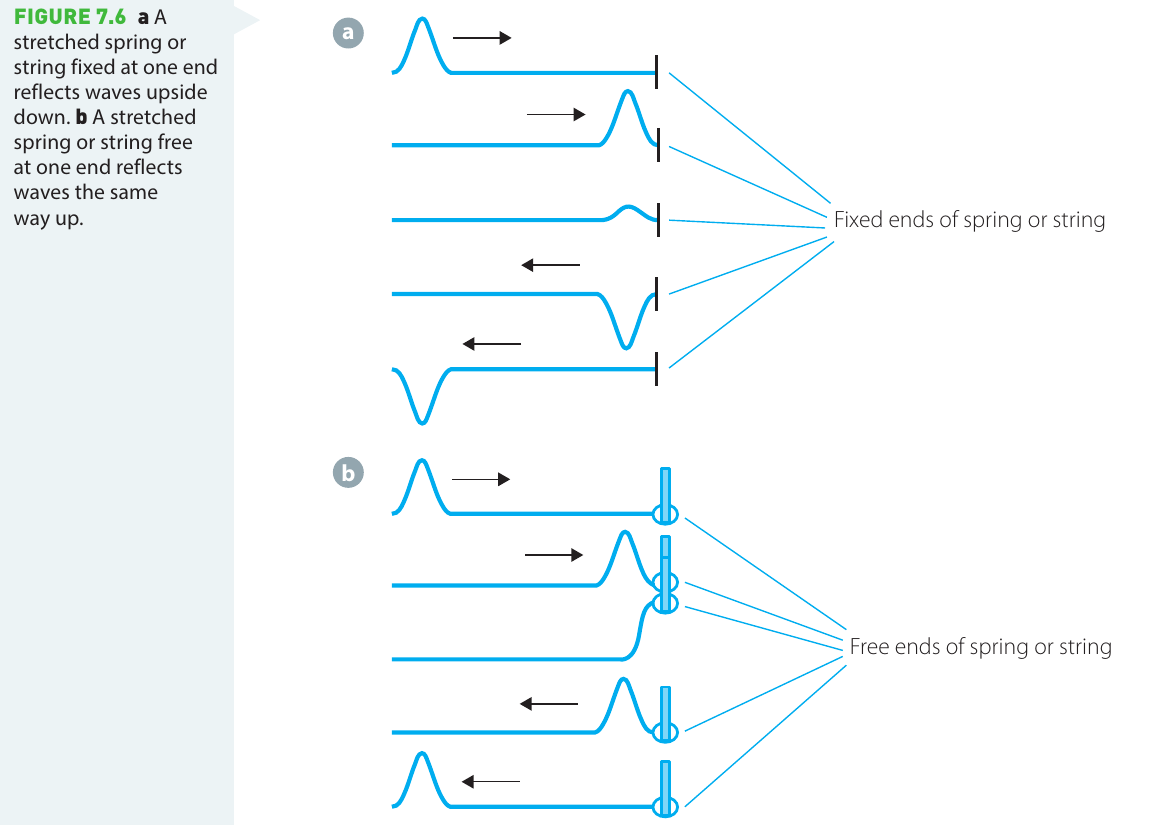
When a transverse wave reaches the end of the medium it is travelling through (such as a spring or string), it reflects back. The behaviour of this reflection depends on how the end is secured:
Fixed end reflection:
- If the end of the spring or string is fixed (cannot move), a crest reflects as a trough
- The wave is inverted or turned upside down upon reflection
- This is called phase inversion
Free end reflection:
- If the end is free to move up and down (such as attached to a loose ring), a crest reflects as a crest
- The wave reflects upright with no inversion
- The wave maintains its original orientation
Important
Common misconception: Students often confuse which type of end causes inversion. Remember: Fixed end flips it (causes phase inversion), while free end keeps it (maintains the wave orientation). In both cases, the reflected wave travels with the same speed and maintains the same shape as the incident wave.
Longitudinal waves
What are longitudinal waves?
In a longitudinal wave, particles oscillate in a direction parallel to the energy flow. This means particles move back and forth along the same line that the wave is travelling.
Unlike transverse waves which create crests and troughs, longitudinal waves create regions of compression and rarefaction as they travel through a medium.
Compressions and rarefactions
Compression:
- A region where particles are crowded together
- Occurs when particles around a point all move towards that point
- This creates a region of maximum pressure
Rarefaction:
- A region where particles are spread apart
- Occurs when particles around a point all move away from that point
- This creates a region of minimum pressure
As a longitudinal wave passes through a medium, any given point experiences a series of alternating compressions and rarefactions. The wavelength () is the distance between two consecutive compressions or two consecutive rarefactions.

Note
Pressure variations in longitudinal waves:
Maximum pressure occurs at compressions; minimum pressure occurs at rarefactions. This pressure variation is what allows us to hear sound waves - the alternating high and low pressure regions vibrate our eardrums.
A useful memory aid: think of "C and R" - Compression (particles squeeze together), Rarefaction (particles spread apart).
Comparing transverse and longitudinal waves
Key differences
The fundamental difference between these two wave types is the direction of particle motion relative to wave propagation:
| Feature | Transverse Waves | Longitudinal Waves |
|---|---|---|
| Particle motion | Perpendicular to wave direction | Parallel to wave direction |
| Pattern created | Crests and troughs | Compressions and rarefactions |
| Pressure variation | Not applicable | Maximum at compressions, minimum at rarefactions |
| Can travel through gases/liquids | No (not effectively) | Yes |
| Examples | Waves on strings, water surface waves, electromagnetic waves | Sound waves, seismic P-waves |
Why transverse waves cannot travel through fluids
Longitudinal waves can pass through gases and liquids, but transverse waves cannot propagate effectively through these substances. This is because:
- Transverse waves require the medium to transmit sideways forces (forces perpendicular to the direction of wave travel)
- Gases and liquids cannot effectively transmit these sideways forces because their particles are not rigidly connected
- The particles in fluids can slide past each other easily, preventing the transmission of transverse oscillations
Important
Critical concept for understanding wave propagation:
The ability of a wave type to travel through a particular medium depends on whether that medium can transmit the required type of force. Fluids cannot effectively transmit sideways forces, which is why transverse waves struggle to propagate through gases and liquids. However, solids can transmit both parallel and perpendicular forces, allowing both wave types to travel through them.
This principle explains why you can hear sound (longitudinal) underwater, but you cannot create sustained transverse waves in water in the same way you can on a string.
Investigation: Comparing wave types
Aim
To observe and compare the motion of particles in transverse and longitudinal waves using a spring.
Safety considerations
| Risk | Safety Measures |
|---|---|
| The spring may flick back into your eye if released | Wear safety glasses when working with springs. Do not over-stretch the spring |
Key observations
For transverse pulses:
- Create by giving the spring a quick sideways shake
- Observe that coils move perpendicular to the pulse direction
- Note the reflection behaviour at the fixed end
For longitudinal pulses:
- Create by making a rapid back-and-forth movement along the spring direction
- Observe that coils move parallel to the pulse direction
- Identify regions of compression and rarefaction
Calculating wave speed
The speed of a wave can be calculated using:
where:
- = wave speed (m/s)
- = distance travelled (m)
- = time taken (s)
Example
Worked Example: Calculating Wave Speed
A longitudinal pulse travels along a 3.0 m spring and takes 0.75 s to reach the other end. Calculate the speed of the wave.
Solution: Using the formula:
Substituting values:
The wave speed is 4.0 m/s.
Note: By recording the wave motion and measuring the distance the pulse travels and the time it takes, you can determine the wave speed for both transverse and longitudinal pulses, then compare the results.
Remember!
Summary
Key Points to Remember:
- Transverse waves: Particles oscillate perpendicular to the direction of wave travel, creating crests and troughs
- Longitudinal waves: Particles oscillate parallel to the direction of wave travel, creating compressions and rarefactions
- Reflection: Transverse waves reflect inverted at fixed ends and upright at free ends
- Medium matters: Longitudinal waves can travel through gases and liquids; transverse waves cannot do so effectively because fluids cannot transmit sideways forces
- Wavelength () is the distance between consecutive crests, troughs, compressions, or rarefactions
- Memory aids: "Trans-VERSE = across" (perpendicular motion) and "Long-itudinal = along" (parallel motion)