Measuring pH (VCE SSCE Chemistry): Revision Notes
📚Revision Notes
Measuring pH
What are indicators?
Indicators are special substances used to distinguish between acids and bases. They are weak acids that display different colours in acidic solutions compared to basic solutions. This colour change happens because the conjugate acid form of the indicator has one colour, while its conjugate base form has a different colour.
Indicators serve two main purposes:
- Determining the pH of a solution
- Performing acid-base analyses in the laboratory
Natural indicators
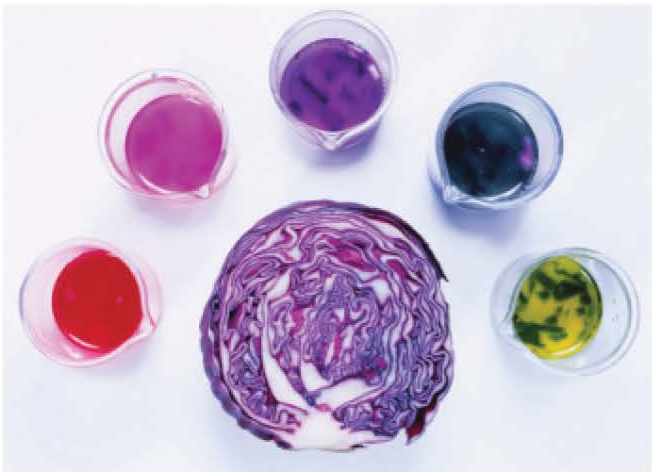
Natural indicators are substances extracted from plants that change colour depending on the pH of the solution they're in. Common plant sources include rose petals, blackberries, and red cabbage.
Note
Natural indicators have been used for centuries to test acids and bases. While they're less precise than modern commercial indicators, they demonstrate the fundamental principle of pH-dependent colour changes and are easily accessible for basic experiments.
Litmus
Litmus is one of the oldest natural indicators still used today. It's a purple, water-soluble mixture of dyes obtained from lichen.
Colour changes:
- In acids: turns red
- In bases: turns blue
Red cabbage
Red cabbage juice is a versatile natural indicator that displays different colours across the entire pH range. The juice extracted from red cabbage leaves changes colour depending on the pH of the solution, making it useful for measuring pH with reasonable accuracy.
Red cabbage colour range:
- Strong acid (pH 1-3): pink/red
- Weak acid (pH 4-6): red/purple
- Neutral (pH 7): purple
- Weak base (pH 8-10): blue/green
- Strong base (pH 11-14): yellow/green
Commercial indicators
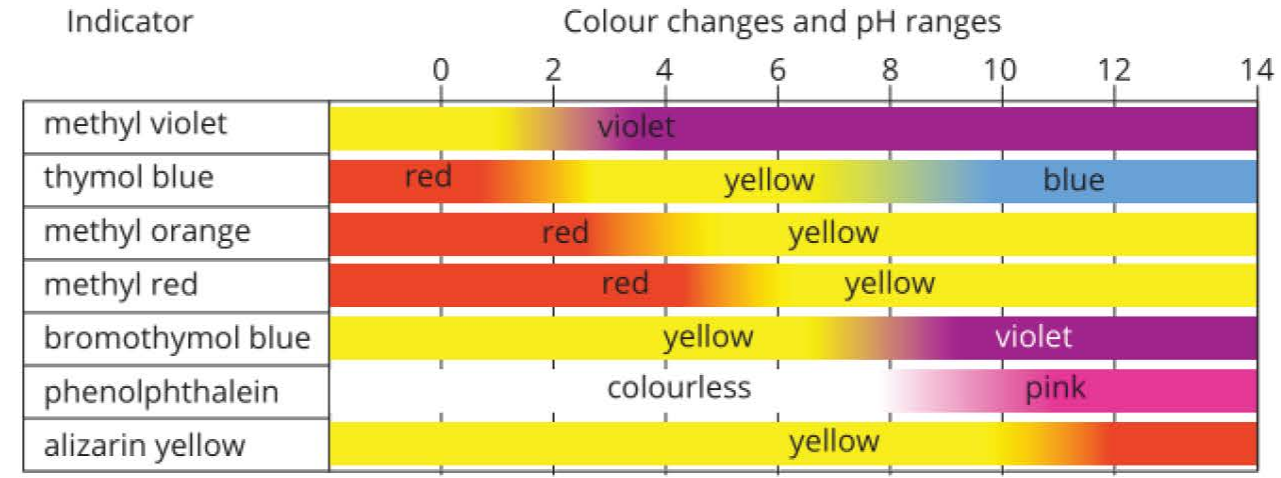
Most indicators used in modern laboratories and industry are commercially produced synthetic indicators. These include bromothymol blue, methyl orange, and phenolphthalein. Each of these indicators changes colour over a specific, narrow pH range, making them particularly useful for acid-base analyses.
Bromothymol blue
Bromothymol blue is a widely used indicator with a clear colour transition.
Colour changes:
- In acidic solutions: yellow
- At pH 7.0 (neutral): green
- In basic solutions: blue
pH range: Changes colour over pH 6.0 to 7.6

Methyl orange
Methyl orange is a synthetic indicator commonly used in the analysis of weak acids.
Colour changes:
- In acidic solutions: red
- At intermediate pH: orange
- In basic solutions: yellow
pH range: Changes colour between pH 3.1 and pH 4.4

Phenolphthalein
Phenolphthalein is a synthetic indicator used for analysing acids and bases.
Colour changes:
- In acidic solutions (pH < 8.3): colourless
- In basic solutions (pH > 10): pink to magenta
pH range: Changes colour over pH 8.3 to 10.0

Universal indicator
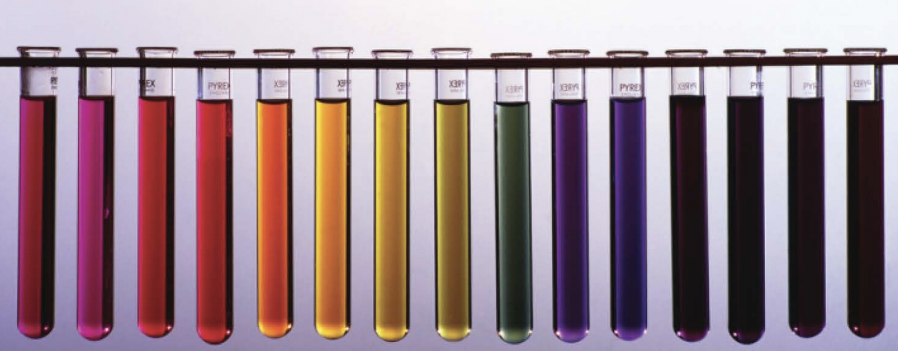
Universal indicator is widely used to estimate the pH of solutions across the entire pH range. Unlike single indicators, it's a mixture of several indicators that displays a full spectrum of colours from red through yellow, green, and blue to violet. Each pH value between 0 and 14 corresponds to a specific colour.
Note
Universal indicator provides more accurate pH determinations than single indicators because it can distinguish between all pH values rather than just indicating "acid" or "base." This makes it particularly valuable when testing solutions of unknown pH.
pH meters
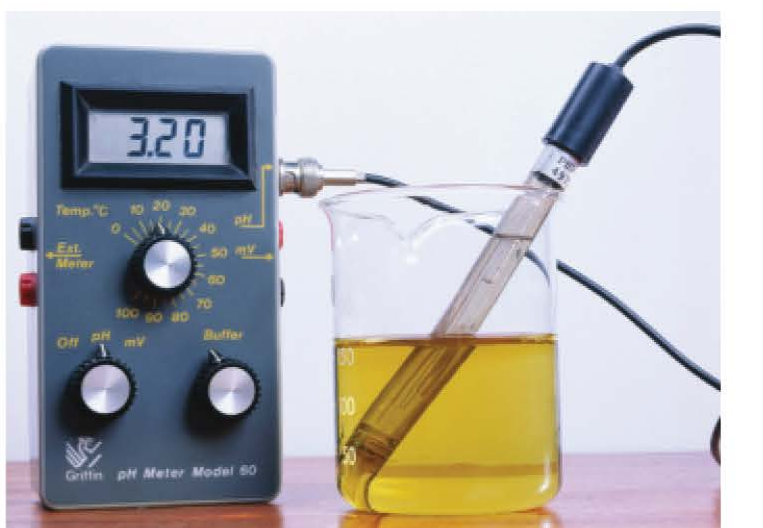
When very accurate measurements of pH are required, a pH meter is the best choice. pH meters are electronic devices that measure pH using a special electrode that responds to hydrogen ion concentration in a solution.
Advantages of pH meters:
- Highly accurate (to 0.01 pH units)
- Highly precise (reproducible results)
- Can measure any pH value from 0 to 14
- Gives numerical readings rather than colour changes
Real-world application: Indicators in gardening
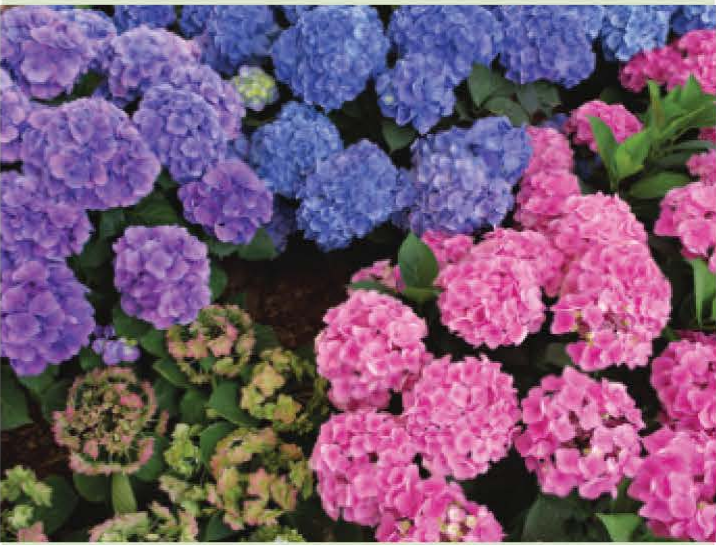
Indicators have practical applications beyond the laboratory. For example, hydrangea flowers naturally act as indicators of soil pH.
Example
Practical Application: Hydrangea Flower Colours
Hydrangeas demonstrate natural pH indication in action:
Flower colours based on soil pH:
- Acidic soil: flowers are blue
- Alkaline soil: flowers are pink
How gardeners manipulate flower colour:
To make flowers more blue:
- Add aluminium sulfate (a weak acid) to the soil
- This lowers the pH, making the soil more acidic
To make flowers more pink:
- Add lime (calcium carbonate, a weak base) to the soil
- This raises the pH, making the soil more alkaline
Testing soil pH: Gardeners mix a soil sample (without organic matter) with water, allow it to settle, then test the water with universal indicator or a pH meter.
Accuracy and precision in pH measurement
Different methods of measuring pH vary in their accuracy and precision:
Important
Key Definitions:
- Accuracy refers to how close measurements are to the true value
- Precision refers to how close measurements are to each other and whether they can be reliably reproduced
Choosing the right method
The choice of pH measurement method depends on the purpose:
For neutralisation reactions: Indicators like phenolphthalein are ideal. For example, when neutralising HCl with NaOH, adding a few drops of phenolphthalein to the acid allows you to detect the exact neutralisation point. The solution changes from colourless to pink as soon as neutralisation is complete.
For unknown samples: Universal indicator or a pH meter is more suitable than single indicators because the pH could be anywhere from 0 to 14.
For high accuracy and precision: A pH meter is the best choice, providing measurements to within 0.01 pH units.
Understanding accuracy vs precision
Think of throwing darts at a dartboard:
- Accurate and precise: All darts land close to the bullseye and close to each other
- Inaccurate but precise: All darts miss the bullseye but land close to each other
- Accurate but imprecise: Darts are scattered around the bullseye
- Inaccurate and imprecise: Darts are scattered far from the bullseye
Comparison of pH measurement methods
| Method | Accuracy | Precision | Overall conclusion |
|---|---|---|---|
| Red cabbage juice | Sample value can be determined to within 2 pH units of the true value | Generally reproducible to within 2 pH units | Least accurate and least precise method |
| Universal indicator | Sample value can be determined to within 1 pH unit of the true value | Generally reproducible to within 1 pH unit | More accurate and precise than natural indicators |
| pH meter | Sample value can be determined to within 0.01 pH units of the true value | Generally reproducible to within 0.01 pH units | Most accurate and precise method |
Note
Red cabbage juice is both less accurate and less precise than universal indicator. When accuracy and precision are required to within one-hundredth of a pH value, a pH meter must be used.
Summary
Key Points to Remember:
-
Indicators are weak acids that change colour depending on whether they're in acidic or basic solutions, with the conjugate acid and conjugate base forms having different colours.
-
Natural indicators like litmus and red cabbage juice come from plants and can identify acids and bases, though with limited precision.
-
Commercial indicators (bromothymol blue, methyl orange, phenolphthalein) each change colour over specific, narrow pH ranges, making them useful for particular applications.
-
Universal indicator is a mixture of several indicators that displays different colours across the entire pH range from 0 to 14.
-
pH meters provide the most accurate and precise measurements (to 0.01 pH units), while natural indicators are the least accurate and precise (to within 2 pH units).