pH: a Measure of Acidity (VCE SSCE Chemistry): Revision Notes
📚Revision Notes
pH: a Measure of Acidity
The pH scale is a convenient way to measure how acidic or basic a solution is. Understanding pH is essential for working with acids and bases in chemistry, as it allows you to express extremely small ion concentrations in a simple numerical form.
Ionic product of water
Water is not just a neutral solvent – its molecules can actually react with each other in a process called self-ionisation. In this reaction, one water molecule acts as an acid (donating a proton) while another acts as a base (accepting the proton). This demonstrates water's amphiprotic nature.
The self-ionisation of water can be represented by the equation:
This reaction occurs to only a very small extent. In pure water at 25°C, the concentrations of both hydronium ions (H₃O⁺) and hydroxide ions (OH⁻) are equal at 1 × 10⁻⁷ M. This means that for every H₃O⁺ or OH⁻ ion in a glass of water, there are approximately 560 million H₂O molecules!
The Kw constant
An important discovery is that all aqueous solutions contain both H₃O⁺ and OH⁻ ions, and the product of their molar concentrations is always constant at a given temperature. This constant is called the ionic product of water (or ionisation constant of water) and is represented by the symbol Kw:
Note
The square brackets [ ] represent molar concentration in mol L⁻¹ (or M).
This relationship is extremely useful because if you know either the hydronium ion concentration or the hydroxide ion concentration in a solution, you can calculate the other. If one concentration increases, the other must decrease proportionally to maintain the constant product.
Acidic and basic solutions
When acidic substances dissolve in water, they produce additional H₃O⁺ ions through reaction with water molecules, on top of those produced by water's self-ionisation. This means acidic solutions have [H₃O⁺] > 10⁻⁷ M at 25°C. Since the product [H₃O⁺][OH⁻] must remain constant at 1.00 × 10⁻¹⁴ M², the hydroxide ion concentration in acidic solutions must be less than 10⁻⁷ M.
The opposite occurs in basic solutions. Bases increase the concentration of OH⁻ ions, so [OH⁻] > 10⁻⁷ M and [H₃O⁺] < 10⁻⁷ M.
Important
Summary of ion concentrations at 25°C:
- Pure water and neutral solutions: [H₃O⁺] = [OH⁻] = 10⁻⁷ M
- Acidic solutions: [H₃O⁺] > 10⁻⁷ M and [OH⁻] < 10⁻⁷ M
- Basic solutions: [H₃O⁺] < 10⁻⁷ M and [OH⁻] > 10⁻⁷ M
Calculating ion concentrations using Kw
You can use the Kw expression to determine the concentrations of hydronium and hydroxide ions in any aqueous solution at 25°C. Here's an example with a strong acid:
Example
Worked Example: Calculating Ion Concentrations in an Acid
Hydrochloric acid (HCl) is a strong acid that ionises completely in water. Each HCl molecule donates one proton to water, forming one H₃O⁺ ion.
For a 0.10 M HCl solution:
- [H₃O⁺] = 0.10 M (complete ionisation)
- Using the Kw expression: [OH⁻] = M
The pH scale
The range of H₃O⁺ concentrations in different solutions is enormous – from greater than 1 M in concentrated acids to less than 10⁻¹⁴ M in concentrated bases. Writing these values in scientific notation becomes cumbersome, so scientists developed the pH scale as a more convenient way to express acidity.
Danish scientist Soren Sorenson first proposed the pH scale in 1909. It is a logarithmic scale, which means each unit represents a tenfold change in hydronium ion concentration. The pH of a solution is defined mathematically as:
This can also be rearranged to calculate hydronium ion concentration from pH:
Important
The negative logarithm creates an inverse relationship between pH and acidity. As the concentration of H₃O⁺ ions increases (more acidic), the pH value decreases. Conversely, as [H₃O⁺] decreases (more basic), the pH increases.
Note
Important property: Because the scale is logarithmic, a solution with pH 2 has 10 times the concentration of hydronium ions as a solution with pH 3, and 100 times the concentration as a solution with pH 4.
pH values of acidic, basic and neutral solutions
On the pH scale, values range from slightly less than 0 (extremely acidic) to about 14 (extremely basic). At 25°C, solutions can be classified based on their pH:
- Neutral solutions: pH = 7
- Acidic solutions: pH < 7
- Basic solutions: pH > 7
The table below shows the pH values of some common substances:
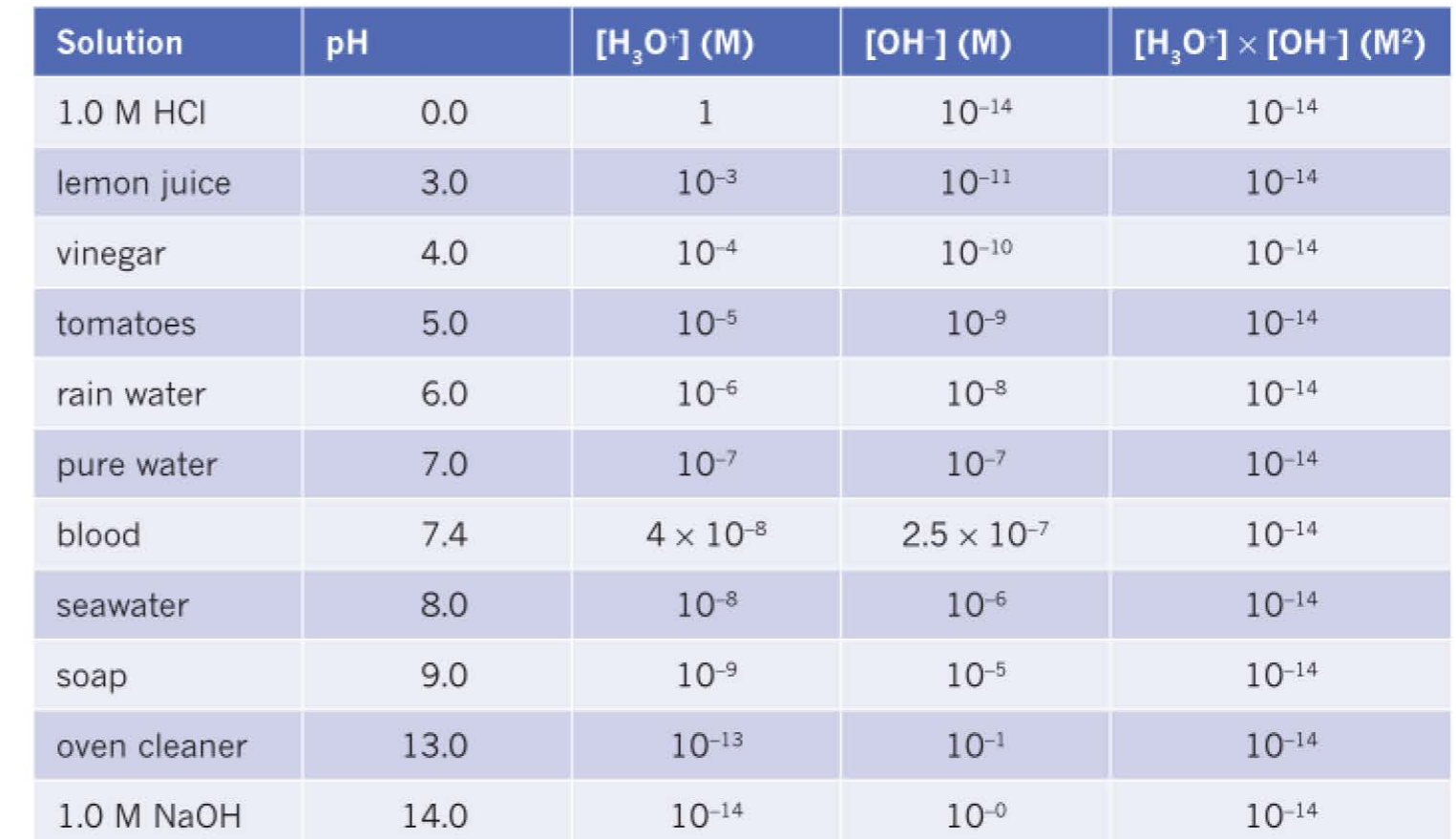
This table illustrates several important points. Notice that for each solution, the product [H₃O⁺] × [OH⁻] always equals 10⁻¹⁴. Also observe the wide range of pH values in everyday substances – from very acidic stomach acid and lemon juice to very basic oven cleaners.
Note
pH and Human Health
The pH of blood is particularly important for human health. Normal blood pH ranges from 7.35 to 7.45, and even small deviations from this narrow range for any length of time can lead to serious illness or death. The body has sophisticated mechanisms to control blood pH and guard against sudden shifts in acidity or alkalinity.
Calculating pH
Being able to calculate pH from ion concentration, and vice versa, is an essential skill in chemistry. Your scientific calculator has a logarithm function (usually labelled "log") that makes these calculations straightforward.
Calculating pH from [H₃O⁺]
When you know the hydronium ion concentration in a solution, you can calculate its pH using the formula pH = -log₁₀[H₃O⁺].
Example
Worked Example: Finding pH from [H₃O⁺]
For a solution with [H₃O⁺] = 0.14 M:
Step 1: Apply the pH formula
Step 2: Calculate using a calculator
The low pH value indicates a highly acidic solution.
Calculating pH of a basic solution
For basic solutions, you need to first find the OH⁻ concentration, then use Kw to find [H₃O⁺], and finally calculate pH.
Example
Worked Example: Calculating pH of a Base
This example shows an important consideration for bases that release multiple hydroxide ions. Barium hydroxide, Ba(OH)₂, releases two OH⁻ ions for each formula unit that dissolves, so you must account for this stoichiometry when calculating [OH⁻].
For a 0.015 M Ba(OH)₂ solution:
Step 1: Write the dissociation equation
Step 2: Calculate [OH⁻] (note the 2:1 ratio)
Step 3: Use Kw to find [H₃O⁺]
Step 4: Calculate pH
Calculating [H₃O⁺] from pH
Sometimes you need to work backwards from pH to find the hydronium ion concentration. For this, use the inverse formula:
Example
Worked Example: Finding [H₃O⁺] from pH
For a solution with pH 5.0:
Step 1: Apply the inverse formula
Step 2: Calculate the concentration
Verification: Notice that pH 5 is acidic (pH < 7), which corresponds to [H₃O⁺] > 10⁻⁷ M, as expected.
More complex pH calculations
Sometimes you're given the mass and volume of a solute rather than its concentration directly. In these cases, you need to:
- Calculate the number of moles from mass and molar mass
- Determine the concentration using
- Account for stoichiometry if the solute releases multiple H₃O⁺ or OH⁻ ions
- Use Kw if needed to convert between ion types
- Calculate pH from [H₃O⁺]
Example
Worked Example: Complex pH Calculation from Mass and Volume
This worked example shows all the steps needed for a more complex problem. Notice how sodium hydroxide completely dissociates in water, releasing one OH⁻ ion per formula unit.
Given: 0.36 g NaOH dissolved in 250 mL of solution
Step 1: Calculate moles of NaOH
Step 2: Calculate concentration (convert volume to L)
Step 3: Write dissociation equation
Step 4: Determine [OH⁻] (1:1 ratio)
Step 5: Calculate [H₃O⁺] using Kw
Step 6: Calculate pH
Temperature and pH
It's important to remember that all the calculations and classifications discussed above apply specifically to 25°C. The value of Kw increases as temperature increases, which affects pH values.
Note
Effect of Temperature on pH
For example:
- At 0°C, pure water has pH 7.47
- At 25°C, pure water has pH 7.00
- At 55°C, pure water has pH 6.57
However, pure water is still considered neutral at all these temperatures because [H₃O⁺] still equals [OH⁻], even though the pH is not exactly 7.00. The definition of a neutral solution is one where the hydronium and hydroxide ion concentrations are equal, not one where pH = 7.
Remember!
Summary
Key Points to Remember:
-
The ionic product of water, at 25°C, is constant for all aqueous solutions at this temperature
-
pH is defined as , creating an inverse relationship between pH and acidity – lower pH means higher acidity
-
At 25°C: neutral solutions have pH = 7, acidic solutions have pH < 7, and basic solutions have pH > 7
-
The pH scale is logarithmic, so each unit change represents a tenfold change in hydronium ion concentration
-
When calculating pH for bases, first find [OH⁻], then use Kw to find [H₃O⁺], and finally calculate pH